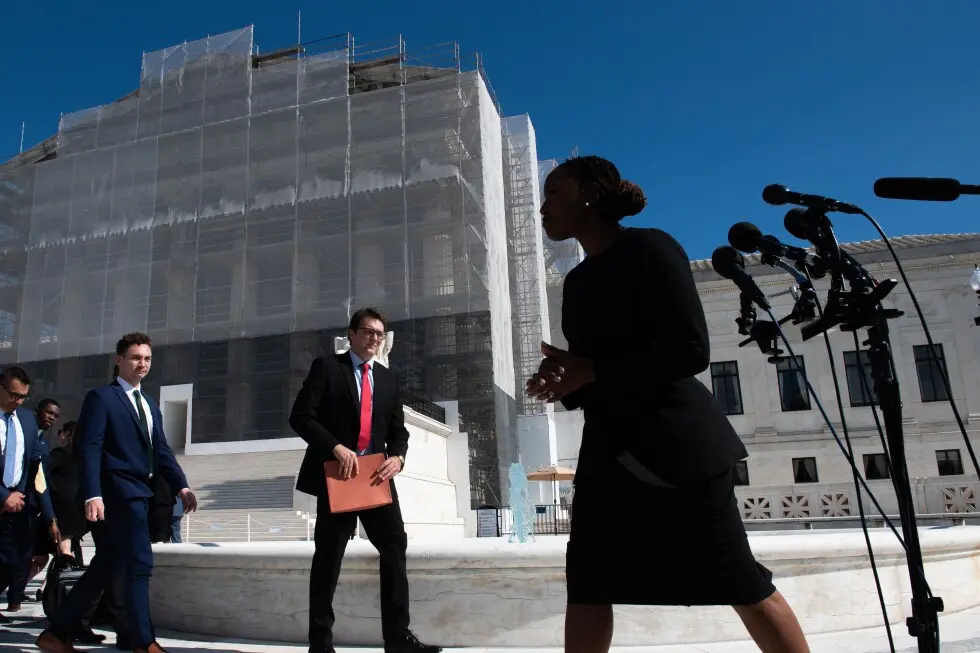
대법원 판결이 선거권법의 주요 도구를 약화시키다
LIVE Supreme Court ruling weakens a key tool of the Voting Rights Act
Associated Press
· 🇺🇸 New York, US
EN
2026-04-30 07:00
Translated
수요일 대법원은 루이지애나의 흑인 다수 의회 선거구를 폐지했으며, 이 판결은 공화당이 주도하는 주들이 민주당을 선호하는 흑인과 라틴계 선거구를 제거하고 의회의 권력 균형에 영향을 미칠 수 있는 문을 열 수 있다.
6-3의 판결로 법원의 보수 다수파는 민주당 클레오 필즈(Cleo Fields)가 대표하는 선거구가 인종에 너무 많이 의존했다고 판단했다. 존 로버츠 대법원장은 이 선거구를 셰브포트, 알렉산드리아, 라팕에트, 배턴루주 지역을 연결하기 위해 200마일(320킬로미터) 이상 뻗어있는 "뱀"이라고 표현했다.
전미행동네트워크 회장 알 샤프턴 목사는 이 판결을 "투표권 운동의 심장에 날린 총알"이라고 불렀다.
의회흑인의원단의 회원들은 대법원 판결에 맞서 싸우겠다고 다짐하고 존 루이스 투표권법(John Lewis Voting Rights Act)의 통과를 촉구했다.
의원단 의장인 뉴욕 민주당 이베트 클라크(Yvette Clarke) 하원의원은 기자들에게 이 판결이 정치인들이 "유권자들이 아닌 자신들의 유권자를 선택"할 수 있도록 허용한다고 말했다.
"대법원은 전국의 흑인 유권자에 대한 조율된 공격의 문을 열었습니다"라고 클라크는 말했다. "이는 명백한 권력 탈취입니다."
또한 뉴욕 출신인 하원 소수당 지도자 하킴 제프리스(Hakeem Jeffries)는 이 판결이 "투표를 억압하고 중간 선거 이후를 조작하기 위한 노력"으로 "트럼프 법원"에서 나왔다고 말했다.
테네시 주의회 지도자들은 새로운 대법원 판결을 고려하여 재선거구가 타당한지 논의할 필요가 있다고 상원 의장 랜디 맥날리(Randy McNally)가 말했다. 왜냐하면 공직 출마 서류 제출 기한이 지났고 후보자들이 이미 경선에 참가했기 때문이다. 초선은 8월 6일이다.
주의 현재 지도는 "강하고, 공정하며, 법적"이며 법원 소송에서 살아남았다고 맥날리는 성명에서 말했다.
11월의 의회 통제권을 놓고 벌이는 전투에 워싱턴의 많은 관심이 쏠려 있지만, 투표용지에는 36개의 주지사 선거가 있다.
켄터키 주지사 앤디 베셰어(Andy Beshear)는 대법원의 판결이 이러한 선거들의 중요성을 상기시켜 준다고 말했다. 왜냐하면 많은 투표 법률이 주 차원에서 만들어지기 때문이다.
"맞서 싸우는 최선의 방법 중 하나는 더 많은 민주당 주지사를 선출하는 것입니다"라고 베셰어는 성명에서 말했다. "올해 우리는 그럴 기회가 36개 있고 이와 같은 판결들은 이제 그 이해 관계가 그 어느 때보다 높다는 것을 보여줍니다."
베셰어는 민주당 주지사 협회 회장이며, 이 단체는 주 지도자로서 민주당원을 선출하는 데 중점을 두고 있다.
흑인 투표력이 희석되었다고 판단한 판사들에 의해 법원에서 명령한 선거구를 가진 쇼마리 피규어스(Shomari Figures) 하원의원은 이 판결이 향후 차별 주장을 입증하기 더 어렵게 만든다고 말했다.
그는 남부 주들이 흑인 유권자의 영향력을 약화시키는 방식으로 지도를 다시 그리도록 촉발할 수 있다고 경고했다. 앨라배마의 현재 지도는 주가 항소 중이지만 2030년까지 법원 명령에 따라 유지된다.
공화당 리차드 허드슨(Richard Hudson) 하원의원은 법원의 판결을 환영했다. "나는 그것이 나오는 것을 보아서 기뻤습니다"라고 그는 미국 국회의사당의 기자들에게 말했다.
하지만 전미공화당의원위원회의 수장은 11월 선거 전에 주들이 의회 선거구 지도를 재고려하도록 권장할 것인지에 대해 직접적으로 말하지 않았다.
"가을에 영향이 어떻게 될 것인지 모르겠습니다"라고 노스캐롤라이나 의원은 말했다.
"꽤 늦었습니다"라고 그는 말했다. "봅시다. 그것은 주지사와 입법자들에게 달려 있습니다."
공화당 제프 랜드리(Jeff Landry) 주지사는 주 검찰총장과 입법 지도자들이 "우리의 선택지가 무엇인지" 논의하고 있다고 말했다. 그는 대법원의 판결을 완전히 평가하는 데 최소 하루가 걸릴 수 있다고 말했다.
소셜 플랫폼 X의 게시물에서 트럼프와 긴밀한 관계를 가진 주지사는 이 판결이 주들이 "정치적 이유로" 선거구를 그릴 수 있다는 것을 확인한다고 말했다. 그는 연방 법원이 "인종 기반 재선거구" 또는 투표권법 위반으로 그가 당파적 분쟁이라고 부르는 것을 처리할 수 없다고 말했다.
미국 최초의 흑인 대통령은 이 판결을 "우리 민주주의에서 동등한 참여를 보장하고 소수 집단의 권리를 다수파의 무분별한 행동으로부터 보호하는 중요한 역할을 포기하려고 의도하는 현재 법원의 다수파의 또 다른 예"라고 규탄하는 성명을 발표했다.
"좋은 소식은 그러한 좌절을 극복할 수 있다는 것입니다"라고 민주당원인 오바마는 계속했다. "하지만 그것은 우리의 민주적 이상을 소중히 여기는 전국의 시민들이 계속해서 동원되고 기록적인 수로 투표하는 경우에만 일어날 것입니다."
85세의 클라이번(Clyburn)이 보유한 사우스캐롤라이나 의회 선거구는 한때 의회에서 가장 높은 지위의 흑인 의원이었으며, 추가 의석을 획득하려는 공화당의 관심 대상이 되어 왔다.
클라이번은 대법원이 "거대한 후퇴"를 한 것이라고 성명에서 말했다. 이는 "우리 나라를 끝없는 재선거구 싸움의 덤불로 더 깊이 보낼 위협"이다. "반복되는 공격적인 지도 재작성, 미결의 법적 싸움, 그리고 끈질긴 당파적 팽팽함이다."
사우스캐롤라이나의 2022년 지도는 민주당원들을 클라이번의 선거구로 밀어 넣는 것으로 2024년 대법원에 의해 승인되었다. 그 이후 공화당들은 의석을 뒤집기 위해 의석을 다시 그리려고 시도해 왔다.
대통령은 이 판결이 다른 선거구들이 공화당을 선호하도록 다시 그려질 수 있는 방법을 열어줄 수 있다고 말했다. 이는 "내가 좋아하는 종류의 판결"이다.
"일부 주들은 다시 그릴 필요가 없고 일부는 그럴 필요가 있습니다"라고 트럼프는 말했다. 일반적으로 그는 공화당 주 관리자들이 의회 지도를 수정하기를 원한다고 말하면서다.
그럼에도 불구하고 그는 처음에 일어난 일을 알지 못했다. 이 판결에 대한 기자의 반응 요청을 받았을 때, 트럼프는 판결이 언제 나왔는지 물었다.
"나는 우주 비행사들과 함께 있었습니다"라고 그는 합리화했다. "나는 계약자들과 함께 있었습니다. 왜냐하면 우리는 무도회장을 짓도록 노력하고 있기 때문입니다."
민주당 라파엘 워녹(Raphael Warnock) 상원의원은 투표권법 없이는 의회에 있지 않을 것이라고 말했고, 대법원의 판결을 인종 정의에 대한 타격으로 강하게 비판했다.
"실수하지 마세요. 이 판결은 짐 크로우 시대의 가장 어두운 날들을 연상시킵니다"라고 그는 기자들에게 말했다.
그는 미국인들이 자신들의 민주주의에서 "더욱 짜내지고 있다"고 말했다.
테네시의 멤피스 중심의 민주당 의석을 다시 선거구화할 가능성에 대해 물었을 때, 테네시의 공화당 하원 의장 카메론 섹스턴(Cameron Sexton)은 서면 성명에서 "나는 백악관과 다른 개인들과의 대화를 하면서 최근 의견을 검토하고 있습니다"라고 말했다.
검찰총장 스티브 마셜(Steve Marshall)은 앨라배마의 의회 지도가 그가 위헌적인 인종 할당제라고 부르는 것이 아니라 유권자의 의지를 반영하기를 원한다고 말했다.
이 주는 흑인이 다수이거나 거의 다수인 추가 선거구가 있는 법원이 그린 지도를 계속 사용하도록 요구하는 연방 명령에 항소하고 있다.
마셜은 수요일의 판결을 "분수령의 순간"이라고 불렀다. 이는 주들이 "인종에 의해 부정행위를 강요받을 수 없다"는 것을 의미한다.
그는 대법원이 남부의 진전을 인식했다고 말했고, 이전 시대의 법률이 더 이상 현재의 조건을 반영하지 않는다고 말했다.
뉴올리언스 출신 흑인 토마스 존슨(Thomas Johnson)은 수요일 루이지애나 주청사를 방문하다가 공화당이 주의 의회 지도를 다시 그려 주로 흑인이 다수인 선거구를 해체할 가능성을 특히 우려한다고 말했다.
"나는 이것이 소수자, 특히 흑인 공동체에 대한 수치스러운 공격이라고 생각합니다"라고 그는 말했다. 그는 워싱턴에서 거의 발언권이 없다고 느낍니다.
존슨은 현재 루이지애나 의회의 흑인 민주당원 2명 중 1명인 미국 하원 대표 트로이 카터(Troy Carter)로부터 대표를 받고 있습니다.
"우리는 우리의 목소리가 들리도록 모든 것을 하고 계속 싸울 것입니다"라고 존슨은 말했다. "그것이 우리가 원하는 전부입니다. 들려지는 것입니다."
대법원이 클레오 필즈 하원의원이 대표하는 선거구에 대해 판결했지만, 루이지애나의 미국 하원 위임단의 다른 민주당 의원은 자신의 의석의 운명에 대해서도 우려하고 있습니다.
"현실은 우리의 지도가 함께 그려졌다는 것입니다"라고 뉴올리언스를 포함하는 선거구를 대표하는 트로이 카터 하원의원은 말했다. "그것은 그들이 모두 위헌이라고 내팽겨쳐진다면, 새로운 지도가 그려질 가능성이 실제로 필즈 의원의 영향을 받을 뿐만 아니라 나에게도 영향을 미칠 수 있다는 것을 의미합니다."
NAACP 법률방어기금의 회장겸 이사장 자나이 넬슨(Janai Nelson)은 이 판결이 미국 민주주의에 대한 타격이며, 다양한 인구 중에서 대법원에 대한 신뢰를 더욱 훼손할 것이라고 말했다.
"이것은 부정행위의 산물이고 대법원이 당파적 정치 이상으로 상승할 수 있는 신뢰도 또는 신뢰도가 남아있는 것을 잃는 날입니다"라고 넬슨은 말했다. "이것은 투표권에 대한 당파성과 정치의 원칙을 높였습니다."
수요일의 판결은 "민권 운동에 대한 깊은 배신"이라고 ACLU 투표권 프로젝트의 부국장 소피아 린 레이킨(Sophia Lin Lakin)이 말했다. 소수 공동체는 의회의 의석을 잃을 뿐만 아니라, 그녀는 의료, 교육, 기반시설 등의 문제에 대한 목소리를 잃을 것이라고 말했다.
"주들은 이제 유색인종 유권자의 대표를 제거하는 지도를 정당화하기 위해 당파적 목표를 지적할 수 있고, 연방 법원은 개입할 기반이 거의 없을 것입니다"라고 그녀는 말했다.
선거 혁신 및 연구 센터의 설립자 겸 행정 책임자인 데이비드 벡커(David Becker)는 이 판결이 입법자들이 소수 유권자의 권력을 감소시킬 수 있도록 할 것이라고 말했다. 적어도 결국에는 말이다.
"2026년에 어떻게 영향을 미칠 것인지 모르겠습니다"라고 벡커는 수요일 기자들과의 전화 통화에서 말했다. "이제 열린 시간이 될 수도 있지만 우리도 시간이 부족합니다."
2013년 중요한 투표권 싸움에서 지원이 패배한 오바마 시대 미국 검찰총장 에릭 홀더(Eric Holder)는 수요일의 판결이 "대법원이 승인한 인종 및 당파적 게리맨더링"이라고 말했다.
"오늘의 법원은 우리 국가 역사에서 가장 파괴적이고 깊이 무책임한 법원 중 하나로 기억될 것을 보장합니다"라고 홀더는 성명에서 말했다.
"그것을 잃어서는 안 될 것은 로버츠 법원이 전국의 공화당 지도자들이 미국 국민에게 의미 있는 발언권을 빼앗으려고 안달하는 시간에 이 판결을 내린다는 것입니다"라고 그는 덧붙였다.
공직을 떠난 후 홀더는 투표권을 보호하고 게리맨더된 의회 및 주 입법부 선거구에 이의를 제기하기 위해 전미재선거구 재단(National Redistricting Foundation)을 설립했습니다.
올해 주지사로 선출되고 있는 공화당 마샤 블랙번(Marsha Blackburn) 미국 상원의원은 소셜 미디어에서 공화당 주 의회 다수 의석이 소집되어 테네시의 유일한 민주당 의회 선거구를 그려 공화당이 추가 의석을 획득하도록 하도록 촉구했다.
이 선거구는 대다수가 흑인인 멤피스 도시를 중심으로 합니다.
2026년 선거를 위해 조지아의 지도를 다시 그리는 것은 어려울 것입니다. 왜냐하면 11월 선거 전 5월 19일 정당 초선을 위한 초기 투표가 이미 진행 중이기 때문입니다.
공화당 브라이언 켐프(Brian Kemp) 주지사와 주 공화당 위원장 조시 매쿤(Josh McKoon)의 대변인은 수요일 즉시 재선거구에 대한 쿼리에 즉시 응하지 않았다. 주 상원 소수파 해롤드 존스 2세(Harold Jones II) 어거스타 민주당원은 빠른 행동의 가능성이 불확실하다고 말했다.
하지만 켐프를 대체하기 위한 주요 공화당 후보 중 한 명은 주지사에게 즉시 행동을 촉구했습니다. 이는 조지아 민주당원들이 이 가을에 이득을 더라도 공화당 권력을 보호할 수 있습니다.
"민주당원들은 전국적으로 권력으로 돌아가려고 선거구를 다시 그리려고 하고 있고, 버지니아에서 일어난 일은 바로 그 시작일 뿐입니다"라고 사업가 릭 잭슨(Rick Jackson)은 성명에서 말했다. "시간을 낭비할 시간이 없습니다. 조지아는 조지아에서 안전한 선거를 보장하고 민주당원들의 전국적 선거 공격에 맞서기 위해 지금 행동해야 합니다."
하원 소수파 지도자 하킴 제프리스는 소셜 미디어의 강하게 표현된 성명에서 대법원을 "극단적 우파주의자"라고 비난했고, 투표 억압이 트럼프와 공화당을 위한 "생활 방식"이라고 말했다.
"공화당원들은 11월에 자유롭고 공정한 선거에서 이길 수 없다는 것을 알고 있기 때문에 그것을 조작하려고 절박합니다. 우리는 절대 그들이 성공하도록 하지 않을 것입니다"라고 민주당원이 썼다.
제프리스는 이전에 트럼프가 투표와 관련해 권력 탈취를 할 때 주장했다.
트럼프가 3월에 확인된 적격 유권자의 전국 목록을 만들고 우편 투표를 제한하는 행정 명령에 서명했을 때, 제프리스는 유색인종 공동체, 장애인 및 기타 주요 인구통계의 투표를 불필요하게 어렵게 만들 것이라고 말했다.
고인의 민권 지도자 마틴 루터 킹 주니어의 장남 마틴 루터 킹 3세(Martin Luther King III)와 그의 아내 아르드레아 워터스 킹(Arndrea Waters King)은 성명에서 대법원의 판결이 "투표권법을 더욱 약화시켰다"고 말했다.
"이 판결은 투표권법의 목적을 훼손함으로써 전국의 흑인과 갈색 공동체의 정치적 권리를 보호하고 보장하는 수백만 명의 유색인종 유권자의 목소리를 침묵시킵니다"라고 그들은 말했다. "마틴 루터 킹 주니어는 투표권이 우리 전체 민주주의 체계의 기초라는 것을 이해했습니다. 그것 없이 우리는 단지 이름으로만 민주주의입니다."
이 부부는 드럼 메이저 연구소(Drum Major Institute)라고 불리는 민권 단체의 설립자입니다.
현재 모두 민주당원으로 구성된 의회흑인의원단의 60명의 회원들은 이 판결이 "수십 년의 흑인의 진전"을 지웠다고 말했다.
"공화당원들은 이제 자신들을 위해 의회 지도를 조작하기 위한 전국적 계획을 진행할 수 있는 능력이 있습니다 - 다수-흑인 선거구를 제거함으로써 자신들을 위해 더 많은 선거구를 제조하는 한편 법원에서 그러한 인종 차별적, 반흑인 지도에 이의를 제기할 능력을 제거합니다"라고 그 단체는 말했다.
이 의원단은 이것이 남부의 대규모 재선거구 변화의 문을 열 수 있다고 덧붙였으며, "필요한 모든 조치"를 시작할 것을 약속했으며, 존 루이스 투표권법에 대한 투표를 촉구했습니다.
존 로버츠 대법원장이 사무엘 알리토 판사가 다수파 의견을 읽을 것이라고 말했을 때 이미 조용한 법정은 침묵했다.
청중의 구성원들은 2조의 판결의 깊이를 듣기를 기다리며 그가 읽는 동안 주목해서 들었다. 청중 중 일부는 엘레나 카간 판사가 반대 의견을 읽으면서 다수파가 투표권법에 대한 수년간의 추구를 효과적으로 끝냈다고 말했을 때 고개를 끄덕였다.
앨라배마 모빌의 샬렐라 다우디(Shalela Dowdy)는 이 판결이 2023년에 만들어진 앨라배마 의회 선거구의 철회로 이어질 것이라고 우려했다. 그녀는 이것이 이전에 무시된 유권자들에게 의견을 낼 수 있는 기회를 주었다고 말했다.
"이것은 후퇴입니다. 이 수준에서 그것을 주의 손에 맡기는 것은 위험합니다"라고 다우디는 말했다. "주들이 자신의 주 인구를 바탕으로 올바른 일을 하지 않는 역사가 있을 뿐입니다."
다우디는 새로운 선거구의 창설로 이어진 소송의 원고였으며, 현재 쇼마리 피규어스 하원의원이 대표합니다.
6-3의 판결로 법원의 보수 다수파는 민주당 클레오 필즈(Cleo Fields)가 대표하는 선거구가 인종에 너무 많이 의존했다고 판단했다. 존 로버츠 대법원장은 이 선거구를 셰브포트, 알렉산드리아, 라팕에트, 배턴루주 지역을 연결하기 위해 200마일(320킬로미터) 이상 뻗어있는 "뱀"이라고 표현했다.
전미행동네트워크 회장 알 샤프턴 목사는 이 판결을 "투표권 운동의 심장에 날린 총알"이라고 불렀다.
의회흑인의원단의 회원들은 대법원 판결에 맞서 싸우겠다고 다짐하고 존 루이스 투표권법(John Lewis Voting Rights Act)의 통과를 촉구했다.
의원단 의장인 뉴욕 민주당 이베트 클라크(Yvette Clarke) 하원의원은 기자들에게 이 판결이 정치인들이 "유권자들이 아닌 자신들의 유권자를 선택"할 수 있도록 허용한다고 말했다.
"대법원은 전국의 흑인 유권자에 대한 조율된 공격의 문을 열었습니다"라고 클라크는 말했다. "이는 명백한 권력 탈취입니다."
또한 뉴욕 출신인 하원 소수당 지도자 하킴 제프리스(Hakeem Jeffries)는 이 판결이 "투표를 억압하고 중간 선거 이후를 조작하기 위한 노력"으로 "트럼프 법원"에서 나왔다고 말했다.
테네시 주의회 지도자들은 새로운 대법원 판결을 고려하여 재선거구가 타당한지 논의할 필요가 있다고 상원 의장 랜디 맥날리(Randy McNally)가 말했다. 왜냐하면 공직 출마 서류 제출 기한이 지났고 후보자들이 이미 경선에 참가했기 때문이다. 초선은 8월 6일이다.
주의 현재 지도는 "강하고, 공정하며, 법적"이며 법원 소송에서 살아남았다고 맥날리는 성명에서 말했다.
11월의 의회 통제권을 놓고 벌이는 전투에 워싱턴의 많은 관심이 쏠려 있지만, 투표용지에는 36개의 주지사 선거가 있다.
켄터키 주지사 앤디 베셰어(Andy Beshear)는 대법원의 판결이 이러한 선거들의 중요성을 상기시켜 준다고 말했다. 왜냐하면 많은 투표 법률이 주 차원에서 만들어지기 때문이다.
"맞서 싸우는 최선의 방법 중 하나는 더 많은 민주당 주지사를 선출하는 것입니다"라고 베셰어는 성명에서 말했다. "올해 우리는 그럴 기회가 36개 있고 이와 같은 판결들은 이제 그 이해 관계가 그 어느 때보다 높다는 것을 보여줍니다."
베셰어는 민주당 주지사 협회 회장이며, 이 단체는 주 지도자로서 민주당원을 선출하는 데 중점을 두고 있다.
흑인 투표력이 희석되었다고 판단한 판사들에 의해 법원에서 명령한 선거구를 가진 쇼마리 피규어스(Shomari Figures) 하원의원은 이 판결이 향후 차별 주장을 입증하기 더 어렵게 만든다고 말했다.
그는 남부 주들이 흑인 유권자의 영향력을 약화시키는 방식으로 지도를 다시 그리도록 촉발할 수 있다고 경고했다. 앨라배마의 현재 지도는 주가 항소 중이지만 2030년까지 법원 명령에 따라 유지된다.
공화당 리차드 허드슨(Richard Hudson) 하원의원은 법원의 판결을 환영했다. "나는 그것이 나오는 것을 보아서 기뻤습니다"라고 그는 미국 국회의사당의 기자들에게 말했다.
하지만 전미공화당의원위원회의 수장은 11월 선거 전에 주들이 의회 선거구 지도를 재고려하도록 권장할 것인지에 대해 직접적으로 말하지 않았다.
"가을에 영향이 어떻게 될 것인지 모르겠습니다"라고 노스캐롤라이나 의원은 말했다.
"꽤 늦었습니다"라고 그는 말했다. "봅시다. 그것은 주지사와 입법자들에게 달려 있습니다."
공화당 제프 랜드리(Jeff Landry) 주지사는 주 검찰총장과 입법 지도자들이 "우리의 선택지가 무엇인지" 논의하고 있다고 말했다. 그는 대법원의 판결을 완전히 평가하는 데 최소 하루가 걸릴 수 있다고 말했다.
소셜 플랫폼 X의 게시물에서 트럼프와 긴밀한 관계를 가진 주지사는 이 판결이 주들이 "정치적 이유로" 선거구를 그릴 수 있다는 것을 확인한다고 말했다. 그는 연방 법원이 "인종 기반 재선거구" 또는 투표권법 위반으로 그가 당파적 분쟁이라고 부르는 것을 처리할 수 없다고 말했다.
미국 최초의 흑인 대통령은 이 판결을 "우리 민주주의에서 동등한 참여를 보장하고 소수 집단의 권리를 다수파의 무분별한 행동으로부터 보호하는 중요한 역할을 포기하려고 의도하는 현재 법원의 다수파의 또 다른 예"라고 규탄하는 성명을 발표했다.
"좋은 소식은 그러한 좌절을 극복할 수 있다는 것입니다"라고 민주당원인 오바마는 계속했다. "하지만 그것은 우리의 민주적 이상을 소중히 여기는 전국의 시민들이 계속해서 동원되고 기록적인 수로 투표하는 경우에만 일어날 것입니다."
85세의 클라이번(Clyburn)이 보유한 사우스캐롤라이나 의회 선거구는 한때 의회에서 가장 높은 지위의 흑인 의원이었으며, 추가 의석을 획득하려는 공화당의 관심 대상이 되어 왔다.
클라이번은 대법원이 "거대한 후퇴"를 한 것이라고 성명에서 말했다. 이는 "우리 나라를 끝없는 재선거구 싸움의 덤불로 더 깊이 보낼 위협"이다. "반복되는 공격적인 지도 재작성, 미결의 법적 싸움, 그리고 끈질긴 당파적 팽팽함이다."
사우스캐롤라이나의 2022년 지도는 민주당원들을 클라이번의 선거구로 밀어 넣는 것으로 2024년 대법원에 의해 승인되었다. 그 이후 공화당들은 의석을 뒤집기 위해 의석을 다시 그리려고 시도해 왔다.
대통령은 이 판결이 다른 선거구들이 공화당을 선호하도록 다시 그려질 수 있는 방법을 열어줄 수 있다고 말했다. 이는 "내가 좋아하는 종류의 판결"이다.
"일부 주들은 다시 그릴 필요가 없고 일부는 그럴 필요가 있습니다"라고 트럼프는 말했다. 일반적으로 그는 공화당 주 관리자들이 의회 지도를 수정하기를 원한다고 말하면서다.
그럼에도 불구하고 그는 처음에 일어난 일을 알지 못했다. 이 판결에 대한 기자의 반응 요청을 받았을 때, 트럼프는 판결이 언제 나왔는지 물었다.
"나는 우주 비행사들과 함께 있었습니다"라고 그는 합리화했다. "나는 계약자들과 함께 있었습니다. 왜냐하면 우리는 무도회장을 짓도록 노력하고 있기 때문입니다."
민주당 라파엘 워녹(Raphael Warnock) 상원의원은 투표권법 없이는 의회에 있지 않을 것이라고 말했고, 대법원의 판결을 인종 정의에 대한 타격으로 강하게 비판했다.
"실수하지 마세요. 이 판결은 짐 크로우 시대의 가장 어두운 날들을 연상시킵니다"라고 그는 기자들에게 말했다.
그는 미국인들이 자신들의 민주주의에서 "더욱 짜내지고 있다"고 말했다.
테네시의 멤피스 중심의 민주당 의석을 다시 선거구화할 가능성에 대해 물었을 때, 테네시의 공화당 하원 의장 카메론 섹스턴(Cameron Sexton)은 서면 성명에서 "나는 백악관과 다른 개인들과의 대화를 하면서 최근 의견을 검토하고 있습니다"라고 말했다.
검찰총장 스티브 마셜(Steve Marshall)은 앨라배마의 의회 지도가 그가 위헌적인 인종 할당제라고 부르는 것이 아니라 유권자의 의지를 반영하기를 원한다고 말했다.
이 주는 흑인이 다수이거나 거의 다수인 추가 선거구가 있는 법원이 그린 지도를 계속 사용하도록 요구하는 연방 명령에 항소하고 있다.
마셜은 수요일의 판결을 "분수령의 순간"이라고 불렀다. 이는 주들이 "인종에 의해 부정행위를 강요받을 수 없다"는 것을 의미한다.
그는 대법원이 남부의 진전을 인식했다고 말했고, 이전 시대의 법률이 더 이상 현재의 조건을 반영하지 않는다고 말했다.
뉴올리언스 출신 흑인 토마스 존슨(Thomas Johnson)은 수요일 루이지애나 주청사를 방문하다가 공화당이 주의 의회 지도를 다시 그려 주로 흑인이 다수인 선거구를 해체할 가능성을 특히 우려한다고 말했다.
"나는 이것이 소수자, 특히 흑인 공동체에 대한 수치스러운 공격이라고 생각합니다"라고 그는 말했다. 그는 워싱턴에서 거의 발언권이 없다고 느낍니다.
존슨은 현재 루이지애나 의회의 흑인 민주당원 2명 중 1명인 미국 하원 대표 트로이 카터(Troy Carter)로부터 대표를 받고 있습니다.
"우리는 우리의 목소리가 들리도록 모든 것을 하고 계속 싸울 것입니다"라고 존슨은 말했다. "그것이 우리가 원하는 전부입니다. 들려지는 것입니다."
대법원이 클레오 필즈 하원의원이 대표하는 선거구에 대해 판결했지만, 루이지애나의 미국 하원 위임단의 다른 민주당 의원은 자신의 의석의 운명에 대해서도 우려하고 있습니다.
"현실은 우리의 지도가 함께 그려졌다는 것입니다"라고 뉴올리언스를 포함하는 선거구를 대표하는 트로이 카터 하원의원은 말했다. "그것은 그들이 모두 위헌이라고 내팽겨쳐진다면, 새로운 지도가 그려질 가능성이 실제로 필즈 의원의 영향을 받을 뿐만 아니라 나에게도 영향을 미칠 수 있다는 것을 의미합니다."
NAACP 법률방어기금의 회장겸 이사장 자나이 넬슨(Janai Nelson)은 이 판결이 미국 민주주의에 대한 타격이며, 다양한 인구 중에서 대법원에 대한 신뢰를 더욱 훼손할 것이라고 말했다.
"이것은 부정행위의 산물이고 대법원이 당파적 정치 이상으로 상승할 수 있는 신뢰도 또는 신뢰도가 남아있는 것을 잃는 날입니다"라고 넬슨은 말했다. "이것은 투표권에 대한 당파성과 정치의 원칙을 높였습니다."
수요일의 판결은 "민권 운동에 대한 깊은 배신"이라고 ACLU 투표권 프로젝트의 부국장 소피아 린 레이킨(Sophia Lin Lakin)이 말했다. 소수 공동체는 의회의 의석을 잃을 뿐만 아니라, 그녀는 의료, 교육, 기반시설 등의 문제에 대한 목소리를 잃을 것이라고 말했다.
"주들은 이제 유색인종 유권자의 대표를 제거하는 지도를 정당화하기 위해 당파적 목표를 지적할 수 있고, 연방 법원은 개입할 기반이 거의 없을 것입니다"라고 그녀는 말했다.
선거 혁신 및 연구 센터의 설립자 겸 행정 책임자인 데이비드 벡커(David Becker)는 이 판결이 입법자들이 소수 유권자의 권력을 감소시킬 수 있도록 할 것이라고 말했다. 적어도 결국에는 말이다.
"2026년에 어떻게 영향을 미칠 것인지 모르겠습니다"라고 벡커는 수요일 기자들과의 전화 통화에서 말했다. "이제 열린 시간이 될 수도 있지만 우리도 시간이 부족합니다."
2013년 중요한 투표권 싸움에서 지원이 패배한 오바마 시대 미국 검찰총장 에릭 홀더(Eric Holder)는 수요일의 판결이 "대법원이 승인한 인종 및 당파적 게리맨더링"이라고 말했다.
"오늘의 법원은 우리 국가 역사에서 가장 파괴적이고 깊이 무책임한 법원 중 하나로 기억될 것을 보장합니다"라고 홀더는 성명에서 말했다.
"그것을 잃어서는 안 될 것은 로버츠 법원이 전국의 공화당 지도자들이 미국 국민에게 의미 있는 발언권을 빼앗으려고 안달하는 시간에 이 판결을 내린다는 것입니다"라고 그는 덧붙였다.
공직을 떠난 후 홀더는 투표권을 보호하고 게리맨더된 의회 및 주 입법부 선거구에 이의를 제기하기 위해 전미재선거구 재단(National Redistricting Foundation)을 설립했습니다.
올해 주지사로 선출되고 있는 공화당 마샤 블랙번(Marsha Blackburn) 미국 상원의원은 소셜 미디어에서 공화당 주 의회 다수 의석이 소집되어 테네시의 유일한 민주당 의회 선거구를 그려 공화당이 추가 의석을 획득하도록 하도록 촉구했다.
이 선거구는 대다수가 흑인인 멤피스 도시를 중심으로 합니다.
2026년 선거를 위해 조지아의 지도를 다시 그리는 것은 어려울 것입니다. 왜냐하면 11월 선거 전 5월 19일 정당 초선을 위한 초기 투표가 이미 진행 중이기 때문입니다.
공화당 브라이언 켐프(Brian Kemp) 주지사와 주 공화당 위원장 조시 매쿤(Josh McKoon)의 대변인은 수요일 즉시 재선거구에 대한 쿼리에 즉시 응하지 않았다. 주 상원 소수파 해롤드 존스 2세(Harold Jones II) 어거스타 민주당원은 빠른 행동의 가능성이 불확실하다고 말했다.
하지만 켐프를 대체하기 위한 주요 공화당 후보 중 한 명은 주지사에게 즉시 행동을 촉구했습니다. 이는 조지아 민주당원들이 이 가을에 이득을 더라도 공화당 권력을 보호할 수 있습니다.
"민주당원들은 전국적으로 권력으로 돌아가려고 선거구를 다시 그리려고 하고 있고, 버지니아에서 일어난 일은 바로 그 시작일 뿐입니다"라고 사업가 릭 잭슨(Rick Jackson)은 성명에서 말했다. "시간을 낭비할 시간이 없습니다. 조지아는 조지아에서 안전한 선거를 보장하고 민주당원들의 전국적 선거 공격에 맞서기 위해 지금 행동해야 합니다."
하원 소수파 지도자 하킴 제프리스는 소셜 미디어의 강하게 표현된 성명에서 대법원을 "극단적 우파주의자"라고 비난했고, 투표 억압이 트럼프와 공화당을 위한 "생활 방식"이라고 말했다.
"공화당원들은 11월에 자유롭고 공정한 선거에서 이길 수 없다는 것을 알고 있기 때문에 그것을 조작하려고 절박합니다. 우리는 절대 그들이 성공하도록 하지 않을 것입니다"라고 민주당원이 썼다.
제프리스는 이전에 트럼프가 투표와 관련해 권력 탈취를 할 때 주장했다.
트럼프가 3월에 확인된 적격 유권자의 전국 목록을 만들고 우편 투표를 제한하는 행정 명령에 서명했을 때, 제프리스는 유색인종 공동체, 장애인 및 기타 주요 인구통계의 투표를 불필요하게 어렵게 만들 것이라고 말했다.
고인의 민권 지도자 마틴 루터 킹 주니어의 장남 마틴 루터 킹 3세(Martin Luther King III)와 그의 아내 아르드레아 워터스 킹(Arndrea Waters King)은 성명에서 대법원의 판결이 "투표권법을 더욱 약화시켰다"고 말했다.
"이 판결은 투표권법의 목적을 훼손함으로써 전국의 흑인과 갈색 공동체의 정치적 권리를 보호하고 보장하는 수백만 명의 유색인종 유권자의 목소리를 침묵시킵니다"라고 그들은 말했다. "마틴 루터 킹 주니어는 투표권이 우리 전체 민주주의 체계의 기초라는 것을 이해했습니다. 그것 없이 우리는 단지 이름으로만 민주주의입니다."
이 부부는 드럼 메이저 연구소(Drum Major Institute)라고 불리는 민권 단체의 설립자입니다.
현재 모두 민주당원으로 구성된 의회흑인의원단의 60명의 회원들은 이 판결이 "수십 년의 흑인의 진전"을 지웠다고 말했다.
"공화당원들은 이제 자신들을 위해 의회 지도를 조작하기 위한 전국적 계획을 진행할 수 있는 능력이 있습니다 - 다수-흑인 선거구를 제거함으로써 자신들을 위해 더 많은 선거구를 제조하는 한편 법원에서 그러한 인종 차별적, 반흑인 지도에 이의를 제기할 능력을 제거합니다"라고 그 단체는 말했다.
이 의원단은 이것이 남부의 대규모 재선거구 변화의 문을 열 수 있다고 덧붙였으며, "필요한 모든 조치"를 시작할 것을 약속했으며, 존 루이스 투표권법에 대한 투표를 촉구했습니다.
존 로버츠 대법원장이 사무엘 알리토 판사가 다수파 의견을 읽을 것이라고 말했을 때 이미 조용한 법정은 침묵했다.
청중의 구성원들은 2조의 판결의 깊이를 듣기를 기다리며 그가 읽는 동안 주목해서 들었다. 청중 중 일부는 엘레나 카간 판사가 반대 의견을 읽으면서 다수파가 투표권법에 대한 수년간의 추구를 효과적으로 끝냈다고 말했을 때 고개를 끄덕였다.
앨라배마 모빌의 샬렐라 다우디(Shalela Dowdy)는 이 판결이 2023년에 만들어진 앨라배마 의회 선거구의 철회로 이어질 것이라고 우려했다. 그녀는 이것이 이전에 무시된 유권자들에게 의견을 낼 수 있는 기회를 주었다고 말했다.
"이것은 후퇴입니다. 이 수준에서 그것을 주의 손에 맡기는 것은 위험합니다"라고 다우디는 말했다. "주들이 자신의 주 인구를 바탕으로 올바른 일을 하지 않는 역사가 있을 뿐입니다."
다우디는 새로운 선거구의 창설로 이어진 소송의 원고였으며, 현재 쇼마리 피규어스 하원의원이 대표합니다.
처리 완료
121 tokens · $0.0003
기사 수집 완료 · 07:00
매체 피드에서 기사 메타데이터 수집
헤드라인 번역 완료 · 07:16
제목/요약 한국어 번역 (fetch 시점 inline)
claude-haiku-4-5-20251001
121 tokens
$0.00029
1.5s
본문 추출 완료
32,819자 추출 완료
본문 한국어 번역 완료 · 07:16
7,736자 번역 완료
지정학적 엔티티 추출 완료 · 07:16
8개 엔티티 추출 완료
지정학적 맥락 & R-Scanner
R-Scanner · 상승
z=1.19
평소보다 보도량이 증가 추세 — 기준: Louisiana
(🇺🇸 US)
최근 6시간 5건
7일 평균 2.71건 / 6h
2개국 매체
3개 매체
본문에서 추출된 지명 (8)
Louisiana
🇺🇸
United States
🇺🇸
Congress
🇺🇸
New York
🇺🇸
Tennessee
🇺🇸
Alabama
🇺🇸
Georgia
🇺🇸
South Carolina
🇺🇸
위치 지도
지도 로딩 중…
같은 주제의 다른 기사 (최근 7일)
Today’s live updates have ended. Read what you missed below and find more coverage at apnews.com.
The Supreme Court on Wednesday struck down Louisiana’s second majority Black congressional district in a decision that could open the door for Republican-led states to eliminate Black and Latino electoral districts that tend to favor Democrats and affect the balance of power in Congress.
In a 6-3 ruling, the court’s conservative majority found that the district, represented by Democrat Cleo Fields, relied too heavily on race. Chief Justice John Roberts had described the district as a “snake” that stretches more than 200 miles (320 kilometers) to link parts of the Shreveport, Alexandria, Lafayette and Baton Rouge areas.
The Rev. Al Sharpton, president of the National Action Network, called the decision a “bullet in the heart of the voting rights movement.”
Members of the Congressional Black Caucus pledged to fight back after the Supreme Court decision and called for the passage of the John Lewis Voting Rights Act.
Rep. Yvette Clarke, a New York Democrat who chairs the caucus, told reporters that the decision allows politicians to “choose their voters instead of the other way around.”
“The Supreme Court has opened the door to a coordinated attack on Black voters across the country,” Clarke said. “This is an outright power grab.”
House Minority Leader Hakeem Jeffries, also of New York, said the decision came from “the Trump court” in “an effort to suppress the vote and rig the midterm elections and beyond.”
“At this moment in time, we’re urging everyone to summon the courage, the character, and the conviction of those heroes like John Lewis and Rosa Parks and so many others upon whose shoulders we stand,” Jeffries said.
Tennessee lawmakers need to discuss whether it’s feasible to redistrict in light of the new court ruling, Senate Speaker Randy McNally said, since deadlines to file paperwork to run for office have passed, and candidates have already entered their races. The primary elections are Aug. 6.
The state’s current map is “strong, fair and legal” and has survived court challenges, McNally said in a statement.
While much of the attention in Washington this year is on the battle for control of Congress, there are 36 governors races on the ballot in November.
Kentucky Gov. Andy Beshear said the Supreme Court’s decision is a reminder of the significance of those races, since so many voting laws are crafted at the state level.
“One of the best ways to fight back is to elect more Democratic governors – who are on the frontlines of protecting and expanding fundamental freedoms and democracy in our states,” Beshear said in a statement. “We have 36 opportunities to do that this year and rulings like this show that the stakes have never been higher.”
Beshear is the chair of the Democratic Governors Association, a group focused on electing Democrats as state leaders.
Rep. Shomari Figures, whose district was court-ordered after judges found Black voting power was diluted, said the ruling makes future discrimination claims harder to prove.
He warned it could prompt Southern states to redraw maps in ways that weaken Black voters’ influence. Alabama’s current map remains in place under a court order through 2030, although the state is appealing.
Rep. Richard Hudson welcomed the court’s decision. “I was glad to see it come down,” he told reporters at the U.S. Capitol.
But the head of the National Republican Congressional Committee stopped short of saying he would encourage states to reconsider congressional district maps before the November election.
“I don’t know what the implications are going be for the fall,” the North Carolina congressman said.
“It’s pretty late,” he said. “We’ll see. It’s up to governors and legislators.”
Republican Gov. Jeff Landry said the state attorney general and legislative leadership are discussing “what our options are.” He said it could take at least a day to fully assess the high court’s decision.
In a post on the social platform X, the governor — who has close ties to Trump — said the ruling affirms that states can draw districts “for political reasons.” He said federal courts cannot require “race-based redistricting” or treat what he called partisan disputes as violations of the Voting Rights Act.
The nation’s first Black president issued a statement decrying the ruling as “just one more example of how a majority of the current Court seems intent on abandoning its vital role in ensuring equal participation in our democracy and protecting the rights of minority groups against majority overreach.”
“The good news is that such setbacks can be overcome,” Obama, a Democrat, continued. “But that will only happen if citizens across the country who cherish our democratic ideals continue to mobilize and vote in record numbers.”
The South Carolina congressional district held by 85-year-old Clyburn, who for a time was the highest-ranking Black member of Congress, has been a focus for Republicans angling to pick up an additional seat.
Clyburn said in a statement that the Supreme Court had taken “a giant step backward,” one that “threatens to send our country deeper into the thicket of never-ending redistricting fights, with repeated aggressive map redraws, protracted legal battles, and relentless partisan tugs-of-war.”
South Carolina’s 2022 map, which packs Democrats into Clyburn’s district, was upheld by the Supreme Court in 2024. Republicans have since tried to redraw the seat to flip it.
The president said the decision, which could pave the way for other districts to be redrawn in the Republicans’ favor, is the “kind of ruling I like.”
“Some states don’t need to redraw, and some do,” Trump said, while noting that generally, he would want Republican state officials to revise the congressional maps.
Still, he wasn’t initially aware of what had happened. When asked by a reporter for his reaction to the decision, Trump asked when the ruling had come out.
“I’ve been with the astronauts,” he rationalized. “I’ve been with contractors because we’re trying to get the ballroom built.”
Democratic Sen. Raphael Warnock says he wouldn’t be in Congress without the Voting Rights Act and slammed the Supreme Court’s decision as a blow for racial justice.
“Make no mistake, this ruling harkens back to the darkest days of the Jim Crow era,” he told reporters.
Americans, he said, are being “further squeezed out of their democracy.”
Asked about the prospect of trying to redistrict the state’s Memphis-centered Democratic seat, Tennessee’s Republican House Speaker Cameron Sexton said in a written statement, “We are reviewing the recent opinion as I have conversations with the White House and other individuals.”
Attorney General Steve Marshall said he wants to ensure Alabama’s congressional maps reflect voters’ will, not what he called an unconstitutional racial quota system.
The state is appealing a federal order requiring the state to continue using a court-drawn map with an additional district where Black voters are a majority or near it.
Marshall called Wednesday’s decision a “watershed moment” that means states “cannot be forced to gerrymander by race.”
He added that the high court recognized progress in the South and said laws from an earlier era no longer reflect current conditions.
Thomas Johnson, a Black man from New Orleans who was visiting Louisiana’s Capitol on Wednesday, said he specifically feared the possibility that Republicans could redraw the state’s congressional map in a way that dismantles predominately Black districts.
“I feel like this is an embarrassing attack upon the minorities, particularly the Black community,” who he feels have little say in Washington.
Johnson is currently represented by U.S. Rep. Troy Carter, one of two Black Democrats from Louisiana in Congress.
“We are going to do all we can and continue fighting so our voices are heard,” Johnson said. “That’s all we want, to be heard.”
While the Supreme Court ruled on the district represented by Rep. Cleo Fields, the other Democratic member of Louisiana’s U.S. House delegation is concerned about the fate of his seat, too.
“The reality is our maps were drawn together,” said Rep. Troy Carter, whose district includes New Orleans. “So that means if they’re all thrown out as unconstitutional, then the likelihood that new maps would be drawn that would in fact not only impact Congressman Fields but also impact me as well.”
Janai Nelson, president and director-counsel of the NAACP Legal Defense Fund, said the decision is a blow to American democracy and one that will further erode trust in the Supreme Court among diverse populations.
“It’s a day of loss of any remnant or modicum of credibility of this Supreme Court to rise above partisan politics,” Nelson said. “It has elevated the principle of partisanship and politics over the right to vote.”
Wednesday’s decision is a “profound betrayal of the civil rights movement,” said Sophia Lin Lakin, deputy director of the ACLU’s Voting Rights Project. Minority communities won’t just potentially lose a seat in Congress, she said, they’ll lose a voice on issues like healthcare, education and infrastructure.
“States can now point to partisan objectives to justify maps that strip voters of color of representation, and federal courts will have little basis to intervene,” she said.
David Becker, the founder and executive director of the Center for Election Innovation and Research, said the ruling will allow lawmakers to reduce the power of minority voters — at least eventually.
“How it will affect 2026, I don’t know,” Becker said Wednesday on a call with reporters. “It could be open season now, but we’re also running out of time.”
Eric Holder, the former Obama-era U.S. attorney general whose administration lost a crucial voting rights battle in 2013, said Wednesday’s ruling amounted to “Supreme Court sanctioned racial and partisan gerrymandering.”
“The Court today ensures that it will be remembered as one of the most destructive and deeply irresponsible Courts in the history of our nation,” Holder said in a statement.
“It should not be lost on anyone,” he added, “that the Roberts court makes this decision at a time when Republican leaders across the country are foaming at the mouth to draw the American people out of a meaningful say in our elections.”
After leaving public service, Holder formed the National Redistricting Foundation to protect voting rights and challenge gerrymandered congressional and state legislative districts.
Republican U.S. Sen. Marsha Blackburn, who is running for governor this year, called on social media for the GOP-supermajority state Legislature to reconvene and draw Tennessee’s only Democratic congressional seat to favor a pickup for Republicans.
The district centers on the majority-Black city of Memphis.
Redrawing Georgia’s maps for the 2026 elections would be difficult because early voting is already underway for the May 19 party primaries, in advance of the November election.
A spokesperson for Republican Gov. Brian Kemp and state Republican Party Chairman Josh McKoon didn’t immediately respond Wednesday to queries about immediate redistricting. State Senate Minority Harold Jones II, an Augusta Democrat, said he’s unsure of the prospects of quick action.
But one leading GOP candidate to replace Kemp urged the governor to act immediately, which could protect Republican power even if Georgia Democrats make gains this fall.
“Democrats nationally are trying to redistrict their way back to power, and what happened in Virginia is just the tip of the spear,” businessman Rick Jackson said in a statement. “There is no time to waste. Georgia must act now to ensure secure elections in Georgia and counter the Democrats’ national assault on our elections.”
House minority leader Hakeem Jeffries accused the Supreme Court of being “far right extremists” and of voter suppression being “a way of life” for Trump and Republicans, in a strongly worded statement on social media.
“Republicans know they cannot win a free and fair election in November and so they are desperate to rig it. We will never let them succeed,” the Democrat wrote.
Jeffries has previously claimed Trump makes power grabs when it comes to voting.
When Trump signed an executive order in March to create a nationwide list of verified eligible voters and to restrict mail-in voting, Jeffries said it would make voting unnecessarily difficult of communities of color, people with disabilities and other key demographics.
Martin Luther King III, the eldest son of the late civil rights leader Martin Luther King Jr., and his wife Arndrea Waters King said in a statement that the Supreme Court decision “further weakened the Voting Rights Act.”
“This decision silences the voices of millions of voters of color by undermining the purpose of the VRA – securing and protecting the political rights of Black and Brown communities across the country,” they said. “Dr. Martin Luther King Jr. understood that voting rights are the foundation of our entire democratic system. Without them, we are a democracy in name only. “
The couple are the founders of a civil rights organization called the Drum Major Institute.
The 60 members of the Congressional Black Caucus, which is currently made up of all Democrats, said the ruling erased “decades of Black progress.”
“Republicans now have the ability to move forward with a nationwide scheme to rig congressional maps in their favor — to manufacture more districts for themselves by eliminating majority-Black districts, while stripping away the ability to challenge those racist, anti-Black maps in court,” the group said.
The caucus added this could open the door for huge redistricting changes in the South and vowed to initiate “any measure necessary” to find a legislative remedy, and called for a vote on the John Lewis Voting Rights Act.
The already quiet courtroom went silent when Chief Justice John Roberts said Justice Samuel Alito would be reading the majority opinion.
Members of the audience listened raptly as he read, waiting to hear the depths of the Section 2 decision. Some in the audience nodded as Justice Elena Kagan read the dissent and said the majority had effectively finished a yearslong pursuit of the Voting Rights Act.
Shalela Dowdy in Mobile, Alabama, said she’s worried the decision will lead to the rollback of an Alabama congressional district created in 2023, which she said gave previously ignored voters a seat at the table.
“It’s a setback. Putting it in the hands of the states on this level is dangerous,” Dowdy said. “There’s just been a history of the states not doing the right thing based off their state population.”
Dowdy was a plaintiff in a lawsuit that resulted in the creation of the new district, now represented by Rep. Shomari Figures.
She added that they are going to have to battle in court, and at the ballot box, to maintain representation: “The fight continues. You can’t get comfortable.”
Reverend Al Sharpton speaks during the National Action Network (NAN) Convention in New York, Wednesday, April 8, 2026. (AP Photo/Angelina Katsanis)
Reverend Al Sharpton speaks during the National Action Network (NAN) Convention in New York, Wednesday, April 8, 2026. (AP Photo/Angelina Katsanis)
“The Supreme Court has not just weakened a law, it has humiliated and dismantled the life’s work of Dr. Martin Luther King Jr., John Lewis, and every man and woman who marched, bled, and died for Black Americans to have an equal voice at the ballot box,” Sharpton, the president of the National Action Network, said in a statement.
“This ruling does not just dishonor the generation that marched, it steals from the generation that hasn’t voted yet,” Sharpton added in the statement. “Black children growing up in this country deserve the same protections their grandparents bled for.”
He called on Congress to restore the Voting Rights Act through federal legislation, a task that has proved elusive while Capitol Hill has been narrowly split between Democrats and Republicans.
A growing number of civil rights and racial justice leaders denounced the Supreme Court’s decision in Louisiana v Callais.
Marc Morial, president of the National Urban League and a former New Orleans mayor, said the court had issued a “profound setback for American democracy and a direct blow to the voting power of Black communities in Louisiana and across the nation.”
“At its core, this case was never about fairness or constitutional principle—it was about whether a multiracial democracy will be permitted to function as intended, or whether the voices of Black voters can once again be weakened, diluted, and silenced,” Morial said in a statement.
Lawmakers are currently in the midst of their 2026 legislative session, which is set to conclude June 1.
Louisiana state Rep. Beau Beaullieu, a Republican who chairs the House committee tasked with drawing any new congressional map, said in a text message to the AP on Wednesday morning that lawmakers are currently reviewing the Supreme Court’s decision and “will know more once we know the particulars” of the ruling.
Louisiana Attorney General Liz Murrill, right, leaves the Supreme Court after giving arguments in the case drawing new congressional district boundaries, Wednesday, Oct. 15, 2025, in Washington. (AP Photo/Cliff Owen)
Louisiana Attorney General Liz Murrill, right, leaves the Supreme Court after giving arguments in the case drawing new congressional district boundaries, Wednesday, Oct. 15, 2025, in Washington. (AP Photo/Cliff Owen)
Louisiana Attorney General Liz Murrill said she will work with fellow Republican Gov. Jeff Landry and the GOP-dominated Legislature to “provide guidance as we move forward to adopt a constitutionally compliant map.”
“The Supreme Court has ended Louisiana’s long-running nightmare of federal courts coercing the state to draw a racially discriminatory map,” Murrill wrote. “That was always unconstitutional—and this is a seismic decision reaffirming equal protection under our nation’s laws.”
The ruling is expected to be an enormous boost for Republican efforts to expand their number of winnable seats in the House of Representatives and state legislatures.
The GOP has long complained that Democrats turned the Voting Rights Act’s protections into a partisan weapon to gain seats.
“For decades the left has spent hundreds of millions of dollars seeking to divide Americans along racial lines in a cynical pursuit of partisan power masquerading as civil rights,” said Adam Kincaid, the National Republican Redistricting Trust’s executive director, in a statement. “Today’s decision rebukes that divisive and unconstitutional effort.”
A federal court in 2023 ordered the creation of a new near-majority Black district which led to the election of Alabama’s second Black congressional representative.
Alabama is under a court order to use the new map through the rest of the decade, but the state appealed to the Supreme Court. Alabama has argued the court-drawn map is an illegal racial gerrymander.
Alabama House Speaker Pro Tempore Chris Pringle, a Republican, said he is hopeful that the Louisiana ruling means justices will rule in favor of Alabama in that appeal, eventually clearing the way for Alabama to draw its own map.
“I do believe the ruling today vindicates the state’s argument that the court illegally racially gerrymandered the state in its ruling,” Pringle said.
The head of an organization that works to elect Democrats to state legislatures says it’s an “all-hands-on-deck moment.”
Heather Williams, who leads the Democratic Legislative Campaign Committee, says Democrats need to strengthen their numbers at statehouses to fight GOP gerrymanders. She says the ruling gives Republican-led legislatures greater ability to “rig maps to protect their own power.”
“State legislatures play a role in drawing over 300 congressional districts, and we must charge into the 2026 elections clear-eyed about the urgency and stakes,” she said.
In most of the states where Republicans could benefit from eliminating Democratic districts that have majority Black or Hispanic populations, filing deadlines for congressional elections have already passed. In some, primaries have already occurred.
Barring extraordinary action, that means the most likely impact of Wednesday’s decision will come in 2028, when the GOP can potentially replace more than a dozen Democratic-held House districts that were previously protected under the Voting Rights Act.
“The Voting Rights Act as a means to protect minority voters from vote dilution is essentially dead,” said Jonathan Cervas, a political scientist at Carnegie-Mellon University who’s served as a special master in multiple Voting Rights Act cases.
Janai Nelson, right, president of the NAACP Legal Defense Fund, who was arguing on behalf of a group of Black voters, leaves the court after speaking with the news media, Wednesday, Oct. 15, 2025, in Washington. (AP Photo/Cliff Owen)
Janai Nelson, right, president of the NAACP Legal Defense Fund, who was arguing on behalf of a group of Black voters, leaves the court after speaking with the news media, Wednesday, Oct. 15, 2025, in Washington. (AP Photo/Cliff Owen)
Over time, the decision could result in a sweeping rollback to Black political power at the state and local level.
There are hundreds of Black state legislators in the South. There are many more Black officials on county and parish governing bodies, school boards and city councils that make decisions about policing, road paving and school districting that touch everyday lives.
In many cases, Black-majority districts that those officials represent have been carved out through decades of repeated Section 2 litigation. In states like Alabama and Mississippi, the racial cleavage is so deep that there are few Democratic state legislators who aren’t Black.
Wednesday’s ruling could let white majorities wipe out districts where Black voters exercise power, particularly where they are numerous but in the minority. That would be a change from today, where Black officials often exercise real influence, even on governing bodies where they are in the minority.
Rep. Richard Hudson of North Carolina is the chairman of the House GOP campaign arm.
“The Supreme Court made clear that our elections should be decided by voters, not engineered through unconstitutional mandates,” he said.
“For too long, activists have manipulated the redistricting process to achieve political outcomes, dividing Americans instead of bringing them together,” he said. “This ruling restores fairness, strengthens confidence in our elections, and ensures every voter is treated equally under the law.”
Troy Carter speaks at his watch party after he defeated Karen Carter Peterson to win the 2nd Congressional District seat, Saturday, April 24, 2021 in New Orleans. (Sophia Germer/The Times-Picayune/The New Orleans Advocate via AP)
Troy Carter speaks at his watch party after he defeated Karen Carter Peterson to win the 2nd Congressional District seat, Saturday, April 24, 2021 in New Orleans. (Sophia Germer/The Times-Picayune/The New Orleans Advocate via AP)
U.S. Rep. Troy Carter called it a “devastating blow to the promise of equal representation in our democracy.”
“This ruling is about far more than lines on a map — it’s about whether Black Louisianians will have a meaningful opportunity to make their voices heard,” Carter, whose predominately-Black congressional district encompasses New Orleans, said in a written statement.
Carter said the consequences of the high court’s decision will be “immediate and severe” and that Louisiana’s two majority-Black congressional districts are now at risk of being dismantled.
“Without the protections of the Voting Rights Act, there is no evidence to suggest that Black voters in our state will be able to elect candidates of their choice,” Carter wrote.
“The Civil War Amendments were forged at tremendous human cost to secure a constitutional order grounded in equality before the law—not racial classifications,” Roberts said. “Today’s decision restores that understanding and reaffirms that the Constitution does not permit sorting Americans by race in the exercise of political power.”
“Today’s appalling decision by the Supreme Court is the latest in a long line of attacks by the conservative Court, congressional Republicans, and President Trump against the fundamental right of every American citizen to vote,” said Rep. Suzan DelBene, who leads Democrats’ campaign efforts for the U.S. House.
She said “Democrats remain poised to retake the House Majority in November.”
Rep. Suzan DelBene, D-Wash., listens to a question as she talks with media members about the opening of the U.S.-Canada border Monday, Nov. 8, 2021, in Blaine, Wash. The U.S. reopened its land borders to nonessential travel Monday after almost 20 months of COVID-19 restrictions. Travel across land borders from Canada and Mexico has been largely restricted to workers whose jobs are deemed essential. New rules will allow fully vaccinated foreign nationals to enter the U.S. regardless of the reason. (AP Photo/Elaine Thompson)
Rep. Suzan DelBene, D-Wash., listens to a question as she talks with media members about the opening of the U.S.-Canada border Monday, Nov. 8, 2021, in Blaine, Wash. The U.S. reopened its land borders to nonessential travel Monday after almost 20 months of COVID-19 restrictions. Travel across land borders from Canada and Mexico has been largely restricted to workers whose jobs are deemed essential. New rules will allow fully vaccinated foreign nationals to enter the U.S. regardless of the reason. (AP Photo/Elaine Thompson)
Derrick Johnson, president of the NAACP, the nation’s oldest civil rights group, said the high court’s decision delivers “a devastating blow to what remains of the Voting Rights Act.”
The ruling is “a license for corrupt politicians who want to rig the system by silencing entire communities,” Johnson said Wednesday. “The Supreme Court betrayed Black voters, they betrayed America, and they betrayed our democracy.”
The ruling comes a month and a half after foot soldiers of the Civil Rights Movement marked 61 years to the day that voting rights marchers were brutally beaten by Alabama state troopers on the Edmund Pettus Bridge in Selma. The violence that became known as Bloody Sunday shocked the nation and helped spur passage of the landmark legislation that the Supreme Court has now weakened.
“This ruling is a major setback for our nation and threatens to erode the hard-won victories we’ve fought, bled, and died for. But the people still can fight back,” Johnson said. “Our democracy is crying for help.”
The decision “guts” voting rights protection while “pretending to uphold it,” said Lauren Groh-Wargo, executive director of Fair Fight Action, a Georgia-based voting rights group founded by Democrat Stacey Abrams.
She said the court rewrote the law to require a showing of intentional discrimination.
That’s after Congress in the early 1980s specifically rewrote the Voting Rights Act to overturn an earlier Supreme Court decision in an Alabama case that tried to do the same thing. At the time, Roberts was a Justice Department attorney advocating for a showing of intentional discrimination.
“It allows states, counties and cities to shield their discriminatory maps by claiming they are advancing their own partisan interests, ignoring that race and party are highly correlated in places across the country, particularly the South,” Groh-Wargo wrote in a text message to the AP.
“This is a complete and total victory for American voters,” White House spokesperson Abigail Jackson said.
“The color of one’s skin should not dictate which congressional district you belong in. We commend the court for putting an end to the unconstitutional abuse of the Voting Rights Act and protecting civil rights,” she said.
The White House is seen, Monday, April 20, 2026, in Washington. (AP Photo/Julia Demaree Nikhinson)
The White House is seen, Monday, April 20, 2026, in Washington. (AP Photo/Julia Demaree Nikhinson)
More than a half-dozens states have already adopted new U.S. House districts since Trump urged Texas Republicans to redraw their districts last year in a bid to win more seats and maintain a slim House majority in the midterm elections.
The battle has been pretty even thus far. Republicans think they could gain up to nine more seats from new districts in Texas, Missouri, North Carolina and Ohio — and perhaps four more if Florida lawmakers pass a new map. Democrats, meanwhile, think they could win 10 additional seats from new districts in California, Utah and Virginia.
Mayor Helena Moreno, a Democrat who represents the largest city in Louisiana’s other predominantly Black congressional district, said the Supreme Court’s ruling was “a step backward.”
“For decades, the Voting Rights Act has served as a critical safeguard to ensure every voice, especially those historically marginalized, has a meaningful opportunity to be heard,” Moreno said.
“Striking down a district that reflected diversity suppresses voices and weakens our democracy. We should be working to expand representation, not roll it back,” she said.
AP took a closer look at the history of the act, which the NAACP’s Demetria McCain said last year was at “a critical juncture.”
President Lyndon B. Johnson signs the Voting Rights Act of 1965 in a ceremony in the President’s Room near the Senate chambers in Washington, Aug. 6, 1965. Surrounding the president from left directly above his right hand, Vice President Hubert Humphrey; Speaker John McCormack; Rep. Emanuel Celler, D-N.Y.; Luci Johnson; and Sen. Everett Dirksen, R-Ill. Behind Humphrey is House Majority Leader Carl Albert of Oklahoma; and behind Celler is Sen. Carl Hayden, D-Ariz. (AP Photo, File)
President Lyndon B. Johnson signs the Voting Rights Act of 1965 in a ceremony in the President’s Room near the Senate chambers in Washington, Aug. 6, 1965. Surrounding the president from left directly above his right hand, Vice President Hubert Humphrey; Speaker John McCormack; Rep. Emanuel Celler, D-N.Y.; Luci Johnson; and Sen. Everett Dirksen, R-Ill. Behind Humphrey is House Majority Leader Carl Albert of Oklahoma; and behind Celler is Sen. Carl Hayden, D-Ariz. (AP Photo, File)
The Florida Senate reversed itself and took a brief break so senators could review the decision and talk with attorneys. But the Republican-dominated chamber is still expected to vote later Wednesday to approve a GOP gerrymander of the state’s congressional districts.
House Republicans have not broken to consider implications of the Louisiana case in their arguments, despite the Democratic majority’s urging.
The current Florida congressional map gave Republicans a 20-8 advantage in the 2024 election. Gov. Ron DeSantis’ proposal is designed to push that to as much as 24-4 in November.
▶
Wednesday is the 60th anniversary of the day President Lyndon Johnson made his way to the U.S. Capitol and, with Martin Luther King Jr. standing behind him, signed the Voting Rights Act into law.
The 1965 voting rights law was the centerpiece legislation of the Civil Rights Movement. It succeeded in opening the ballot box to Black Americans and reducing persistent discrimination in voting.
Nearly 70 of the 435 congressional districts are protected by Section 2, election law expert Nicholas Stephanopoulos has estimated.
▶
“The consequences are likely to be far-reaching and grave. Today’s decision renders Section 2 all but a dead letter,” Kagan stated in dissent.
Justice Samuel Alito, writing for the six conservatives, said the Louisiana district at the heart of the case “is an unconstitutional gerrymander.”
Roberts, the chief justice, described the district as a “snake” that stretches more than 200 miles (320 kilometers) to link parts of the Shreveport, Alexandria, Lafayette and Baton Rouge areas.
The court’s decision was released as Florida legislators debated a proposed redraw of the state’s congressional lines, submitted by Republican Gov. Ron DeSantis and intended to give the GOP a chance at as much as a 24-4 advantage in the state’s U.S. House delegation.
Senate Democrats urged the Republican supermajority to delay debate to at least offer lawmakers a chance to read the decision and consult attorneys on how it might affect DeSantis’ proposal. Florida Senate Republicans refused.
AP contacted multiple law professors and redistricting attorneys in the minutes after the decision came out who said they were still reading the decision so did not yet know its full implications.
The Supreme Court on Wednesday struck down Louisiana’s second majority Black congressional district in a decision that could open the door for Republican-led states to eliminate Black and Latino electoral districts that tend to favor Democrats and affect the balance of power in Congress.
In a 6-3 ruling, the court’s conservative majority found that the district, represented by Democrat Cleo Fields, relied too heavily on race. Chief Justice John Roberts had described the district as a “snake” that stretches more than 200 miles (320 kilometers) to link parts of the Shreveport, Alexandria, Lafayette and Baton Rouge areas.
The Rev. Al Sharpton, president of the National Action Network, called the decision a “bullet in the heart of the voting rights movement.”
Members of the Congressional Black Caucus pledged to fight back after the Supreme Court decision and called for the passage of the John Lewis Voting Rights Act.
Rep. Yvette Clarke, a New York Democrat who chairs the caucus, told reporters that the decision allows politicians to “choose their voters instead of the other way around.”
“The Supreme Court has opened the door to a coordinated attack on Black voters across the country,” Clarke said. “This is an outright power grab.”
House Minority Leader Hakeem Jeffries, also of New York, said the decision came from “the Trump court” in “an effort to suppress the vote and rig the midterm elections and beyond.”
“At this moment in time, we’re urging everyone to summon the courage, the character, and the conviction of those heroes like John Lewis and Rosa Parks and so many others upon whose shoulders we stand,” Jeffries said.
Tennessee lawmakers need to discuss whether it’s feasible to redistrict in light of the new court ruling, Senate Speaker Randy McNally said, since deadlines to file paperwork to run for office have passed, and candidates have already entered their races. The primary elections are Aug. 6.
The state’s current map is “strong, fair and legal” and has survived court challenges, McNally said in a statement.
While much of the attention in Washington this year is on the battle for control of Congress, there are 36 governors races on the ballot in November.
Kentucky Gov. Andy Beshear said the Supreme Court’s decision is a reminder of the significance of those races, since so many voting laws are crafted at the state level.
“One of the best ways to fight back is to elect more Democratic governors – who are on the frontlines of protecting and expanding fundamental freedoms and democracy in our states,” Beshear said in a statement. “We have 36 opportunities to do that this year and rulings like this show that the stakes have never been higher.”
Beshear is the chair of the Democratic Governors Association, a group focused on electing Democrats as state leaders.
Rep. Shomari Figures, whose district was court-ordered after judges found Black voting power was diluted, said the ruling makes future discrimination claims harder to prove.
He warned it could prompt Southern states to redraw maps in ways that weaken Black voters’ influence. Alabama’s current map remains in place under a court order through 2030, although the state is appealing.
Rep. Richard Hudson welcomed the court’s decision. “I was glad to see it come down,” he told reporters at the U.S. Capitol.
But the head of the National Republican Congressional Committee stopped short of saying he would encourage states to reconsider congressional district maps before the November election.
“I don’t know what the implications are going be for the fall,” the North Carolina congressman said.
“It’s pretty late,” he said. “We’ll see. It’s up to governors and legislators.”
Republican Gov. Jeff Landry said the state attorney general and legislative leadership are discussing “what our options are.” He said it could take at least a day to fully assess the high court’s decision.
In a post on the social platform X, the governor — who has close ties to Trump — said the ruling affirms that states can draw districts “for political reasons.” He said federal courts cannot require “race-based redistricting” or treat what he called partisan disputes as violations of the Voting Rights Act.
The nation’s first Black president issued a statement decrying the ruling as “just one more example of how a majority of the current Court seems intent on abandoning its vital role in ensuring equal participation in our democracy and protecting the rights of minority groups against majority overreach.”
“The good news is that such setbacks can be overcome,” Obama, a Democrat, continued. “But that will only happen if citizens across the country who cherish our democratic ideals continue to mobilize and vote in record numbers.”
The South Carolina congressional district held by 85-year-old Clyburn, who for a time was the highest-ranking Black member of Congress, has been a focus for Republicans angling to pick up an additional seat.
Clyburn said in a statement that the Supreme Court had taken “a giant step backward,” one that “threatens to send our country deeper into the thicket of never-ending redistricting fights, with repeated aggressive map redraws, protracted legal battles, and relentless partisan tugs-of-war.”
South Carolina’s 2022 map, which packs Democrats into Clyburn’s district, was upheld by the Supreme Court in 2024. Republicans have since tried to redraw the seat to flip it.
The president said the decision, which could pave the way for other districts to be redrawn in the Republicans’ favor, is the “kind of ruling I like.”
“Some states don’t need to redraw, and some do,” Trump said, while noting that generally, he would want Republican state officials to revise the congressional maps.
Still, he wasn’t initially aware of what had happened. When asked by a reporter for his reaction to the decision, Trump asked when the ruling had come out.
“I’ve been with the astronauts,” he rationalized. “I’ve been with contractors because we’re trying to get the ballroom built.”
Democratic Sen. Raphael Warnock says he wouldn’t be in Congress without the Voting Rights Act and slammed the Supreme Court’s decision as a blow for racial justice.
“Make no mistake, this ruling harkens back to the darkest days of the Jim Crow era,” he told reporters.
Americans, he said, are being “further squeezed out of their democracy.”
Asked about the prospect of trying to redistrict the state’s Memphis-centered Democratic seat, Tennessee’s Republican House Speaker Cameron Sexton said in a written statement, “We are reviewing the recent opinion as I have conversations with the White House and other individuals.”
Attorney General Steve Marshall said he wants to ensure Alabama’s congressional maps reflect voters’ will, not what he called an unconstitutional racial quota system.
The state is appealing a federal order requiring the state to continue using a court-drawn map with an additional district where Black voters are a majority or near it.
Marshall called Wednesday’s decision a “watershed moment” that means states “cannot be forced to gerrymander by race.”
He added that the high court recognized progress in the South and said laws from an earlier era no longer reflect current conditions.
Thomas Johnson, a Black man from New Orleans who was visiting Louisiana’s Capitol on Wednesday, said he specifically feared the possibility that Republicans could redraw the state’s congressional map in a way that dismantles predominately Black districts.
“I feel like this is an embarrassing attack upon the minorities, particularly the Black community,” who he feels have little say in Washington.
Johnson is currently represented by U.S. Rep. Troy Carter, one of two Black Democrats from Louisiana in Congress.
“We are going to do all we can and continue fighting so our voices are heard,” Johnson said. “That’s all we want, to be heard.”
While the Supreme Court ruled on the district represented by Rep. Cleo Fields, the other Democratic member of Louisiana’s U.S. House delegation is concerned about the fate of his seat, too.
“The reality is our maps were drawn together,” said Rep. Troy Carter, whose district includes New Orleans. “So that means if they’re all thrown out as unconstitutional, then the likelihood that new maps would be drawn that would in fact not only impact Congressman Fields but also impact me as well.”
Janai Nelson, president and director-counsel of the NAACP Legal Defense Fund, said the decision is a blow to American democracy and one that will further erode trust in the Supreme Court among diverse populations.
“It’s a day of loss of any remnant or modicum of credibility of this Supreme Court to rise above partisan politics,” Nelson said. “It has elevated the principle of partisanship and politics over the right to vote.”
Wednesday’s decision is a “profound betrayal of the civil rights movement,” said Sophia Lin Lakin, deputy director of the ACLU’s Voting Rights Project. Minority communities won’t just potentially lose a seat in Congress, she said, they’ll lose a voice on issues like healthcare, education and infrastructure.
“States can now point to partisan objectives to justify maps that strip voters of color of representation, and federal courts will have little basis to intervene,” she said.
David Becker, the founder and executive director of the Center for Election Innovation and Research, said the ruling will allow lawmakers to reduce the power of minority voters — at least eventually.
“How it will affect 2026, I don’t know,” Becker said Wednesday on a call with reporters. “It could be open season now, but we’re also running out of time.”
Eric Holder, the former Obama-era U.S. attorney general whose administration lost a crucial voting rights battle in 2013, said Wednesday’s ruling amounted to “Supreme Court sanctioned racial and partisan gerrymandering.”
“The Court today ensures that it will be remembered as one of the most destructive and deeply irresponsible Courts in the history of our nation,” Holder said in a statement.
“It should not be lost on anyone,” he added, “that the Roberts court makes this decision at a time when Republican leaders across the country are foaming at the mouth to draw the American people out of a meaningful say in our elections.”
After leaving public service, Holder formed the National Redistricting Foundation to protect voting rights and challenge gerrymandered congressional and state legislative districts.
Republican U.S. Sen. Marsha Blackburn, who is running for governor this year, called on social media for the GOP-supermajority state Legislature to reconvene and draw Tennessee’s only Democratic congressional seat to favor a pickup for Republicans.
The district centers on the majority-Black city of Memphis.
Redrawing Georgia’s maps for the 2026 elections would be difficult because early voting is already underway for the May 19 party primaries, in advance of the November election.
A spokesperson for Republican Gov. Brian Kemp and state Republican Party Chairman Josh McKoon didn’t immediately respond Wednesday to queries about immediate redistricting. State Senate Minority Harold Jones II, an Augusta Democrat, said he’s unsure of the prospects of quick action.
But one leading GOP candidate to replace Kemp urged the governor to act immediately, which could protect Republican power even if Georgia Democrats make gains this fall.
“Democrats nationally are trying to redistrict their way back to power, and what happened in Virginia is just the tip of the spear,” businessman Rick Jackson said in a statement. “There is no time to waste. Georgia must act now to ensure secure elections in Georgia and counter the Democrats’ national assault on our elections.”
House minority leader Hakeem Jeffries accused the Supreme Court of being “far right extremists” and of voter suppression being “a way of life” for Trump and Republicans, in a strongly worded statement on social media.
“Republicans know they cannot win a free and fair election in November and so they are desperate to rig it. We will never let them succeed,” the Democrat wrote.
Jeffries has previously claimed Trump makes power grabs when it comes to voting.
When Trump signed an executive order in March to create a nationwide list of verified eligible voters and to restrict mail-in voting, Jeffries said it would make voting unnecessarily difficult of communities of color, people with disabilities and other key demographics.
Martin Luther King III, the eldest son of the late civil rights leader Martin Luther King Jr., and his wife Arndrea Waters King said in a statement that the Supreme Court decision “further weakened the Voting Rights Act.”
“This decision silences the voices of millions of voters of color by undermining the purpose of the VRA – securing and protecting the political rights of Black and Brown communities across the country,” they said. “Dr. Martin Luther King Jr. understood that voting rights are the foundation of our entire democratic system. Without them, we are a democracy in name only. “
The couple are the founders of a civil rights organization called the Drum Major Institute.
The 60 members of the Congressional Black Caucus, which is currently made up of all Democrats, said the ruling erased “decades of Black progress.”
“Republicans now have the ability to move forward with a nationwide scheme to rig congressional maps in their favor — to manufacture more districts for themselves by eliminating majority-Black districts, while stripping away the ability to challenge those racist, anti-Black maps in court,” the group said.
The caucus added this could open the door for huge redistricting changes in the South and vowed to initiate “any measure necessary” to find a legislative remedy, and called for a vote on the John Lewis Voting Rights Act.
The already quiet courtroom went silent when Chief Justice John Roberts said Justice Samuel Alito would be reading the majority opinion.
Members of the audience listened raptly as he read, waiting to hear the depths of the Section 2 decision. Some in the audience nodded as Justice Elena Kagan read the dissent and said the majority had effectively finished a yearslong pursuit of the Voting Rights Act.
Shalela Dowdy in Mobile, Alabama, said she’s worried the decision will lead to the rollback of an Alabama congressional district created in 2023, which she said gave previously ignored voters a seat at the table.
“It’s a setback. Putting it in the hands of the states on this level is dangerous,” Dowdy said. “There’s just been a history of the states not doing the right thing based off their state population.”
Dowdy was a plaintiff in a lawsuit that resulted in the creation of the new district, now represented by Rep. Shomari Figures.
She added that they are going to have to battle in court, and at the ballot box, to maintain representation: “The fight continues. You can’t get comfortable.”
Reverend Al Sharpton speaks during the National Action Network (NAN) Convention in New York, Wednesday, April 8, 2026. (AP Photo/Angelina Katsanis)
Reverend Al Sharpton speaks during the National Action Network (NAN) Convention in New York, Wednesday, April 8, 2026. (AP Photo/Angelina Katsanis)
“The Supreme Court has not just weakened a law, it has humiliated and dismantled the life’s work of Dr. Martin Luther King Jr., John Lewis, and every man and woman who marched, bled, and died for Black Americans to have an equal voice at the ballot box,” Sharpton, the president of the National Action Network, said in a statement.
“This ruling does not just dishonor the generation that marched, it steals from the generation that hasn’t voted yet,” Sharpton added in the statement. “Black children growing up in this country deserve the same protections their grandparents bled for.”
He called on Congress to restore the Voting Rights Act through federal legislation, a task that has proved elusive while Capitol Hill has been narrowly split between Democrats and Republicans.
A growing number of civil rights and racial justice leaders denounced the Supreme Court’s decision in Louisiana v Callais.
Marc Morial, president of the National Urban League and a former New Orleans mayor, said the court had issued a “profound setback for American democracy and a direct blow to the voting power of Black communities in Louisiana and across the nation.”
“At its core, this case was never about fairness or constitutional principle—it was about whether a multiracial democracy will be permitted to function as intended, or whether the voices of Black voters can once again be weakened, diluted, and silenced,” Morial said in a statement.
Lawmakers are currently in the midst of their 2026 legislative session, which is set to conclude June 1.
Louisiana state Rep. Beau Beaullieu, a Republican who chairs the House committee tasked with drawing any new congressional map, said in a text message to the AP on Wednesday morning that lawmakers are currently reviewing the Supreme Court’s decision and “will know more once we know the particulars” of the ruling.
Louisiana Attorney General Liz Murrill, right, leaves the Supreme Court after giving arguments in the case drawing new congressional district boundaries, Wednesday, Oct. 15, 2025, in Washington. (AP Photo/Cliff Owen)
Louisiana Attorney General Liz Murrill, right, leaves the Supreme Court after giving arguments in the case drawing new congressional district boundaries, Wednesday, Oct. 15, 2025, in Washington. (AP Photo/Cliff Owen)
Louisiana Attorney General Liz Murrill said she will work with fellow Republican Gov. Jeff Landry and the GOP-dominated Legislature to “provide guidance as we move forward to adopt a constitutionally compliant map.”
“The Supreme Court has ended Louisiana’s long-running nightmare of federal courts coercing the state to draw a racially discriminatory map,” Murrill wrote. “That was always unconstitutional—and this is a seismic decision reaffirming equal protection under our nation’s laws.”
The ruling is expected to be an enormous boost for Republican efforts to expand their number of winnable seats in the House of Representatives and state legislatures.
The GOP has long complained that Democrats turned the Voting Rights Act’s protections into a partisan weapon to gain seats.
“For decades the left has spent hundreds of millions of dollars seeking to divide Americans along racial lines in a cynical pursuit of partisan power masquerading as civil rights,” said Adam Kincaid, the National Republican Redistricting Trust’s executive director, in a statement. “Today’s decision rebukes that divisive and unconstitutional effort.”
A federal court in 2023 ordered the creation of a new near-majority Black district which led to the election of Alabama’s second Black congressional representative.
Alabama is under a court order to use the new map through the rest of the decade, but the state appealed to the Supreme Court. Alabama has argued the court-drawn map is an illegal racial gerrymander.
Alabama House Speaker Pro Tempore Chris Pringle, a Republican, said he is hopeful that the Louisiana ruling means justices will rule in favor of Alabama in that appeal, eventually clearing the way for Alabama to draw its own map.
“I do believe the ruling today vindicates the state’s argument that the court illegally racially gerrymandered the state in its ruling,” Pringle said.
The head of an organization that works to elect Democrats to state legislatures says it’s an “all-hands-on-deck moment.”
Heather Williams, who leads the Democratic Legislative Campaign Committee, says Democrats need to strengthen their numbers at statehouses to fight GOP gerrymanders. She says the ruling gives Republican-led legislatures greater ability to “rig maps to protect their own power.”
“State legislatures play a role in drawing over 300 congressional districts, and we must charge into the 2026 elections clear-eyed about the urgency and stakes,” she said.
In most of the states where Republicans could benefit from eliminating Democratic districts that have majority Black or Hispanic populations, filing deadlines for congressional elections have already passed. In some, primaries have already occurred.
Barring extraordinary action, that means the most likely impact of Wednesday’s decision will come in 2028, when the GOP can potentially replace more than a dozen Democratic-held House districts that were previously protected under the Voting Rights Act.
“The Voting Rights Act as a means to protect minority voters from vote dilution is essentially dead,” said Jonathan Cervas, a political scientist at Carnegie-Mellon University who’s served as a special master in multiple Voting Rights Act cases.
Janai Nelson, right, president of the NAACP Legal Defense Fund, who was arguing on behalf of a group of Black voters, leaves the court after speaking with the news media, Wednesday, Oct. 15, 2025, in Washington. (AP Photo/Cliff Owen)
Janai Nelson, right, president of the NAACP Legal Defense Fund, who was arguing on behalf of a group of Black voters, leaves the court after speaking with the news media, Wednesday, Oct. 15, 2025, in Washington. (AP Photo/Cliff Owen)
Over time, the decision could result in a sweeping rollback to Black political power at the state and local level.
There are hundreds of Black state legislators in the South. There are many more Black officials on county and parish governing bodies, school boards and city councils that make decisions about policing, road paving and school districting that touch everyday lives.
In many cases, Black-majority districts that those officials represent have been carved out through decades of repeated Section 2 litigation. In states like Alabama and Mississippi, the racial cleavage is so deep that there are few Democratic state legislators who aren’t Black.
Wednesday’s ruling could let white majorities wipe out districts where Black voters exercise power, particularly where they are numerous but in the minority. That would be a change from today, where Black officials often exercise real influence, even on governing bodies where they are in the minority.
Rep. Richard Hudson of North Carolina is the chairman of the House GOP campaign arm.
“The Supreme Court made clear that our elections should be decided by voters, not engineered through unconstitutional mandates,” he said.
“For too long, activists have manipulated the redistricting process to achieve political outcomes, dividing Americans instead of bringing them together,” he said. “This ruling restores fairness, strengthens confidence in our elections, and ensures every voter is treated equally under the law.”
Troy Carter speaks at his watch party after he defeated Karen Carter Peterson to win the 2nd Congressional District seat, Saturday, April 24, 2021 in New Orleans. (Sophia Germer/The Times-Picayune/The New Orleans Advocate via AP)
Troy Carter speaks at his watch party after he defeated Karen Carter Peterson to win the 2nd Congressional District seat, Saturday, April 24, 2021 in New Orleans. (Sophia Germer/The Times-Picayune/The New Orleans Advocate via AP)
U.S. Rep. Troy Carter called it a “devastating blow to the promise of equal representation in our democracy.”
“This ruling is about far more than lines on a map — it’s about whether Black Louisianians will have a meaningful opportunity to make their voices heard,” Carter, whose predominately-Black congressional district encompasses New Orleans, said in a written statement.
Carter said the consequences of the high court’s decision will be “immediate and severe” and that Louisiana’s two majority-Black congressional districts are now at risk of being dismantled.
“Without the protections of the Voting Rights Act, there is no evidence to suggest that Black voters in our state will be able to elect candidates of their choice,” Carter wrote.
“The Civil War Amendments were forged at tremendous human cost to secure a constitutional order grounded in equality before the law—not racial classifications,” Roberts said. “Today’s decision restores that understanding and reaffirms that the Constitution does not permit sorting Americans by race in the exercise of political power.”
“Today’s appalling decision by the Supreme Court is the latest in a long line of attacks by the conservative Court, congressional Republicans, and President Trump against the fundamental right of every American citizen to vote,” said Rep. Suzan DelBene, who leads Democrats’ campaign efforts for the U.S. House.
She said “Democrats remain poised to retake the House Majority in November.”
Rep. Suzan DelBene, D-Wash., listens to a question as she talks with media members about the opening of the U.S.-Canada border Monday, Nov. 8, 2021, in Blaine, Wash. The U.S. reopened its land borders to nonessential travel Monday after almost 20 months of COVID-19 restrictions. Travel across land borders from Canada and Mexico has been largely restricted to workers whose jobs are deemed essential. New rules will allow fully vaccinated foreign nationals to enter the U.S. regardless of the reason. (AP Photo/Elaine Thompson)
Rep. Suzan DelBene, D-Wash., listens to a question as she talks with media members about the opening of the U.S.-Canada border Monday, Nov. 8, 2021, in Blaine, Wash. The U.S. reopened its land borders to nonessential travel Monday after almost 20 months of COVID-19 restrictions. Travel across land borders from Canada and Mexico has been largely restricted to workers whose jobs are deemed essential. New rules will allow fully vaccinated foreign nationals to enter the U.S. regardless of the reason. (AP Photo/Elaine Thompson)
Derrick Johnson, president of the NAACP, the nation’s oldest civil rights group, said the high court’s decision delivers “a devastating blow to what remains of the Voting Rights Act.”
The ruling is “a license for corrupt politicians who want to rig the system by silencing entire communities,” Johnson said Wednesday. “The Supreme Court betrayed Black voters, they betrayed America, and they betrayed our democracy.”
The ruling comes a month and a half after foot soldiers of the Civil Rights Movement marked 61 years to the day that voting rights marchers were brutally beaten by Alabama state troopers on the Edmund Pettus Bridge in Selma. The violence that became known as Bloody Sunday shocked the nation and helped spur passage of the landmark legislation that the Supreme Court has now weakened.
“This ruling is a major setback for our nation and threatens to erode the hard-won victories we’ve fought, bled, and died for. But the people still can fight back,” Johnson said. “Our democracy is crying for help.”
The decision “guts” voting rights protection while “pretending to uphold it,” said Lauren Groh-Wargo, executive director of Fair Fight Action, a Georgia-based voting rights group founded by Democrat Stacey Abrams.
She said the court rewrote the law to require a showing of intentional discrimination.
That’s after Congress in the early 1980s specifically rewrote the Voting Rights Act to overturn an earlier Supreme Court decision in an Alabama case that tried to do the same thing. At the time, Roberts was a Justice Department attorney advocating for a showing of intentional discrimination.
“It allows states, counties and cities to shield their discriminatory maps by claiming they are advancing their own partisan interests, ignoring that race and party are highly correlated in places across the country, particularly the South,” Groh-Wargo wrote in a text message to the AP.
“This is a complete and total victory for American voters,” White House spokesperson Abigail Jackson said.
“The color of one’s skin should not dictate which congressional district you belong in. We commend the court for putting an end to the unconstitutional abuse of the Voting Rights Act and protecting civil rights,” she said.
The White House is seen, Monday, April 20, 2026, in Washington. (AP Photo/Julia Demaree Nikhinson)
The White House is seen, Monday, April 20, 2026, in Washington. (AP Photo/Julia Demaree Nikhinson)
More than a half-dozens states have already adopted new U.S. House districts since Trump urged Texas Republicans to redraw their districts last year in a bid to win more seats and maintain a slim House majority in the midterm elections.
The battle has been pretty even thus far. Republicans think they could gain up to nine more seats from new districts in Texas, Missouri, North Carolina and Ohio — and perhaps four more if Florida lawmakers pass a new map. Democrats, meanwhile, think they could win 10 additional seats from new districts in California, Utah and Virginia.
Mayor Helena Moreno, a Democrat who represents the largest city in Louisiana’s other predominantly Black congressional district, said the Supreme Court’s ruling was “a step backward.”
“For decades, the Voting Rights Act has served as a critical safeguard to ensure every voice, especially those historically marginalized, has a meaningful opportunity to be heard,” Moreno said.
“Striking down a district that reflected diversity suppresses voices and weakens our democracy. We should be working to expand representation, not roll it back,” she said.
AP took a closer look at the history of the act, which the NAACP’s Demetria McCain said last year was at “a critical juncture.”
President Lyndon B. Johnson signs the Voting Rights Act of 1965 in a ceremony in the President’s Room near the Senate chambers in Washington, Aug. 6, 1965. Surrounding the president from left directly above his right hand, Vice President Hubert Humphrey; Speaker John McCormack; Rep. Emanuel Celler, D-N.Y.; Luci Johnson; and Sen. Everett Dirksen, R-Ill. Behind Humphrey is House Majority Leader Carl Albert of Oklahoma; and behind Celler is Sen. Carl Hayden, D-Ariz. (AP Photo, File)
President Lyndon B. Johnson signs the Voting Rights Act of 1965 in a ceremony in the President’s Room near the Senate chambers in Washington, Aug. 6, 1965. Surrounding the president from left directly above his right hand, Vice President Hubert Humphrey; Speaker John McCormack; Rep. Emanuel Celler, D-N.Y.; Luci Johnson; and Sen. Everett Dirksen, R-Ill. Behind Humphrey is House Majority Leader Carl Albert of Oklahoma; and behind Celler is Sen. Carl Hayden, D-Ariz. (AP Photo, File)
The Florida Senate reversed itself and took a brief break so senators could review the decision and talk with attorneys. But the Republican-dominated chamber is still expected to vote later Wednesday to approve a GOP gerrymander of the state’s congressional districts.
House Republicans have not broken to consider implications of the Louisiana case in their arguments, despite the Democratic majority’s urging.
The current Florida congressional map gave Republicans a 20-8 advantage in the 2024 election. Gov. Ron DeSantis’ proposal is designed to push that to as much as 24-4 in November.
▶
Wednesday is the 60th anniversary of the day President Lyndon Johnson made his way to the U.S. Capitol and, with Martin Luther King Jr. standing behind him, signed the Voting Rights Act into law.
The 1965 voting rights law was the centerpiece legislation of the Civil Rights Movement. It succeeded in opening the ballot box to Black Americans and reducing persistent discrimination in voting.
Nearly 70 of the 435 congressional districts are protected by Section 2, election law expert Nicholas Stephanopoulos has estimated.
▶
“The consequences are likely to be far-reaching and grave. Today’s decision renders Section 2 all but a dead letter,” Kagan stated in dissent.
Justice Samuel Alito, writing for the six conservatives, said the Louisiana district at the heart of the case “is an unconstitutional gerrymander.”
Roberts, the chief justice, described the district as a “snake” that stretches more than 200 miles (320 kilometers) to link parts of the Shreveport, Alexandria, Lafayette and Baton Rouge areas.
The court’s decision was released as Florida legislators debated a proposed redraw of the state’s congressional lines, submitted by Republican Gov. Ron DeSantis and intended to give the GOP a chance at as much as a 24-4 advantage in the state’s U.S. House delegation.
Senate Democrats urged the Republican supermajority to delay debate to at least offer lawmakers a chance to read the decision and consult attorneys on how it might affect DeSantis’ proposal. Florida Senate Republicans refused.
AP contacted multiple law professors and redistricting attorneys in the minutes after the decision came out who said they were still reading the decision so did not yet know its full implications.