아마존에서의 고고학 발굴이 식민지화 이전 원주민 주민들에 대한 단서 제공
Archaeological digs in Amazon provide clues about Indigenous inhabitants before colonization
Associated Press
· 🇺🇸 New York, US
https://apnews.com/author/gabriela-s-pessoa
EN
2026-04-24 04:00
Translated
마카파, 브라질 (AP) — 아마존 열대우림에서 도로를 포장하는 것은 오랫동안 그곳에 사는 사람들을 위협하는 산림 벌채를 초래해왔다. 그러나 같은 도로 공사로 인해 고고학자들은 유럽인들이 도착하기 훨씬 전의 이 지역의 과거를 엿볼 수 있게 되었다.
건설 공사는 포장이 시작되기 전에 고고학 조사가 필요한 경우가 많으며, 최근의 발견들 중 일부는 브라질 북부 아마파 주의 BR-156 고속도로를 따라 나타났다. 지금까지 9개의 발굴지에서 발견된 것들 중에는 매장용 항아리일 수 있는 도자기 항아리와 인간의 얼굴을 닮은 작은 유물들이 있다.
아마파 과학기술연구소의 고고학연구센터를 관리하는 루시오 플라비오 코스타 레이테는 "우리가 이 지역의 과거에 대해 알고 있는 것은 또한 이러한 프로젝트에 의해 열린 기회와도 관련이 있으며, 이는 우리의 관계에 다소 양면적인 성격을 부여한다"고 말했다. "동시에, 우리가 이러한 장소들에 대해 얻는 지식은 우리가 이러한 지역들에 더욱 주의 깊은 관심을 기울이도록 이끌며, 영구적인 보호 조치를 채택함으로써 말이다."
과학자들은 최근 연구가 이 지역의 과거에 대한 이해를 인간이 없는 사막이 아니라 콜럼버스 도착 훨씬 이전에 상호 연결된 사회에 의해 형성된 풍경으로 강화했다고 말한다. 예를 들어, BR-156을 따라 발견된 물질에는 브라질의 파라 주에서 카리브해에 이르는 공동체들의 영향을 반영한 다양한 스타일과 기법의 도자기가 포함되었다.
국가 운송 인프라 부서를 위해 일하는 팀이 청소하고 분석했다. 고고학자 중 한 명인 마노엘 파비아노 다 실바 산토스는 자신이 발굴한 아마존 토양의 층들이 역사적 시간대라고 말했다.
윗층에서 그는 유럽 점령과 관련된 포르투갈 도자기와 못과 같은 물품들을 발견했다.
"더 깊이 파고들면서, 우리는 식민지배자들의 도착 이전과 이후의 장소의 전환을 표시하는 초기 원주민 존재와 관련된 도자기와 도기들을 발견했다"고 산토스는 말했다.
유물들은 결국 코스타 레이테가 감독하는 아마파 주 수집품으로 갈 것이며, 이는 약 530,000개의 유물을 포함한다. 가장 오래된 유물은 약 6,140년 전의 것으로, 아마파 전역의 오랜 인간 존재를 확인한다고 그는 말했다.
유물들은 고대 원주민 사회가 어떻게 살았으며, 죽었으며, 열대우림과 상호작용했는지에 대한 통찰력을 제공한다.
"제 학생들과 자주 논쟁하는 것이 있습니다 — 우리는 보통 기술을 컴퓨터와 마이크로칩으로 생각합니다"라고 코스타 레이테는 고대 도자기 선반들을 걸어다니며 말했다. "하지만 이 모든 것은 경관을 신중하게 읽고 자료의 신중한 선택이 필요했습니다."
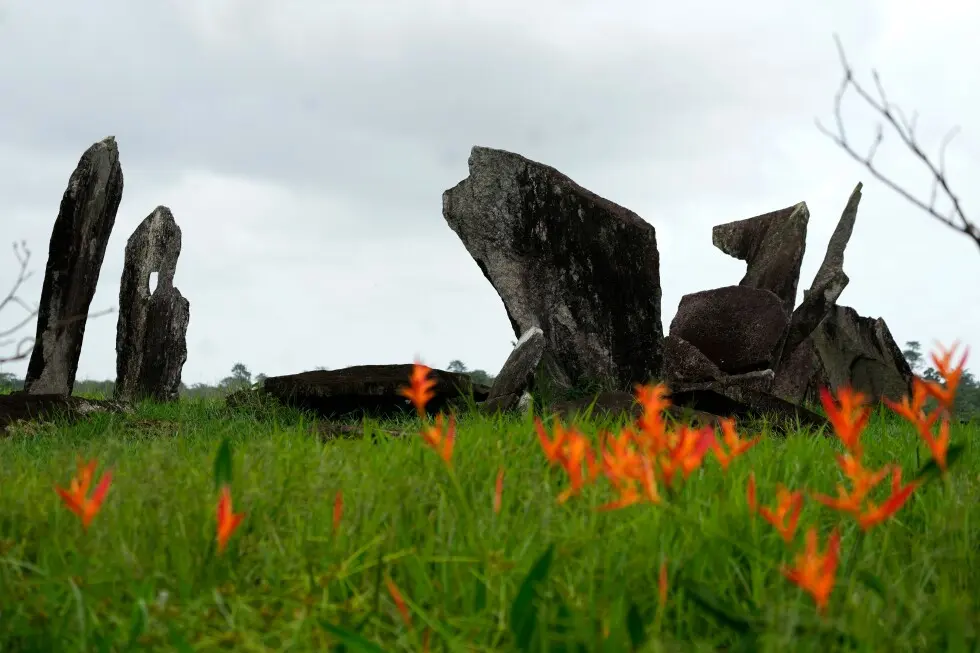
일부가 "아마존의 스톤헨지"라고 부르는 솔스티스 고고학공원은 아마파 주 칼코에네에서 볼 수 있다.
아마파의 가장 인상적인 역사 지역 중 하나는 칼코에네 도시에 있으며, 약 30미터(98피트) 지름의 원 모양으로 배열된 127개의 조각된 거석으로 이루어진 1,000년 된 돌 기념물이 있고, 열대우림 속의 개활지에 위치하며 느린 강으로 경계를 이루고 있다.
일부는 솔스티스 고고학공원을 영국 기념물과의 유사성 때문에 "아마존의 스톤헨지"라고 부른다. 연구원들은 돌들이 북반구의 동지에 태양이 뜨는 정확한 지점을 표시하도록 위치해 있다고 발견했으며, 미나스제라이스 연방대학의 교수이자 약 20년 전 이 장소에서 발굴을 시작한 팀의 일부였던 고고학자 마리아나 페트리 카브랄은 이렇게 말했다.
"모든 돌들이 정확히 무엇을 의미하는지 말하기는 어렵지만, 우리가 알고 있는 것은 그들이 현장 자신의 것이 아니라는 것입니다. 그들은 다른 인근 위치에서 가져왔습니다"라고 그녀는 말했다.
후속 연구와 발굴에서 현장이 묘지로도 사용되었음을 발견했다. 방사성탄소 연대측정은 약 1,100년 전부터 시작하여 수백 년 동안 점유되었음을 보여주었다고 그녀는 말했다.
2005년에 발견된 현장은 아마파 과학기술연구소로부터 사전 승인을 받아 방문할 수 있다. 동시에, 이 현장은 더 많은 사람들이 방문할 수 있게 해 줄 국립공원이 되는 과정을 거치고 있다.
이러한 고고학 유적지는 브라질 법에 의해 보호되며, 이는 변경을 금지한다. 이는 주변 열대우림에 대한 추가 보호 층을 추가한다.
현대 고고학 및 역사 생태학 연구는 원주민들이 수백 년 동안 아마존에 살았을 뿐만 아니라 그것을 형성했음을 보여준다. 그들은 장기적이고 지속 가능한 관행을 통해 경관을 관리하고 재배했다고 상파울루 대학의 고고학 교수인 에두아르도 네베스는 말했다.
네베스는 30년 이상 아마존 열대우림을 연구해 왔으며, 2023년 이래 숲 캐노피 아래 숨겨진 고고학 유적지를 식별하기 위해 위성 스캔을 사용하는 아마존 드러남 프로젝트를 주도해 왔다.
스캔은 고고학 유적지를 연결하는 도로와 반복된 점유와 의도적인 경관 수정을 가리키는 열대우림의 묻힌 패턴을 드러냈다. 네베스가 말했듯이, 이러한 특징들은 함께 대규모 정착지를 시사한다.
고고학자들은 오랫동안 그러한 연결을 의심해 왔으며, 네베스는 덧붙였지만, 기술이 그들의 더 광범위한 지리적 범위를 보는 것을 가능하게 했다. 스캔은 숲 전역의 정착지 클러스터를 연결하는 도로의 네트워크를 보여주며, 남쪽 아마조나스 주와 아크레에서 가장 명확하다.
"사람들이 원주민 부족을 생각할 때, 그들은 종종 숲 한복판의 작은 마을을 고립된 것으로 상상합니다. 하지만 증거는 다양한 정착지를 연결하는 높은 수준의 상호 연결성을 보여줍니다"라고 네베스는 말했다.
"아마파는 이러한 인구가 얼마나 역동적이고 활동적이었는지, 그리고 그들이 수천 년 동안 지속되어 온 교환 네트워크를 어떻게 유지했는지를 보는 데 도움이 되는 핵심 조각입니다"라고 카브랄은 말했다.
펠리페 캄포스 멜로가 보도에 기여했다.
AP의 기후 및 환경 보도는 여러 민간 재단으로부터 재정적 지원을 받는다. AP는 모든 콘텐츠에 대해 전적인 책임을 진다.
건설 공사는 포장이 시작되기 전에 고고학 조사가 필요한 경우가 많으며, 최근의 발견들 중 일부는 브라질 북부 아마파 주의 BR-156 고속도로를 따라 나타났다. 지금까지 9개의 발굴지에서 발견된 것들 중에는 매장용 항아리일 수 있는 도자기 항아리와 인간의 얼굴을 닮은 작은 유물들이 있다.
아마파 과학기술연구소의 고고학연구센터를 관리하는 루시오 플라비오 코스타 레이테는 "우리가 이 지역의 과거에 대해 알고 있는 것은 또한 이러한 프로젝트에 의해 열린 기회와도 관련이 있으며, 이는 우리의 관계에 다소 양면적인 성격을 부여한다"고 말했다. "동시에, 우리가 이러한 장소들에 대해 얻는 지식은 우리가 이러한 지역들에 더욱 주의 깊은 관심을 기울이도록 이끌며, 영구적인 보호 조치를 채택함으로써 말이다."
과학자들은 최근 연구가 이 지역의 과거에 대한 이해를 인간이 없는 사막이 아니라 콜럼버스 도착 훨씬 이전에 상호 연결된 사회에 의해 형성된 풍경으로 강화했다고 말한다. 예를 들어, BR-156을 따라 발견된 물질에는 브라질의 파라 주에서 카리브해에 이르는 공동체들의 영향을 반영한 다양한 스타일과 기법의 도자기가 포함되었다.
국가 운송 인프라 부서를 위해 일하는 팀이 청소하고 분석했다. 고고학자 중 한 명인 마노엘 파비아노 다 실바 산토스는 자신이 발굴한 아마존 토양의 층들이 역사적 시간대라고 말했다.
윗층에서 그는 유럽 점령과 관련된 포르투갈 도자기와 못과 같은 물품들을 발견했다.
"더 깊이 파고들면서, 우리는 식민지배자들의 도착 이전과 이후의 장소의 전환을 표시하는 초기 원주민 존재와 관련된 도자기와 도기들을 발견했다"고 산토스는 말했다.
유물들은 결국 코스타 레이테가 감독하는 아마파 주 수집품으로 갈 것이며, 이는 약 530,000개의 유물을 포함한다. 가장 오래된 유물은 약 6,140년 전의 것으로, 아마파 전역의 오랜 인간 존재를 확인한다고 그는 말했다.
유물들은 고대 원주민 사회가 어떻게 살았으며, 죽었으며, 열대우림과 상호작용했는지에 대한 통찰력을 제공한다.
"제 학생들과 자주 논쟁하는 것이 있습니다 — 우리는 보통 기술을 컴퓨터와 마이크로칩으로 생각합니다"라고 코스타 레이테는 고대 도자기 선반들을 걸어다니며 말했다. "하지만 이 모든 것은 경관을 신중하게 읽고 자료의 신중한 선택이 필요했습니다."
일부가 "아마존의 스톤헨지"라고 부르는 솔스티스 고고학공원은 아마파 주 칼코에네에서 볼 수 있다.
아마파의 가장 인상적인 역사 지역 중 하나는 칼코에네 도시에 있으며, 약 30미터(98피트) 지름의 원 모양으로 배열된 127개의 조각된 거석으로 이루어진 1,000년 된 돌 기념물이 있고, 열대우림 속의 개활지에 위치하며 느린 강으로 경계를 이루고 있다.
일부는 솔스티스 고고학공원을 영국 기념물과의 유사성 때문에 "아마존의 스톤헨지"라고 부른다. 연구원들은 돌들이 북반구의 동지에 태양이 뜨는 정확한 지점을 표시하도록 위치해 있다고 발견했으며, 미나스제라이스 연방대학의 교수이자 약 20년 전 이 장소에서 발굴을 시작한 팀의 일부였던 고고학자 마리아나 페트리 카브랄은 이렇게 말했다.
"모든 돌들이 정확히 무엇을 의미하는지 말하기는 어렵지만, 우리가 알고 있는 것은 그들이 현장 자신의 것이 아니라는 것입니다. 그들은 다른 인근 위치에서 가져왔습니다"라고 그녀는 말했다.
후속 연구와 발굴에서 현장이 묘지로도 사용되었음을 발견했다. 방사성탄소 연대측정은 약 1,100년 전부터 시작하여 수백 년 동안 점유되었음을 보여주었다고 그녀는 말했다.
2005년에 발견된 현장은 아마파 과학기술연구소로부터 사전 승인을 받아 방문할 수 있다. 동시에, 이 현장은 더 많은 사람들이 방문할 수 있게 해 줄 국립공원이 되는 과정을 거치고 있다.
이러한 고고학 유적지는 브라질 법에 의해 보호되며, 이는 변경을 금지한다. 이는 주변 열대우림에 대한 추가 보호 층을 추가한다.
현대 고고학 및 역사 생태학 연구는 원주민들이 수백 년 동안 아마존에 살았을 뿐만 아니라 그것을 형성했음을 보여준다. 그들은 장기적이고 지속 가능한 관행을 통해 경관을 관리하고 재배했다고 상파울루 대학의 고고학 교수인 에두아르도 네베스는 말했다.
네베스는 30년 이상 아마존 열대우림을 연구해 왔으며, 2023년 이래 숲 캐노피 아래 숨겨진 고고학 유적지를 식별하기 위해 위성 스캔을 사용하는 아마존 드러남 프로젝트를 주도해 왔다.
스캔은 고고학 유적지를 연결하는 도로와 반복된 점유와 의도적인 경관 수정을 가리키는 열대우림의 묻힌 패턴을 드러냈다. 네베스가 말했듯이, 이러한 특징들은 함께 대규모 정착지를 시사한다.
고고학자들은 오랫동안 그러한 연결을 의심해 왔으며, 네베스는 덧붙였지만, 기술이 그들의 더 광범위한 지리적 범위를 보는 것을 가능하게 했다. 스캔은 숲 전역의 정착지 클러스터를 연결하는 도로의 네트워크를 보여주며, 남쪽 아마조나스 주와 아크레에서 가장 명확하다.
"사람들이 원주민 부족을 생각할 때, 그들은 종종 숲 한복판의 작은 마을을 고립된 것으로 상상합니다. 하지만 증거는 다양한 정착지를 연결하는 높은 수준의 상호 연결성을 보여줍니다"라고 네베스는 말했다.
"아마파는 이러한 인구가 얼마나 역동적이고 활동적이었는지, 그리고 그들이 수천 년 동안 지속되어 온 교환 네트워크를 어떻게 유지했는지를 보는 데 도움이 되는 핵심 조각입니다"라고 카브랄은 말했다.
펠리페 캄포스 멜로가 보도에 기여했다.
AP의 기후 및 환경 보도는 여러 민간 재단으로부터 재정적 지원을 받는다. AP는 모든 콘텐츠에 대해 전적인 책임을 진다.
처리 완료
5,692 tokens · $0.0148
기사 수집 완료 · 04:00
매체 피드에서 기사 메타데이터 수집
헤드라인 번역 완료 · 11:36
제목/요약 한국어 번역 (fetch 시점 inline)
kimi-k2.5
0 tokens
$0.00000
0.1s
본문 추출 완료
8,961자 추출 완료
본문 한국어 번역 완료 · 11:36
2,867자 번역 완료
claude-haiku-4-5-20251001
5,692 tokens
$0.01479
33.3s
지정학적 엔티티 추출 완료 · 11:36
8개 엔티티 추출 완료
지정학적 맥락 & R-Scanner
R-Scanner · 평상
z=-0.47
일상적인 보도 수준 — 기준: Brazil
(🇧🇷 BR)
최근 6시간 4건
7일 평균 5.18건 / 6h
2개국 매체
2개 매체
본문에서 추출된 지명 (8)
위치 지도
지도 로딩 중…
같은 주제의 다른 기사 (최근 7일)
MACAPA, Brazil (AP) — Paving roads in the Amazon rainforest has long brought deforestation that threatens the people who live there. The same roadwork, however, has also allowed archaeologists to get glimpses of the region’s past long before Europeans arrived to reshape it.
The construction often requires archaeological surveys before the paving starts, and some of the latest discoveries have emerged along the BR-156 highway in Brazil’s northern state of Amapa. Among the findings so far from nine dig sites: pottery vases that may be funerary urns, as well as small artifacts that resemble human faces.
“What we now about the region’s past is also tied to the opening created by these projects, which gives our relationship with them a somewhat ambivalent character,” said Lúcio Flávio Costa Leite, who manages the Archaeological Research Center at Amapa’s Institute for Scientific and Technological Research. “At the same time, the knowledge we gain about these sites leads us to pay closer attention to these regions, including by adopting permanent protection measures.”
Scientists say recent research has reinforced understanding of the region’s past not as a human desert, but rather as a landscape shaped by interconnected societies long before Columbus arrived. The material found along BR-156, for example, included pottery in multiple styles and techniques that reflected influences from communities ranging from Brazil’s Para state to the Caribbean.
Archaeologists conduct a technical visit at Quintela archaeological site in the Vila Nova community along the BR-156 highway in Santana, Amapa state, Brazil, Saturday, March 14, 2026. (AP Photo/Eraldo Peres)
Archaeologists conduct a technical visit at Quintela archaeological site in the Vila Nova community along the BR-156 highway in Santana, Amapa state, Brazil, Saturday, March 14, 2026. (AP Photo/Eraldo Peres)
Archaeologists conduct a technical visit at the Quintela site in the Vila Nova community along the BR-156 highway in Santana, Amapa state, Brazil, Saturday, March 14, 2026. (AP Photo/Eraldo Peres)
Archaeologists conduct a technical visit at the Quintela site in the Vila Nova community along the BR-156 highway in Santana, Amapa state, Brazil, Saturday, March 14, 2026. (AP Photo/Eraldo Peres)
It’s been cleaned and analyzed by a team working for the National Department of Transport Infrastructure. One of the archaeologists, Manoel Fabiano da Silva Santos, said the layers of the Amazon soil he excavated are a historic timeline.
In the upper layers, he found items such as Portuguese porcelain and nails linked to European occupation.
“Digging deeper, we uncovered pottery and ceramics associated with earlier Indigenous presence, marking the site’s transition before and after the arrival of colonizers,” Santos said.
Archaeologist Manoel Fabiano da Silva Santos shows a soil layer scale while explaining the historical timeline at National Department of Transport Infrastructure in Macapa, Amapa state, Brazil, Saturday, March 14, 2026. (AP Photo/Eraldo Peres)
Archaeologist Manoel Fabiano da Silva Santos shows a soil layer scale while explaining the historical timeline at National Department of Transport Infrastructure in Macapa, Amapa state, Brazil, Saturday, March 14, 2026. (AP Photo/Eraldo Peres)
Archaeologist Lucio Flavio Costa Leite speaks about the collection of cataloged archaeological artifacts at the Institute for Scientific and Technological Research in Macapa, Amapa state, Brazil, Sunday, March 8, 2026. (AP Photo/Eraldo Peres)
Archaeologist Lucio Flavio Costa Leite speaks about the collection of cataloged archaeological artifacts at the Institute for Scientific and Technological Research in Macapa, Amapa state, Brazil, Sunday, March 8, 2026. (AP Photo/Eraldo Peres)
The artifacts will eventually go to Amapa’s state collection, overseen by Costa Leite, which includes about 530,000 pieces. The oldest piece is around 6,140 years old, confirming a long human presence across Amapa, he said.
The artifacts offer insight into how ancient Indigenous societies lived, died and interacted with the rainforest.
“Here is something I often debate with my students -- we usually think of technology as computers and microchips,” Costa Leite said, walking through shelves of ancient pottery. “But all of this required careful reading of the landscape and deliberate choices of materials.”
The Archaeological Park of the Solstice, which some call the “Stonehenge of the Amazon” is visible in Calcoene, Amapa state, Brazil, Friday, March 13, 2026. (AP Photo/Eraldo Peres)
The Archaeological Park of the Solstice, which some call the “Stonehenge of the Amazon” is visible in Calcoene, Amapa state, Brazil, Friday, March 13, 2026. (AP Photo/Eraldo Peres)
One of the most impressive historic areas in Amapa is in the city of Calcoene, where a 1,000‑year‑old stone monument made up of 127 carved monoliths arranged in a circle about 30 meters (98 feet) in diameter, set in open grassland amid the rainforest and bordered by a slow river.
Some have dubbed the Archaeological Park of the Solstice the “Stonehenge of the Amazon” for its resemblance to the British monument. Researchers found that the stones were positioned so that during the winter solstice in the Northern Hemisphere they marked the exact point where the sun rises, said archaeologist Mariana Petry Cabral, a professor at the Federal University of Minas Gerais who was part of the team that began digging at the site some two decades ago.
“It’s hard to say exactly what all the stones mean, but what we do know is that they are not from the site itself. They were brought from other nearby locations,” she said.
Subsequent research and excavations found the site also served as a burial ground. Radiocarbon dating showed it was occupied for hundreds of years, beginning around 1,100 years ago, she said.
The site, discovered by scientists in 2005, can be visited with prior approval from Amapa’s Institute for Scientific and Technological Research. At the same time, the site is going through the process to become a national park, which will allow more people to visit.
Such archaeological sites are protected by Brazilian law, which prohibits them being altered. That adds a layer of protection for surrounding rainforest.
Vehicles drive on a fully paved section of BR-156 highway that connects the state capital Macapa with the city of Oiapoque, Amapa state, Brazil, Monday, March 9, 2026. (AP Photo/Eraldo Peres)
Vehicles drive on a fully paved section of BR-156 highway that connects the state capital Macapa with the city of Oiapoque, Amapa state, Brazil, Monday, March 9, 2026. (AP Photo/Eraldo Peres)
Modern archaeological and historical ecology research shows that Indigenous peoples not only lived in the Amazon for centuries but also shaped it. They managed and cultivated the landscape through long‑term, sustainable practices, said Eduardo Neves, an archaeologist professor at the University of Sao Paulo.
Neves has studied the Amazon rainforest for more than 30 years and, since 2023, has led the Amazon Revealed project, which uses satellite scans to identify archaeological sites hidden beneath the forest canopy.
Scans have revealed roads linking archaeological sites and buried patterns in the rainforest that point to repeated occupation and deliberate landscape modification. Together, Neves said, the features suggest large settlements.
Archaeologist Manoel Fabiano da Silva Santos shows an anthropomorphic artifact found at the Quintela archaeological site at the National Department of Transport Infrastructure in Macapa, Amapa state, Brazil, Saturday, March 14, 2026. (AP Photo/Eraldo Peres)
Archaeologist Manoel Fabiano da Silva Santos shows an anthropomorphic artifact found at the Quintela archaeological site at the National Department of Transport Infrastructure in Macapa, Amapa state, Brazil, Saturday, March 14, 2026. (AP Photo/Eraldo Peres)
Archaeologists had long suspected such connections, Neves added, but technology has made it possible to see their broader geographic reach. The scans show networks of roads connecting clusters of settlements across the forest, most clearly in southern Amazonas state and Acre.
“When people think of an Indigenous tribe, they often imagine a small village isolated in the middle of the forest. But evidence shows a high degree of interconnectivity linking different settlements,” Neves said.
“Amapa is a key piece that helps us see how dynamic and active these populations were, and how they maintained networks of exchange that have been in place for millennia,” Cabral said.
Felipe Campos Mello contributed reporting.
The Associated Press’ climate and environmental coverage receives financial support from multiple private foundations. AP is solely responsible for all content. Find AP’s standards for working with philanthropies, a list of supporters and funded coverage areas at AP.org.
The construction often requires archaeological surveys before the paving starts, and some of the latest discoveries have emerged along the BR-156 highway in Brazil’s northern state of Amapa. Among the findings so far from nine dig sites: pottery vases that may be funerary urns, as well as small artifacts that resemble human faces.
“What we now about the region’s past is also tied to the opening created by these projects, which gives our relationship with them a somewhat ambivalent character,” said Lúcio Flávio Costa Leite, who manages the Archaeological Research Center at Amapa’s Institute for Scientific and Technological Research. “At the same time, the knowledge we gain about these sites leads us to pay closer attention to these regions, including by adopting permanent protection measures.”
Scientists say recent research has reinforced understanding of the region’s past not as a human desert, but rather as a landscape shaped by interconnected societies long before Columbus arrived. The material found along BR-156, for example, included pottery in multiple styles and techniques that reflected influences from communities ranging from Brazil’s Para state to the Caribbean.
Archaeologists conduct a technical visit at Quintela archaeological site in the Vila Nova community along the BR-156 highway in Santana, Amapa state, Brazil, Saturday, March 14, 2026. (AP Photo/Eraldo Peres)
Archaeologists conduct a technical visit at Quintela archaeological site in the Vila Nova community along the BR-156 highway in Santana, Amapa state, Brazil, Saturday, March 14, 2026. (AP Photo/Eraldo Peres)
Archaeologists conduct a technical visit at the Quintela site in the Vila Nova community along the BR-156 highway in Santana, Amapa state, Brazil, Saturday, March 14, 2026. (AP Photo/Eraldo Peres)
Archaeologists conduct a technical visit at the Quintela site in the Vila Nova community along the BR-156 highway in Santana, Amapa state, Brazil, Saturday, March 14, 2026. (AP Photo/Eraldo Peres)
It’s been cleaned and analyzed by a team working for the National Department of Transport Infrastructure. One of the archaeologists, Manoel Fabiano da Silva Santos, said the layers of the Amazon soil he excavated are a historic timeline.
In the upper layers, he found items such as Portuguese porcelain and nails linked to European occupation.
“Digging deeper, we uncovered pottery and ceramics associated with earlier Indigenous presence, marking the site’s transition before and after the arrival of colonizers,” Santos said.
Archaeologist Manoel Fabiano da Silva Santos shows a soil layer scale while explaining the historical timeline at National Department of Transport Infrastructure in Macapa, Amapa state, Brazil, Saturday, March 14, 2026. (AP Photo/Eraldo Peres)
Archaeologist Manoel Fabiano da Silva Santos shows a soil layer scale while explaining the historical timeline at National Department of Transport Infrastructure in Macapa, Amapa state, Brazil, Saturday, March 14, 2026. (AP Photo/Eraldo Peres)
Archaeologist Lucio Flavio Costa Leite speaks about the collection of cataloged archaeological artifacts at the Institute for Scientific and Technological Research in Macapa, Amapa state, Brazil, Sunday, March 8, 2026. (AP Photo/Eraldo Peres)
Archaeologist Lucio Flavio Costa Leite speaks about the collection of cataloged archaeological artifacts at the Institute for Scientific and Technological Research in Macapa, Amapa state, Brazil, Sunday, March 8, 2026. (AP Photo/Eraldo Peres)
The artifacts will eventually go to Amapa’s state collection, overseen by Costa Leite, which includes about 530,000 pieces. The oldest piece is around 6,140 years old, confirming a long human presence across Amapa, he said.
The artifacts offer insight into how ancient Indigenous societies lived, died and interacted with the rainforest.
“Here is something I often debate with my students -- we usually think of technology as computers and microchips,” Costa Leite said, walking through shelves of ancient pottery. “But all of this required careful reading of the landscape and deliberate choices of materials.”
The Archaeological Park of the Solstice, which some call the “Stonehenge of the Amazon” is visible in Calcoene, Amapa state, Brazil, Friday, March 13, 2026. (AP Photo/Eraldo Peres)
The Archaeological Park of the Solstice, which some call the “Stonehenge of the Amazon” is visible in Calcoene, Amapa state, Brazil, Friday, March 13, 2026. (AP Photo/Eraldo Peres)
One of the most impressive historic areas in Amapa is in the city of Calcoene, where a 1,000‑year‑old stone monument made up of 127 carved monoliths arranged in a circle about 30 meters (98 feet) in diameter, set in open grassland amid the rainforest and bordered by a slow river.
Some have dubbed the Archaeological Park of the Solstice the “Stonehenge of the Amazon” for its resemblance to the British monument. Researchers found that the stones were positioned so that during the winter solstice in the Northern Hemisphere they marked the exact point where the sun rises, said archaeologist Mariana Petry Cabral, a professor at the Federal University of Minas Gerais who was part of the team that began digging at the site some two decades ago.
“It’s hard to say exactly what all the stones mean, but what we do know is that they are not from the site itself. They were brought from other nearby locations,” she said.
Subsequent research and excavations found the site also served as a burial ground. Radiocarbon dating showed it was occupied for hundreds of years, beginning around 1,100 years ago, she said.
The site, discovered by scientists in 2005, can be visited with prior approval from Amapa’s Institute for Scientific and Technological Research. At the same time, the site is going through the process to become a national park, which will allow more people to visit.
Such archaeological sites are protected by Brazilian law, which prohibits them being altered. That adds a layer of protection for surrounding rainforest.
Vehicles drive on a fully paved section of BR-156 highway that connects the state capital Macapa with the city of Oiapoque, Amapa state, Brazil, Monday, March 9, 2026. (AP Photo/Eraldo Peres)
Vehicles drive on a fully paved section of BR-156 highway that connects the state capital Macapa with the city of Oiapoque, Amapa state, Brazil, Monday, March 9, 2026. (AP Photo/Eraldo Peres)
Modern archaeological and historical ecology research shows that Indigenous peoples not only lived in the Amazon for centuries but also shaped it. They managed and cultivated the landscape through long‑term, sustainable practices, said Eduardo Neves, an archaeologist professor at the University of Sao Paulo.
Neves has studied the Amazon rainforest for more than 30 years and, since 2023, has led the Amazon Revealed project, which uses satellite scans to identify archaeological sites hidden beneath the forest canopy.
Scans have revealed roads linking archaeological sites and buried patterns in the rainforest that point to repeated occupation and deliberate landscape modification. Together, Neves said, the features suggest large settlements.
Archaeologist Manoel Fabiano da Silva Santos shows an anthropomorphic artifact found at the Quintela archaeological site at the National Department of Transport Infrastructure in Macapa, Amapa state, Brazil, Saturday, March 14, 2026. (AP Photo/Eraldo Peres)
Archaeologist Manoel Fabiano da Silva Santos shows an anthropomorphic artifact found at the Quintela archaeological site at the National Department of Transport Infrastructure in Macapa, Amapa state, Brazil, Saturday, March 14, 2026. (AP Photo/Eraldo Peres)
Archaeologists had long suspected such connections, Neves added, but technology has made it possible to see their broader geographic reach. The scans show networks of roads connecting clusters of settlements across the forest, most clearly in southern Amazonas state and Acre.
“When people think of an Indigenous tribe, they often imagine a small village isolated in the middle of the forest. But evidence shows a high degree of interconnectivity linking different settlements,” Neves said.
“Amapa is a key piece that helps us see how dynamic and active these populations were, and how they maintained networks of exchange that have been in place for millennia,” Cabral said.
Felipe Campos Mello contributed reporting.
The Associated Press’ climate and environmental coverage receives financial support from multiple private foundations. AP is solely responsible for all content. Find AP’s standards for working with philanthropies, a list of supporters and funded coverage areas at AP.org.