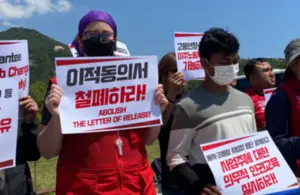
한국의 비자 시스템에서 직업 변경 권리를 요구하는 이주 노동자들
Migrant workers call for right to change jobs under Korea’s visa system
The Korea Herald
· 🇰🇷 Seoul, KR
Lim Jae-seong
EN
2026-04-30 14:55
Translated
남아시아 이주 노동자의 폭행이 동영상에 기록된 가운데, 한국의 비자 규칙이 직업 변경을 불가능하게 만든다고 주장했다.
방글라데시 이주 노동자 라키불 이슬람은 목요일 서울 중심부의 청와대 앞에서 기자회견을 열고 "한국어를 잘 했다면 이런 학대가 일어나지 않았을 것 같다"고 말했다. "하지만 이것은 언어 문제가 아니었다. 노동자들은 회사가 잘못을 저질렀을 때 견디거나 포기하도록 강요받는다."
외국인 노동자들과 옹호 단체들은 한국의 비자 시스템과 연결된 직업 변경 제한을 폐지할 것을 촉구하며, 이 규칙이 이주 노동자들을 직장 괴롭힘과 인권 침해에 취약하게 만든다고 주장했다.
연사들은 태국 노동자가 심한 장 손상을 입은 사건을 포함하여 외국인 노동자 관련 최근 학대 사건들을 언급했다. 시위대는 공동 성명에서 현재 체계가 학대적인 직장을 떠나기 어렵게 만들기 때문에 많은 피해자들이 침묵을 지킨다고 밝혔다.
"이주 노동자는 위험한 상황에서 자신을 보호하기 위해 직장을 변경할 권리가 있어야 하지만, 이 기본적인 권리도 보장되지 않습니다. 직업을 떠날 수 있는 능력은 고용주가 근무 조건을 개선하도록 장려할 수도 있습니다."
한국의 고용허가제에 따르면, 이주 노동자들은 일반적으로 지정된 직장으로 제한되며, 적절한 허가 없이 직업을 떠나면 그들이 한국에서 얼마나 오래 살았는지와 관계없이 강제 추방될 수 있다. 많은 노동자들은 한국에 도착하기 전에 모국의 중개인들에게 상당한 빚을 진다.
이 문제는 30만 명 이상의 노동자를 포함하는 E-9 비전문직 비자와 가장 관련이 있다. 정부는 노동자가 책임이 없는 경우와 같은 특정 조건에서 제한된 직업 변경을 허용하지만, 변경 횟수는 제한되고 일반적으로 같은 지역 내로 제한된다.
옹호 단체들은 이러한 예외가 너무 좁고 특히 한국어나 법률 제도에 익숙하지 않은 노동자들의 경우 접근하기 어렵다고 주장하며, 인권 보호에 상당한 공백을 남긴다고 말했다.
기자회견에는 E-2 언어 교육 비자와 E-7 전문직 비자 소유자도 유사한 제한을 받는다고 말한 교육 및 전문직 비자 소유자들의 대표자들이 참석했다.
서울 원어민 교사 노조 회장인 에린 데이는 "계약 중 직업을 변경하려면 고용주의 허가와 해제 서신이 필요합니다. 일부 고용주는 교사들이 큰 '위약금'을 지불할 경우에만 이를 제공합니다."라고 말했다.
이준석 대통령 행정부가 노동 권리 강화에 더 큰 중점을 두면서 고용노동부는 규칙을 완화하는 조치를 검토 중인 것으로 알려졌다. 현지 언론에 따르면 논의에는 E-9 노동자들이 필수 고용 기간을 완료한 후 해당 지역 내에서 직업을 변경할 수 있도록 허용하는 것이 포함되어 있다.
그러나 옹호 단체들은 이러한 조치가 부족하다고 주장하며, 고용주의 동의를 요구하여 직업을 떠나는 것은 미지급 임금과 직장 상해 시 보호 부족을 포함한 학대를 가능하게 하는 근본적인 문제로 남아 있다고 말했다.
"외국인 근로자 고용법은 직업 변경을 허용하는 예외에 관한 한 관행에서 매우 좁고 엄격하게 해석됩니다."라고 원곡 법률사무소의 변호사 최정규는 말했다.
"정부가 기준을 완화하는 것을 논의하고 있지만, 구조적 문제를 해결하기 위해 직장 변경 사유에 대한 제한을 완전히 폐지해야 합니다."
방글라데시 이주 노동자 라키불 이슬람은 목요일 서울 중심부의 청와대 앞에서 기자회견을 열고 "한국어를 잘 했다면 이런 학대가 일어나지 않았을 것 같다"고 말했다. "하지만 이것은 언어 문제가 아니었다. 노동자들은 회사가 잘못을 저질렀을 때 견디거나 포기하도록 강요받는다."
외국인 노동자들과 옹호 단체들은 한국의 비자 시스템과 연결된 직업 변경 제한을 폐지할 것을 촉구하며, 이 규칙이 이주 노동자들을 직장 괴롭힘과 인권 침해에 취약하게 만든다고 주장했다.
연사들은 태국 노동자가 심한 장 손상을 입은 사건을 포함하여 외국인 노동자 관련 최근 학대 사건들을 언급했다. 시위대는 공동 성명에서 현재 체계가 학대적인 직장을 떠나기 어렵게 만들기 때문에 많은 피해자들이 침묵을 지킨다고 밝혔다.
"이주 노동자는 위험한 상황에서 자신을 보호하기 위해 직장을 변경할 권리가 있어야 하지만, 이 기본적인 권리도 보장되지 않습니다. 직업을 떠날 수 있는 능력은 고용주가 근무 조건을 개선하도록 장려할 수도 있습니다."
한국의 고용허가제에 따르면, 이주 노동자들은 일반적으로 지정된 직장으로 제한되며, 적절한 허가 없이 직업을 떠나면 그들이 한국에서 얼마나 오래 살았는지와 관계없이 강제 추방될 수 있다. 많은 노동자들은 한국에 도착하기 전에 모국의 중개인들에게 상당한 빚을 진다.
이 문제는 30만 명 이상의 노동자를 포함하는 E-9 비전문직 비자와 가장 관련이 있다. 정부는 노동자가 책임이 없는 경우와 같은 특정 조건에서 제한된 직업 변경을 허용하지만, 변경 횟수는 제한되고 일반적으로 같은 지역 내로 제한된다.
옹호 단체들은 이러한 예외가 너무 좁고 특히 한국어나 법률 제도에 익숙하지 않은 노동자들의 경우 접근하기 어렵다고 주장하며, 인권 보호에 상당한 공백을 남긴다고 말했다.
기자회견에는 E-2 언어 교육 비자와 E-7 전문직 비자 소유자도 유사한 제한을 받는다고 말한 교육 및 전문직 비자 소유자들의 대표자들이 참석했다.
서울 원어민 교사 노조 회장인 에린 데이는 "계약 중 직업을 변경하려면 고용주의 허가와 해제 서신이 필요합니다. 일부 고용주는 교사들이 큰 '위약금'을 지불할 경우에만 이를 제공합니다."라고 말했다.
이준석 대통령 행정부가 노동 권리 강화에 더 큰 중점을 두면서 고용노동부는 규칙을 완화하는 조치를 검토 중인 것으로 알려졌다. 현지 언론에 따르면 논의에는 E-9 노동자들이 필수 고용 기간을 완료한 후 해당 지역 내에서 직업을 변경할 수 있도록 허용하는 것이 포함되어 있다.
그러나 옹호 단체들은 이러한 조치가 부족하다고 주장하며, 고용주의 동의를 요구하여 직업을 떠나는 것은 미지급 임금과 직장 상해 시 보호 부족을 포함한 학대를 가능하게 하는 근본적인 문제로 남아 있다고 말했다.
"외국인 근로자 고용법은 직업 변경을 허용하는 예외에 관한 한 관행에서 매우 좁고 엄격하게 해석됩니다."라고 원곡 법률사무소의 변호사 최정규는 말했다.
"정부가 기준을 완화하는 것을 논의하고 있지만, 구조적 문제를 해결하기 위해 직장 변경 사유에 대한 제한을 완전히 폐지해야 합니다."
처리 완료
3,024 tokens · $0.0084
기사 수집 완료 · 14:55
매체 피드에서 기사 메타데이터 수집
헤드라인 번역 완료 · 15:05
제목/요약 한국어 번역 (fetch 시점 inline)
claude-haiku-4-5-20251001
153 tokens
$0.00042
1.5s
본문 추출 완료
3,644자 추출 완료
본문 한국어 번역 완료 · 15:05
1,585자 번역 완료
claude-haiku-4-5-20251001
2,871 tokens
$0.00798
15.0s
지정학적 엔티티 추출 완료 · 15:05
4개 엔티티 추출 완료
지정학적 맥락 & R-Scanner
R-Scanner · 핫스팟
z=4.11
평소보다 훨씬 많은 매체가 집중 보도 중 — 기준: South Korea
(🇰🇷 KR)
최근 6시간 25건
7일 평균 10.86건 / 6h
4개국 매체
4개 매체
본문에서 추출된 지명 (4)
위치 지도
지도 로딩 중…
같은 주제의 다른 기사 (최근 7일)
Advocates, lawyers say job-change restrictions leave migrant workers with too few ways out of abuse
A Bangladeshi migrant worker whose assault was captured on video said Thursday he endured abuse because South Korea’s visa rules made leaving his job feel impossible.
“I thought such abuse would not happen if I spoke Korean well,” Rakibul Islam said at a press conference in front of Cheong Wa Dae in central Seoul. “But this was not a language issue. Workers are forced to endure or give up when companies do wrong.”
His testimony came as foreign workers and advocacy groups called for abolishing restrictions on job changes tied to Korea’s visa system, arguing that the rules leave migrant workers vulnerable to workplace harassment and human rights abuses.
Speakers pointed to a series of recent abuse cases involving foreign workers, including a Thai worker who suffered a severe intestinal injury and Islam, who they said was repeatedly slapped by his employer. In a joint statement, protesters said many victims remain silent because the current system makes it difficult to leave abusive workplaces without risking their legal status.
“Migrant workers should have the right to change workplaces to protect themselves in dangerous situations, but even this basic right is not guaranteed,” the group said. “The ability to leave a job could also encourage employers to improve working conditions.”
Under Korea’s Employment Permit System, migrant workers are generally restricted to designated workplaces, and leaving a job without proper authorization can result in deportation, regardless of how long they have lived in the country. Many workers also incur significant debt to brokers in their home countries before arriving in Korea.
The issue is most often associated with the E-9 nonprofessional visa, which covers more than 300,000 workers. While the government allows limited job changes under specific conditions, such as when workers are not at fault, the number of changes is capped and typically restricted within the same region.
Advocates argue that these exceptions are too narrow and difficult to access, particularly for workers unfamiliar with the Korean language or legal system, leaving significant blind spots in human rights protection.
The press conference included representatives of teaching and professional visa holders, who said similar restrictions affect holders of E-2 language teaching visas and E-7 professional visas.
“I need my employer’s permission and a letter of release to change jobs midcontract,” said Erin Day, chair of the Seoul Native Language Teachers Union. “Some employers offer it only if teachers pay large ‘penalty fees.’”
As the administration of President Lee Jae Myung places greater emphasis on strengthening labor rights, the Ministry of Employment and Labor is reportedly reviewing measures to ease the rules. Discussions include allowing E-9 workers to change jobs within their region after completing a mandatory period of employment, according to local media.
However, advocacy groups say such measures fall short, arguing that requiring employer consent to leave a job remains a fundamental issue that enables abuse, including unpaid wages and lack of protection in cases of workplace injury.
“The Act on the Employment of Foreign Workers is interpreted very narrowly and strictly in practice when it comes to exceptions allowing job changes,” said Choi Jung-kyu, a lawyer at law firm Wongok.
“While the government is discussing easing the criteria, the restrictions on grounds for changing workplaces should be completely abolished to address the structural problem.”
A Bangladeshi migrant worker whose assault was captured on video said Thursday he endured abuse because South Korea’s visa rules made leaving his job feel impossible.
“I thought such abuse would not happen if I spoke Korean well,” Rakibul Islam said at a press conference in front of Cheong Wa Dae in central Seoul. “But this was not a language issue. Workers are forced to endure or give up when companies do wrong.”
His testimony came as foreign workers and advocacy groups called for abolishing restrictions on job changes tied to Korea’s visa system, arguing that the rules leave migrant workers vulnerable to workplace harassment and human rights abuses.
Speakers pointed to a series of recent abuse cases involving foreign workers, including a Thai worker who suffered a severe intestinal injury and Islam, who they said was repeatedly slapped by his employer. In a joint statement, protesters said many victims remain silent because the current system makes it difficult to leave abusive workplaces without risking their legal status.
“Migrant workers should have the right to change workplaces to protect themselves in dangerous situations, but even this basic right is not guaranteed,” the group said. “The ability to leave a job could also encourage employers to improve working conditions.”
Under Korea’s Employment Permit System, migrant workers are generally restricted to designated workplaces, and leaving a job without proper authorization can result in deportation, regardless of how long they have lived in the country. Many workers also incur significant debt to brokers in their home countries before arriving in Korea.
The issue is most often associated with the E-9 nonprofessional visa, which covers more than 300,000 workers. While the government allows limited job changes under specific conditions, such as when workers are not at fault, the number of changes is capped and typically restricted within the same region.
Advocates argue that these exceptions are too narrow and difficult to access, particularly for workers unfamiliar with the Korean language or legal system, leaving significant blind spots in human rights protection.
The press conference included representatives of teaching and professional visa holders, who said similar restrictions affect holders of E-2 language teaching visas and E-7 professional visas.
“I need my employer’s permission and a letter of release to change jobs midcontract,” said Erin Day, chair of the Seoul Native Language Teachers Union. “Some employers offer it only if teachers pay large ‘penalty fees.’”
As the administration of President Lee Jae Myung places greater emphasis on strengthening labor rights, the Ministry of Employment and Labor is reportedly reviewing measures to ease the rules. Discussions include allowing E-9 workers to change jobs within their region after completing a mandatory period of employment, according to local media.
However, advocacy groups say such measures fall short, arguing that requiring employer consent to leave a job remains a fundamental issue that enables abuse, including unpaid wages and lack of protection in cases of workplace injury.
“The Act on the Employment of Foreign Workers is interpreted very narrowly and strictly in practice when it comes to exceptions allowing job changes,” said Choi Jung-kyu, a lawyer at law firm Wongok.
“While the government is discussing easing the criteria, the restrictions on grounds for changing workplaces should be completely abolished to address the structural problem.”