티후아나 강 하수, 캘리포니아 공기 유독하게 만들어 수천 명 질병 앓아
Tijuana River sewage is making the air toxic and sickening thousands in California
Associated Press
· 🇺🇸 New York, US
https://apnews.com/author/julie-watson
EN
2026-04-17 04:45
Translated
[CONTENT]
샌디에이고(AP) — 썩은 계란 냄새가 스티브 에거의 남부 캘리포니아 집 전체에 퍼져 있으며, 특히 밤에 근처 티후아나 강이 멕시코에서 유입된 하수로 거품을 일으키며 태평양으로 흘러 들어갈 때 심해진다.
72세의 에거는 그와 아내가 자주 두통을 겪고, 숨이 막혀 깨어나 가래를 뱉는다고 말한다. 그들의 집에는 15분마다 공기를 순환시키는 병원급 여과 시스템이 설치되어 있다.
이러한 조치에도 불구하고 "대부분의 밤에 우리는 끔찍한 악취를 들이마신다"고 그는 말했다. "정말 끔찍하다."
국경 및 수위 위원회에 따르면 2018년 이후 산업용 화학물질과 쓰레기가 가득한 원시 하수 1,000억 갤런(3,780억 리터) 이상이 티후아나 강으로 흘러 들어갔다. 이 강은 에거 가족 세 대가 낙농업을 했던 땅을 가로지른다. 미국과 멕시코는 지난해 티후아나의 인구 증가와 많은 미국 기업이 소유한 공장의 산업 폐기물을 처리하기 위해 폐수 처리장을 업그레이드하여 오랜 문제를 해결하기로 합의했다.
그동안 수만 명이 하수에 노출되고 있다. 리 젤딘 환경보호청장은 2월 샌디에이고 방문 중 이 문제를 해결하는 데 약 2년이 걸릴 것이라고 말했으며, 이는 대부분 빈곤한 라티노 인구에 영향을 미치는 미국 최악이자 가장 오래 지속된 환경 위기 중 하나다.
원시 하수는 악취가 나는 것뿐만 아니라 수소 황화물이라는 유독 가스를 방출하는데, 이는 코의 신경을 침식하고 천식 발작을 유발할 수 있다. 질병통제예방센터에 따르면 이는 두통, 메스컴움, 착란, 떨림, 기침, 호흡곤란, 피부 및 눈 자극, 심지어 사망까지 일으킬 수 있다. 장기적인 건강 문제는 이제 막 이해되기 시작했다.
수소 황화물에 대한 연방 안전 기준은 폐수 처리장이나 분뇨 구덩이와 같이 위험이 극심한 작업장의 근로자를 제외하고는 없다. 일부 주는 수십 년 전 기준을 설정했지만 그것들은 시대에 뒤떨어졌다. 캘리포니아 주의 한 제안은 56년 된 주 기준이 이 가스의 건강 위험을 반영하도록 요구한다. 텍사스 주에서도 법 개정을 검토 중이다.
"표준이 처음 설정되었을 때와 그 후 검토되었을 때를 돌아보면, 모두 불쾌감에 관한 것이었습니다—기본적으로 냄새에 관한 것이었죠"라고 티후아나 강 계곡을 대표하는 민주당 스티브 파딜라 상원의원이 말했다. "우리는 여기서 건강 영향이 무엇인지 과학적으로 이해하지 못했고, 이제 우리는 알게 되었습니다."
이 법안이 통과되더라도 새로운 기준은 2030년까지 개발되지 않을 가능성이 높다.
에거의 울타리에는 "악취 멈춰라" 표지판이 붙어 있는데, 이는 해안 보전 시민단체가 국경을 넘는 하수 문제 해결을 요구하며 시작한 캠페인의 일부다.
길이 120마일(195km)인 이 강은 멕시코 도시 티후아나에서 시작해 캘리포니아로 흘러 들어와 바다로 빠진다. 근처 샌디에이고 카운티 해변은 수년간 폐쇄되었고, 물에서 훈련하는 네이비 실들도 병에 걸렸다.
국제수계경계위원회 자료에 따르면 올해 1월 이후 티후아나 강은 대부분 원시 하수와 산업 폐기물 100억 갤런(380억 리터)을 미국 국경을 넘어 운반했다. 비교해 보면, 1월에 파열된 대형 파이프는 처리되지 않은 하수 2억 4,400만 갤런(9억 2,400만 리터)을 포토맥 강으로 흘려보내 부유하고 대부분 백인 커뮤니티에 영향을 미쳤다. 그 유출은 몇 주 내에 연방 정부의 개입을 촉발했다.
2024년 샌디에이고 카운티와 CDC가 티후아나 강 근처 약 4만 가구를 대상으로 한 샘플링 조사에서 71%가 집 안에서 하수 냄새를 맡았고 69%가 노출로 인해 가족 구성원이 아팠다고 답했다.
로마 린다 대학교 공중보건대학 환경미생물학 부교수인 라이언 싱클레어는 "낮은 수준에서도 당신은 그것이 부비강에 있는 것처럼 느낄 것입니다. 냄새를 없앨 수 없습니다. 지속적인 자극이 될 것입니다"라고 말했다.
환경보호청은 지역 및 주 관리들과 협력하여 냄새를 완화할 방법을 찾고 있다고 밝혔다.
샌디에이고 카운티는 올해 1만 개 이상의 공기 여과기를 가정에 배포했다. 하지만 공기는 여전히 위협이다. 강의 거품은 이제 우주에서도 볼 수 있다.
2024년 9월, 샌디에이고 캘리포니아 대학 화학 교수인 킴벌리 프래더와 연구팀은 에거가 사는 동네에 공기 모니터를 설치했다.
그들이 발견한 것은 그들을 놀라게 했다: 밤에 강 흐름이 최고조에 달했을 때 수소 황화물 농도가 일반적인 도시 수준보다 4,500배 높았고 캘리포니아 공기 기준보다 150배 높았다.
에거와 같은 많은 주민들은 정당성을 느꼈다.
"그들은 대체로 가스라이팅을 당하며 '가스가 있어요. 불쾌감일 뿐이에요. 냄새가 나지만 나쁘지 않아요'라고 들었습니다"라고 프래더가 말했다.
그녀는 연구진이 이후 강에서 나오는 수천 가지의 다른 가스를 탐지했는데, 이들은 냄새가 나지 않으며 "그중 많은 것이 더 유독하다"고 말했다.
에거는 의사들이 이사하라고 말했지만, 수소 황화물 노출로 고통받고 있다는 서면 진단을 받지는 못했다고 말했다.
하지만 그의 가족 뿌리는 깊다. 그의 아내는 티후아나에서 자랐다. 그의 형과 작고한 형의 가족은 에거 낙농장이었던 인근 집에 살고 있다. 근처에는 황폐한 젖소 헛간과 녹슨 농기구가 있다.
"이곳은 내가 평생 살아온 곳이며, 가족과 부모님, 조부모님과 함께한 곳입니다"라고 그는 말했다. "이곳이 집입니다."
에거가 어린 시절, 그는 우기에만 흐르던 강에서 수영했다. 이제는 대부분 하수와 산업 폐기물로 가득 차 연중 흐른다. 그는 강이 국경에 더 가깝고 대부분의 주거지와 학교에서 더 멀리 떨어진 역사적 경로로 복원되어야 한다고 말한다. 그러면 물이 고여 수소 황화물 가스의 핫스팟을 만들지 않을 것이라고 그는 믿는다.
에거의 집에서 반 마일도 떨어지지 않은 곳, 토성 대로 근처에서 강이 잠시 지하로 강제 유입된 후 파이프에서 분출되는 곳에서 냄새가 압도적이다.
과학자들은 이를 "토성 핫스팟"이라고 부른다. 악취는 창문을 올린 채 지나가는 차 안으로 스며들며 며칠 동안 남아 있다.
매튜 딕슨 박사와 그의 아내인 킴벌리 딕슨 박사는 핫스팟에서 약 1마일 떨어진 곳에 진료소를 운영한다. 많은 환자들이 편두통, 메스컴움, 쌕쌕거림, 눈 감염, 뇌안개로 고통받고 있다. 천식을 앓는 사람들은 공기가 악취를 풍길 때 흡입기를 더 자주 사용한다고 말한다.
"밖에서 냄새가 나지 않을 때 기분이 나아진다고 말하죠"라고 킴벌리 딕슨 박사가 말했다.
2023년 8월, 열대폭풍으로 강이 범람해 거리로 넘쳤다. 며칠 내에 의사들의 환자 수가 3배로 늘었다.
전자 건강 기록은 의사들이 의심했던 것을 확인해 주었다. 강 흐름이 급증했을 때 호흡기 문제로 치료받은 환자 수가 130% 증가했다고 그들은 말했다.
"이것이 고쳐지지 않는 매일"이라고 매튜 딕슨 박사가 말했다. "더 많은 사람들이 아프게 됩니다."
샌디에이고(AP) — 썩은 계란 냄새가 스티브 에거의 남부 캘리포니아 집 전체에 퍼져 있으며, 특히 밤에 근처 티후아나 강이 멕시코에서 유입된 하수로 거품을 일으키며 태평양으로 흘러 들어갈 때 심해진다.
72세의 에거는 그와 아내가 자주 두통을 겪고, 숨이 막혀 깨어나 가래를 뱉는다고 말한다. 그들의 집에는 15분마다 공기를 순환시키는 병원급 여과 시스템이 설치되어 있다.
이러한 조치에도 불구하고 "대부분의 밤에 우리는 끔찍한 악취를 들이마신다"고 그는 말했다. "정말 끔찍하다."
국경 및 수위 위원회에 따르면 2018년 이후 산업용 화학물질과 쓰레기가 가득한 원시 하수 1,000억 갤런(3,780억 리터) 이상이 티후아나 강으로 흘러 들어갔다. 이 강은 에거 가족 세 대가 낙농업을 했던 땅을 가로지른다. 미국과 멕시코는 지난해 티후아나의 인구 증가와 많은 미국 기업이 소유한 공장의 산업 폐기물을 처리하기 위해 폐수 처리장을 업그레이드하여 오랜 문제를 해결하기로 합의했다.
그동안 수만 명이 하수에 노출되고 있다. 리 젤딘 환경보호청장은 2월 샌디에이고 방문 중 이 문제를 해결하는 데 약 2년이 걸릴 것이라고 말했으며, 이는 대부분 빈곤한 라티노 인구에 영향을 미치는 미국 최악이자 가장 오래 지속된 환경 위기 중 하나다.
원시 하수는 악취가 나는 것뿐만 아니라 수소 황화물이라는 유독 가스를 방출하는데, 이는 코의 신경을 침식하고 천식 발작을 유발할 수 있다. 질병통제예방센터에 따르면 이는 두통, 메스컴움, 착란, 떨림, 기침, 호흡곤란, 피부 및 눈 자극, 심지어 사망까지 일으킬 수 있다. 장기적인 건강 문제는 이제 막 이해되기 시작했다.
수소 황화물에 대한 연방 안전 기준은 폐수 처리장이나 분뇨 구덩이와 같이 위험이 극심한 작업장의 근로자를 제외하고는 없다. 일부 주는 수십 년 전 기준을 설정했지만 그것들은 시대에 뒤떨어졌다. 캘리포니아 주의 한 제안은 56년 된 주 기준이 이 가스의 건강 위험을 반영하도록 요구한다. 텍사스 주에서도 법 개정을 검토 중이다.
"표준이 처음 설정되었을 때와 그 후 검토되었을 때를 돌아보면, 모두 불쾌감에 관한 것이었습니다—기본적으로 냄새에 관한 것이었죠"라고 티후아나 강 계곡을 대표하는 민주당 스티브 파딜라 상원의원이 말했다. "우리는 여기서 건강 영향이 무엇인지 과학적으로 이해하지 못했고, 이제 우리는 알게 되었습니다."
이 법안이 통과되더라도 새로운 기준은 2030년까지 개발되지 않을 가능성이 높다.
에거의 울타리에는 "악취 멈춰라" 표지판이 붙어 있는데, 이는 해안 보전 시민단체가 국경을 넘는 하수 문제 해결을 요구하며 시작한 캠페인의 일부다.
길이 120마일(195km)인 이 강은 멕시코 도시 티후아나에서 시작해 캘리포니아로 흘러 들어와 바다로 빠진다. 근처 샌디에이고 카운티 해변은 수년간 폐쇄되었고, 물에서 훈련하는 네이비 실들도 병에 걸렸다.
국제수계경계위원회 자료에 따르면 올해 1월 이후 티후아나 강은 대부분 원시 하수와 산업 폐기물 100억 갤런(380억 리터)을 미국 국경을 넘어 운반했다. 비교해 보면, 1월에 파열된 대형 파이프는 처리되지 않은 하수 2억 4,400만 갤런(9억 2,400만 리터)을 포토맥 강으로 흘려보내 부유하고 대부분 백인 커뮤니티에 영향을 미쳤다. 그 유출은 몇 주 내에 연방 정부의 개입을 촉발했다.
2024년 샌디에이고 카운티와 CDC가 티후아나 강 근처 약 4만 가구를 대상으로 한 샘플링 조사에서 71%가 집 안에서 하수 냄새를 맡았고 69%가 노출로 인해 가족 구성원이 아팠다고 답했다.
로마 린다 대학교 공중보건대학 환경미생물학 부교수인 라이언 싱클레어는 "낮은 수준에서도 당신은 그것이 부비강에 있는 것처럼 느낄 것입니다. 냄새를 없앨 수 없습니다. 지속적인 자극이 될 것입니다"라고 말했다.
환경보호청은 지역 및 주 관리들과 협력하여 냄새를 완화할 방법을 찾고 있다고 밝혔다.
샌디에이고 카운티는 올해 1만 개 이상의 공기 여과기를 가정에 배포했다. 하지만 공기는 여전히 위협이다. 강의 거품은 이제 우주에서도 볼 수 있다.
2024년 9월, 샌디에이고 캘리포니아 대학 화학 교수인 킴벌리 프래더와 연구팀은 에거가 사는 동네에 공기 모니터를 설치했다.
그들이 발견한 것은 그들을 놀라게 했다: 밤에 강 흐름이 최고조에 달했을 때 수소 황화물 농도가 일반적인 도시 수준보다 4,500배 높았고 캘리포니아 공기 기준보다 150배 높았다.
에거와 같은 많은 주민들은 정당성을 느꼈다.
"그들은 대체로 가스라이팅을 당하며 '가스가 있어요. 불쾌감일 뿐이에요. 냄새가 나지만 나쁘지 않아요'라고 들었습니다"라고 프래더가 말했다.
그녀는 연구진이 이후 강에서 나오는 수천 가지의 다른 가스를 탐지했는데, 이들은 냄새가 나지 않으며 "그중 많은 것이 더 유독하다"고 말했다.
에거는 의사들이 이사하라고 말했지만, 수소 황화물 노출로 고통받고 있다는 서면 진단을 받지는 못했다고 말했다.
하지만 그의 가족 뿌리는 깊다. 그의 아내는 티후아나에서 자랐다. 그의 형과 작고한 형의 가족은 에거 낙농장이었던 인근 집에 살고 있다. 근처에는 황폐한 젖소 헛간과 녹슨 농기구가 있다.
"이곳은 내가 평생 살아온 곳이며, 가족과 부모님, 조부모님과 함께한 곳입니다"라고 그는 말했다. "이곳이 집입니다."
에거가 어린 시절, 그는 우기에만 흐르던 강에서 수영했다. 이제는 대부분 하수와 산업 폐기물로 가득 차 연중 흐른다. 그는 강이 국경에 더 가깝고 대부분의 주거지와 학교에서 더 멀리 떨어진 역사적 경로로 복원되어야 한다고 말한다. 그러면 물이 고여 수소 황화물 가스의 핫스팟을 만들지 않을 것이라고 그는 믿는다.
에거의 집에서 반 마일도 떨어지지 않은 곳, 토성 대로 근처에서 강이 잠시 지하로 강제 유입된 후 파이프에서 분출되는 곳에서 냄새가 압도적이다.
과학자들은 이를 "토성 핫스팟"이라고 부른다. 악취는 창문을 올린 채 지나가는 차 안으로 스며들며 며칠 동안 남아 있다.
매튜 딕슨 박사와 그의 아내인 킴벌리 딕슨 박사는 핫스팟에서 약 1마일 떨어진 곳에 진료소를 운영한다. 많은 환자들이 편두통, 메스컴움, 쌕쌕거림, 눈 감염, 뇌안개로 고통받고 있다. 천식을 앓는 사람들은 공기가 악취를 풍길 때 흡입기를 더 자주 사용한다고 말한다.
"밖에서 냄새가 나지 않을 때 기분이 나아진다고 말하죠"라고 킴벌리 딕슨 박사가 말했다.
2023년 8월, 열대폭풍으로 강이 범람해 거리로 넘쳤다. 며칠 내에 의사들의 환자 수가 3배로 늘었다.
전자 건강 기록은 의사들이 의심했던 것을 확인해 주었다. 강 흐름이 급증했을 때 호흡기 문제로 치료받은 환자 수가 130% 증가했다고 그들은 말했다.
"이것이 고쳐지지 않는 매일"이라고 매튜 딕슨 박사가 말했다. "더 많은 사람들이 아프게 됩니다."
72세의 에거는 그와 아내가 자주 두통을 겪고, 숨이 막혀 깨어나 가래를 뱉는다고 말한다. 그들의 집에는 15분마다 공기를 순환시키는 병원급 여과 시스템이 설치되어 있다.
이러한 조치에도 불구하고 "대부분의 밤에 우리는 끔찍한 악취를 들이마신다"고 그는 말했다. "정말 끔찍하다."
국경 및 수위 위원회에 따르면 2018년 이후 산업용 화학물질과 쓰레기가 가득한 원시 하수 1,000억 갤런(3,780억 리터) 이상이 티후아나 강으로 흘러 들어갔다. 이 강은 에거 가족 세 대가 낙농업을 했던 땅을 가로지른다. 미국과 멕시코는 지난해 티후아나의 인구 증가와 많은 미국 기업이 소유한 공장의 산업 폐기물을 처리하기 위해 폐수 처리장을 업그레이드하여 오랜 문제를 해결하기로 합의했다.
그동안 수만 명이 하수에 노출되고 있다. 리 젤딘 환경보호청장은 2월 샌디에이고 방문 중 이 문제를 해결하는 데 약 2년이 걸릴 것이라고 말했으며, 이는 대부분 빈곤한 라티노 인구에 영향을 미치는 미국 최악이자 가장 오래 지속된 환경 위기 중 하나다.
원시 하수는 악취가 나는 것뿐만 아니라 수소 황화물이라는 유독 가스를 방출하는데, 이는 코의 신경을 침식하고 천식 발작을 유발할 수 있다. 질병통제예방센터에 따르면 이는 두통, 메스컴움, 착란, 떨림, 기침, 호흡곤란, 피부 및 눈 자극, 심지어 사망까지 일으킬 수 있다. 장기적인 건강 문제는 이제 막 이해되기 시작했다.
수소 황화물에 대한 연방 안전 기준은 폐수 처리장이나 분뇨 구덩이와 같이 위험이 극심한 작업장의 근로자를 제외하고는 없다. 일부 주는 수십 년 전 기준을 설정했지만 그것들은 시대에 뒤떨어졌다. 캘리포니아 주의 한 제안은 56년 된 주 기준이 이 가스의 건강 위험을 반영하도록 요구한다. 텍사스 주에서도 법 개정을 검토 중이다.
"표준이 처음 설정되었을 때와 그 후 검토되었을 때를 돌아보면, 모두 불쾌감에 관한 것이었습니다—기본적으로 냄새에 관한 것이었죠"라고 티후아나 강 계곡을 대표하는 민주당 스티브 파딜라 상원의원이 말했다. "우리는 여기서 건강 영향이 무엇인지 과학적으로 이해하지 못했고, 이제 우리는 알게 되었습니다."
이 법안이 통과되더라도 새로운 기준은 2030년까지 개발되지 않을 가능성이 높다.
에거의 울타리에는 "악취 멈춰라" 표지판이 붙어 있는데, 이는 해안 보전 시민단체가 국경을 넘는 하수 문제 해결을 요구하며 시작한 캠페인의 일부다.
길이 120마일(195km)인 이 강은 멕시코 도시 티후아나에서 시작해 캘리포니아로 흘러 들어와 바다로 빠진다. 근처 샌디에이고 카운티 해변은 수년간 폐쇄되었고, 물에서 훈련하는 네이비 실들도 병에 걸렸다.
국제수계경계위원회 자료에 따르면 올해 1월 이후 티후아나 강은 대부분 원시 하수와 산업 폐기물 100억 갤런(380억 리터)을 미국 국경을 넘어 운반했다. 비교해 보면, 1월에 파열된 대형 파이프는 처리되지 않은 하수 2억 4,400만 갤런(9억 2,400만 리터)을 포토맥 강으로 흘려보내 부유하고 대부분 백인 커뮤니티에 영향을 미쳤다. 그 유출은 몇 주 내에 연방 정부의 개입을 촉발했다.
2024년 샌디에이고 카운티와 CDC가 티후아나 강 근처 약 4만 가구를 대상으로 한 샘플링 조사에서 71%가 집 안에서 하수 냄새를 맡았고 69%가 노출로 인해 가족 구성원이 아팠다고 답했다.
로마 린다 대학교 공중보건대학 환경미생물학 부교수인 라이언 싱클레어는 "낮은 수준에서도 당신은 그것이 부비강에 있는 것처럼 느낄 것입니다. 냄새를 없앨 수 없습니다. 지속적인 자극이 될 것입니다"라고 말했다.
환경보호청은 지역 및 주 관리들과 협력하여 냄새를 완화할 방법을 찾고 있다고 밝혔다.
샌디에이고 카운티는 올해 1만 개 이상의 공기 여과기를 가정에 배포했다. 하지만 공기는 여전히 위협이다. 강의 거품은 이제 우주에서도 볼 수 있다.
2024년 9월, 샌디에이고 캘리포니아 대학 화학 교수인 킴벌리 프래더와 연구팀은 에거가 사는 동네에 공기 모니터를 설치했다.
그들이 발견한 것은 그들을 놀라게 했다: 밤에 강 흐름이 최고조에 달했을 때 수소 황화물 농도가 일반적인 도시 수준보다 4,500배 높았고 캘리포니아 공기 기준보다 150배 높았다.
에거와 같은 많은 주민들은 정당성을 느꼈다.
"그들은 대체로 가스라이팅을 당하며 '가스가 있어요. 불쾌감일 뿐이에요. 냄새가 나지만 나쁘지 않아요'라고 들었습니다"라고 프래더가 말했다.
그녀는 연구진이 이후 강에서 나오는 수천 가지의 다른 가스를 탐지했는데, 이들은 냄새가 나지 않으며 "그중 많은 것이 더 유독하다"고 말했다.
에거는 의사들이 이사하라고 말했지만, 수소 황화물 노출로 고통받고 있다는 서면 진단을 받지는 못했다고 말했다.
하지만 그의 가족 뿌리는 깊다. 그의 아내는 티후아나에서 자랐다. 그의 형과 작고한 형의 가족은 에거 낙농장이었던 인근 집에 살고 있다. 근처에는 황폐한 젖소 헛간과 녹슨 농기구가 있다.
"이곳은 내가 평생 살아온 곳이며, 가족과 부모님, 조부모님과 함께한 곳입니다"라고 그는 말했다. "이곳이 집입니다."
에거가 어린 시절, 그는 우기에만 흐르던 강에서 수영했다. 이제는 대부분 하수와 산업 폐기물로 가득 차 연중 흐른다. 그는 강이 국경에 더 가깝고 대부분의 주거지와 학교에서 더 멀리 떨어진 역사적 경로로 복원되어야 한다고 말한다. 그러면 물이 고여 수소 황화물 가스의 핫스팟을 만들지 않을 것이라고 그는 믿는다.
에거의 집에서 반 마일도 떨어지지 않은 곳, 토성 대로 근처에서 강이 잠시 지하로 강제 유입된 후 파이프에서 분출되는 곳에서 냄새가 압도적이다.
과학자들은 이를 "토성 핫스팟"이라고 부른다. 악취는 창문을 올린 채 지나가는 차 안으로 스며들며 며칠 동안 남아 있다.
매튜 딕슨 박사와 그의 아내인 킴벌리 딕슨 박사는 핫스팟에서 약 1마일 떨어진 곳에 진료소를 운영한다. 많은 환자들이 편두통, 메스컴움, 쌕쌕거림, 눈 감염, 뇌안개로 고통받고 있다. 천식을 앓는 사람들은 공기가 악취를 풍길 때 흡입기를 더 자주 사용한다고 말한다.
"밖에서 냄새가 나지 않을 때 기분이 나아진다고 말하죠"라고 킴벌리 딕슨 박사가 말했다.
2023년 8월, 열대폭풍으로 강이 범람해 거리로 넘쳤다. 며칠 내에 의사들의 환자 수가 3배로 늘었다.
전자 건강 기록은 의사들이 의심했던 것을 확인해 주었다. 강 흐름이 급증했을 때 호흡기 문제로 치료받은 환자 수가 130% 증가했다고 그들은 말했다.
"이것이 고쳐지지 않는 매일"이라고 매튜 딕슨 박사가 말했다. "더 많은 사람들이 아프게 됩니다."
처리 완료
97 tokens · $0.0002
기사 수집 완료 · 04:45
매체 피드에서 기사 메타데이터 수집
헤드라인 번역 완료 · 04:56
제목/요약 한국어 번역 (fetch 시점 inline)
kimi-k2.5
97 tokens
$0.00016
1.9s
본문 추출 완료
11,514자 추출 완료
본문 한국어 번역 완료 · 04:56
3,334자 번역 완료
지정학적 엔티티 추출 완료 · 04:56
8개 엔티티 추출 완료
지정학적 맥락 & R-Scanner
R-Scanner · 평상
z=-0.04
일상적인 보도 수준 — 기준: Tijuana River
(🇲🇽 MX)
최근 6시간 0건
7일 평균 0.04건 / 6h
0개국 매체
0개 매체
본문에서 추출된 지명 (8)
Tijuana River
🇲🇽
California
🇺🇸
San Diego
🇺🇸
Mexico
🇲🇽
United States
🇺🇸
Tijuana
🇲🇽
Imperial Beach
🇺🇸
Coronado
🇺🇸
위치 지도
지도 로딩 중…
SAN DIEGO (AP) — The smell of rotten eggs permeates Steve Egger’s Southern California home, especially at night as the nearby Tijuana River foams up with sewage from Mexico before emptying into the Pacific Ocean.
Egger, 72, says he and his wife have frequent headaches and wake up congested and coughing up phlegm. Their home is outfitted with a hospital-grade filtration system that cycles the air every 15 minutes.
Despite those measures, “most nights we breathe in a horrible stench,” he said. “It’s awful.”
Since 2018, more than 100 billion gallons (378 billion liters) of raw sewage laden with industrial chemicals and trash have poured into the Tijuana River, according to the International Boundary and Water Commission. The river traverses land where three generations of the Egger family once raised dairy cows. The United States and Mexico signed an agreement last year to clean up the longstanding problem by upgrading wastewater plants to keep up with Tijuana’s population growth and industrial waste from factories, many owned by U.S. companies.
Steve Egger stands near what scientists call “the Saturn hot spot,” a section of the Tijuana River where the contaminated water splashes out of pipes and creates pools of foam near his home Friday, March 6, 2026, in San Diego. (AP Photo/Gregory Bull)
Steve Egger stands near what scientists call “the Saturn hot spot,” a section of the Tijuana River where the contaminated water splashes out of pipes and creates pools of foam near his home Friday, March 6, 2026, in San Diego. (AP Photo/Gregory Bull)
In the meantime, tens of thousands of people are being exposed to the sewage. Environmental Protection Agency Administrator Lee Zeldin said during a February visit to San Diego that it will take about two years to resolve one of the nation’s worst and longest-running environmental crises, which affects a largely poor, Latino population.
Raw sewage doesn’t just smell bad. It emits hydrogen sulfide, a toxic gas that can erode neurons in the nose and trigger asthma attacks. It can cause headaches, nausea, delirium, tremors, cough, shortness of breath, skin and eye irritation and even death, according to the Centers for Disease Control and Prevention. Its long-term health problems are only starting to be understood.
There is no federal safety standard for hydrogen sulfide except for workers at sites where the risk is extreme, such as wastewater treatment plants or manure pits. A few states set standards decades ago, but those are outdated. A California proposal would require the state’s 56-year-old standard reflect the health risks of the gas. In Texas, lawmakers are also considering updating its law.
“I think when you look back when the standard was first established and then it was reviewed, it was all about nuisance — basically it was all about odor,” said the California bill’s author, Democratic Sen. Steve Padilla, who represents the Tijuana River Valley. “I don’t think we had the understanding scientifically of what the health impacts were here, and now we do.”
Even if the bill passes, the new standard would likely not be developed until 2030.
A sign warns of sewage and chemical contaminated water along a beach Tuesday, March 10, 2026, in Coronado, Calif. (AP Photo/Gregory Bull)
A sign warns of sewage and chemical contaminated water along a beach Tuesday, March 10, 2026, in Coronado, Calif. (AP Photo/Gregory Bull)
A “Stop the Stink” sign is on Egger’s fence, part of a campaign that Citizens for Coastal Conservancy launched to demand officials clean up the cross-border sewage.
The 120-mile (195 km)-long river starts in the Mexican city of Tijuana, crosses into California and empties into the ocean. San Diego County beaches nearby have closed for years, and Navy SEALs who train in the water have fallen ill.
Just since January, the Tijuana River has carried 10 billion gallons (38 billion liters) of mostly raw sewage and industrial waste across the U.S. border, according to International Water and Boundary Commission data. By comparison, a massive pipe that ruptured in January sent 244 million gallons (924 million liters) of untreated sewage into the Potomac River, affecting affluent, largely white communities. That spill prompted federal intervention within weeks.
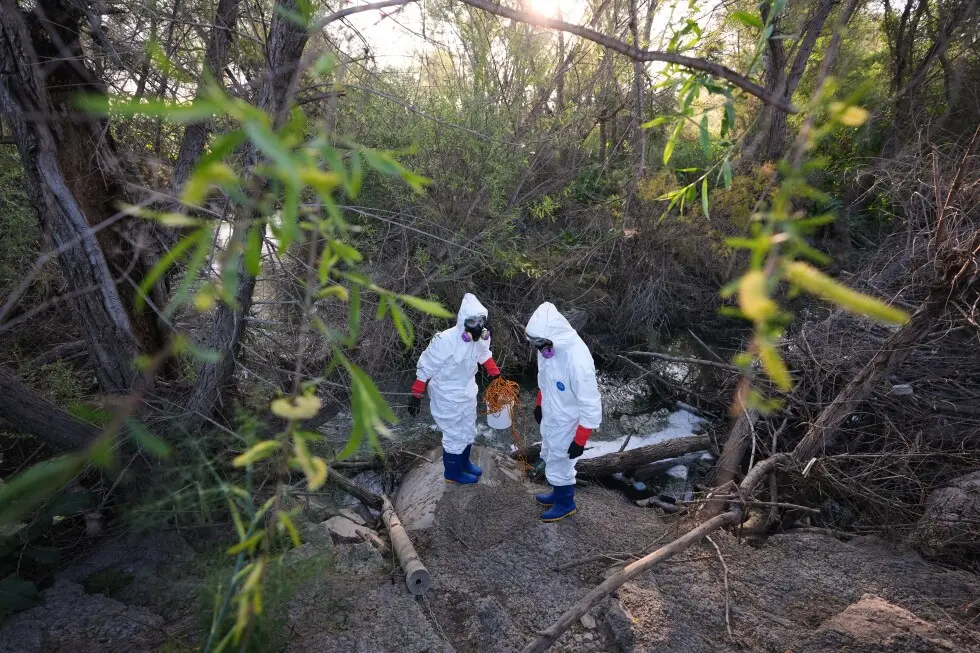
Trent Fry, right, and Leila El Masri handle a water sample of the Tijuana River, as part of a research team from the University of California, San Diego, Wednesday, March 11, 2026, in San Diego. (AP Photo/Gregory Bull)
Trent Fry, right, and Leila El Masri handle a water sample of the Tijuana River, as part of a research team from the University of California, San Diego, Wednesday, March 11, 2026, in San Diego. (AP Photo/Gregory Bull)
Justin Hamlin, left, and Maddie Tibayan, walk along the Imperial Beach pier after gathering a sample of seawater as part of a research team from the University of California, San Diego, Wednesday, March 11, 2026, in Imperial Beach, Calif. (AP Photo/Gregory Bull)
Justin Hamlin, left, and Maddie Tibayan, walk along the Imperial Beach pier after gathering a sample of seawater as part of a research team from the University of California, San Diego, Wednesday, March 11, 2026, in Imperial Beach, Calif. (AP Photo/Gregory Bull)
In 2024, a sampling by San Diego County and the CDC representing the roughly 40,000 households close to the Tijuana River found 71% could smell sewage inside their homes and 69% had a member get sick from being exposed.
Even at low levels, “you’re going to feel like it’s in your sinuses. You can’t get rid of the smell. It’s going to be a constant irritation,” said Ryan Sinclair, an associate professor of environmental microbiology at Loma Linda University School of Public Health.
The EPA said it is working with local and state officials to find ways to mitigate the smell.
San Diego County this year distributed over 10,000 air filters to homes. But the air remains a threat. The river’s foam can now be seen from space.
Surfers look on as Justin Hamlin, right, and Maddie Tibayan, gather a sample of seawater with a bucket off the Imperial Beach pier as part of a research team from the University of California, San Diego, Wednesday, March 11, 2026, in Imperial Beach, Calif. (AP Photo/Gregory Bull)
Surfers look on as Justin Hamlin, right, and Maddie Tibayan, gather a sample of seawater with a bucket off the Imperial Beach pier as part of a research team from the University of California, San Diego, Wednesday, March 11, 2026, in Imperial Beach, Calif. (AP Photo/Gregory Bull)
In September 2024, Kimberly Prather, a chemistry professor at the University of California, San Diego, and a team of researchers installed air monitors in the neighborhood where Egger lives.
What they found stunned them: The hydrogen sulfide concentrations were 4,500 times higher than typical urban levels and 150 times higher than California’s air standards when river flows peaked at night.
Many residents, like Egger, felt vindicated.
“They’d been being more or less gaslit and told, ‘There’s gas. It’s a nuisance. It smells, but it’s not bad,’” Prather said.
She said her researchers have since detected thousands of other gases coming from the river that don’t smell, “and many of them are more toxic.”
Trent Fry, part of a research team from the University of California, San Diego, takes a sample of seawater Wednesday, March 11, 2026, in Imperial Beach, Calif. (AP Photo/Gregory Bull)
Trent Fry, part of a research team from the University of California, San Diego, takes a sample of seawater Wednesday, March 11, 2026, in Imperial Beach, Calif. (AP Photo/Gregory Bull)
Egger said doctors have told him to move, though they have not given him a written diagnosis as suffering from hydrogen sulfide exposure.
But his family’s roots run deep. His wife grew up in Tijuana. His brother and his late brother’s family live in the neighboring houses on what was Egger Dairy. Nearby are the dilapidated milk barn and rusting farm equipment.
“This is where I’ve lived all my life, with my family, my parents, my grandparents,” he said. “This is home.”
Surfers pass under a wave alongside the Imperial Beach pier Wednesday, March 11, 2026, in Imperial Beach, Calif. (AP Photo/Gregory Bull)
Surfers pass under a wave alongside the Imperial Beach pier Wednesday, March 11, 2026, in Imperial Beach, Calif. (AP Photo/Gregory Bull)
When Egger was a boy, he swam in the river that ran only during the rainy season. Now mostly filled with sewage and industrial waste, it goes year-round. He says the river should be restored to its historical route, which is closer to the border and farther from most residences and schools. He believes then it would not pond, creating hot spots of hydrogen sulfide gas.
Less than half a mile from Egger’s home, the smell is overwhelming where the river shoots out of pipes after being forced briefly underground near Saturn Boulevard.
Scientists call it “the Saturn hot spot.” The stench permeates passing cars with the windows up, lingering inside for days.
Oscar Romo walks among debris that has been captured by a trash boom installed in the Tijuana River at the border near where the river enters the United States from Tijuana, Mexico, Wednesday, April 8, 2026, in San Diego, Calif. (AP Photo/Gregory Bull)
Oscar Romo walks among debris that has been captured by a trash boom installed in the Tijuana River at the border near where the river enters the United States from Tijuana, Mexico, Wednesday, April 8, 2026, in San Diego, Calif. (AP Photo/Gregory Bull)
Dr. Matthew Dickson and his wife, Dr. Kimberly Dickson, run a clinic about a mile from the hot spot. Many of their patients suffer from migraines, nausea, wheezing, eye infections and brain fog. Those with asthma say they use their inhalers more when the air reeks.
“They’d say, ‘You know, I feel better when it doesn’t smell outside,’” Dr. Kimberly Dickson said.
In August 2023, a tropical storm caused the river to overflow onto the streets. Within days, the doctors’ caseloads tripled.
Oscar Romo looks out over debris that has been captured by a trash boom installed in the Tijuana River at the border near where the river enters the United States from Tijuana, Mexico, Wednesday, April 8, 2026, in San Diego, Calif. (AP Photo/Gregory Bull)
Oscar Romo looks out over debris that has been captured by a trash boom installed in the Tijuana River at the border near where the river enters the United States from Tijuana, Mexico, Wednesday, April 8, 2026, in San Diego, Calif. (AP Photo/Gregory Bull)
Electronic health records confirmed what the doctors suspected. When the river flows have jumped, the number of patients they have treated for respiratory problems has increased by 130%, they said.
“Every day that this isn’t fixed,” Dr. Matthew Dickson said, “more people are getting sick.”
A man walks along the an aqueduct holding the Tijuana River as it arrives to the border and enters the United States, above, from Tijuana, Mexico, Wednesday, April 8, 2026. (AP Photo/Gregory Bull)
A man walks along the an aqueduct holding the Tijuana River as it arrives to the border and enters the United States, above, from Tijuana, Mexico, Wednesday, April 8, 2026. (AP Photo/Gregory Bull)
The Associated Press receives support from the Walton Family Foundation for coverage of water and environmental policy. The AP is solely responsible for all content. For all of AP’s environmental coverage, visit https://apnews.com/hub/climate-and-environment
Egger, 72, says he and his wife have frequent headaches and wake up congested and coughing up phlegm. Their home is outfitted with a hospital-grade filtration system that cycles the air every 15 minutes.
Despite those measures, “most nights we breathe in a horrible stench,” he said. “It’s awful.”
Since 2018, more than 100 billion gallons (378 billion liters) of raw sewage laden with industrial chemicals and trash have poured into the Tijuana River, according to the International Boundary and Water Commission. The river traverses land where three generations of the Egger family once raised dairy cows. The United States and Mexico signed an agreement last year to clean up the longstanding problem by upgrading wastewater plants to keep up with Tijuana’s population growth and industrial waste from factories, many owned by U.S. companies.
Steve Egger stands near what scientists call “the Saturn hot spot,” a section of the Tijuana River where the contaminated water splashes out of pipes and creates pools of foam near his home Friday, March 6, 2026, in San Diego. (AP Photo/Gregory Bull)
Steve Egger stands near what scientists call “the Saturn hot spot,” a section of the Tijuana River where the contaminated water splashes out of pipes and creates pools of foam near his home Friday, March 6, 2026, in San Diego. (AP Photo/Gregory Bull)
In the meantime, tens of thousands of people are being exposed to the sewage. Environmental Protection Agency Administrator Lee Zeldin said during a February visit to San Diego that it will take about two years to resolve one of the nation’s worst and longest-running environmental crises, which affects a largely poor, Latino population.
Raw sewage doesn’t just smell bad. It emits hydrogen sulfide, a toxic gas that can erode neurons in the nose and trigger asthma attacks. It can cause headaches, nausea, delirium, tremors, cough, shortness of breath, skin and eye irritation and even death, according to the Centers for Disease Control and Prevention. Its long-term health problems are only starting to be understood.
There is no federal safety standard for hydrogen sulfide except for workers at sites where the risk is extreme, such as wastewater treatment plants or manure pits. A few states set standards decades ago, but those are outdated. A California proposal would require the state’s 56-year-old standard reflect the health risks of the gas. In Texas, lawmakers are also considering updating its law.
“I think when you look back when the standard was first established and then it was reviewed, it was all about nuisance — basically it was all about odor,” said the California bill’s author, Democratic Sen. Steve Padilla, who represents the Tijuana River Valley. “I don’t think we had the understanding scientifically of what the health impacts were here, and now we do.”
Even if the bill passes, the new standard would likely not be developed until 2030.
A sign warns of sewage and chemical contaminated water along a beach Tuesday, March 10, 2026, in Coronado, Calif. (AP Photo/Gregory Bull)
A sign warns of sewage and chemical contaminated water along a beach Tuesday, March 10, 2026, in Coronado, Calif. (AP Photo/Gregory Bull)
A “Stop the Stink” sign is on Egger’s fence, part of a campaign that Citizens for Coastal Conservancy launched to demand officials clean up the cross-border sewage.
The 120-mile (195 km)-long river starts in the Mexican city of Tijuana, crosses into California and empties into the ocean. San Diego County beaches nearby have closed for years, and Navy SEALs who train in the water have fallen ill.
Just since January, the Tijuana River has carried 10 billion gallons (38 billion liters) of mostly raw sewage and industrial waste across the U.S. border, according to International Water and Boundary Commission data. By comparison, a massive pipe that ruptured in January sent 244 million gallons (924 million liters) of untreated sewage into the Potomac River, affecting affluent, largely white communities. That spill prompted federal intervention within weeks.
Trent Fry, right, and Leila El Masri handle a water sample of the Tijuana River, as part of a research team from the University of California, San Diego, Wednesday, March 11, 2026, in San Diego. (AP Photo/Gregory Bull)
Trent Fry, right, and Leila El Masri handle a water sample of the Tijuana River, as part of a research team from the University of California, San Diego, Wednesday, March 11, 2026, in San Diego. (AP Photo/Gregory Bull)
Justin Hamlin, left, and Maddie Tibayan, walk along the Imperial Beach pier after gathering a sample of seawater as part of a research team from the University of California, San Diego, Wednesday, March 11, 2026, in Imperial Beach, Calif. (AP Photo/Gregory Bull)
Justin Hamlin, left, and Maddie Tibayan, walk along the Imperial Beach pier after gathering a sample of seawater as part of a research team from the University of California, San Diego, Wednesday, March 11, 2026, in Imperial Beach, Calif. (AP Photo/Gregory Bull)
In 2024, a sampling by San Diego County and the CDC representing the roughly 40,000 households close to the Tijuana River found 71% could smell sewage inside their homes and 69% had a member get sick from being exposed.
Even at low levels, “you’re going to feel like it’s in your sinuses. You can’t get rid of the smell. It’s going to be a constant irritation,” said Ryan Sinclair, an associate professor of environmental microbiology at Loma Linda University School of Public Health.
The EPA said it is working with local and state officials to find ways to mitigate the smell.
San Diego County this year distributed over 10,000 air filters to homes. But the air remains a threat. The river’s foam can now be seen from space.
Surfers look on as Justin Hamlin, right, and Maddie Tibayan, gather a sample of seawater with a bucket off the Imperial Beach pier as part of a research team from the University of California, San Diego, Wednesday, March 11, 2026, in Imperial Beach, Calif. (AP Photo/Gregory Bull)
Surfers look on as Justin Hamlin, right, and Maddie Tibayan, gather a sample of seawater with a bucket off the Imperial Beach pier as part of a research team from the University of California, San Diego, Wednesday, March 11, 2026, in Imperial Beach, Calif. (AP Photo/Gregory Bull)
In September 2024, Kimberly Prather, a chemistry professor at the University of California, San Diego, and a team of researchers installed air monitors in the neighborhood where Egger lives.
What they found stunned them: The hydrogen sulfide concentrations were 4,500 times higher than typical urban levels and 150 times higher than California’s air standards when river flows peaked at night.
Many residents, like Egger, felt vindicated.
“They’d been being more or less gaslit and told, ‘There’s gas. It’s a nuisance. It smells, but it’s not bad,’” Prather said.
She said her researchers have since detected thousands of other gases coming from the river that don’t smell, “and many of them are more toxic.”
Trent Fry, part of a research team from the University of California, San Diego, takes a sample of seawater Wednesday, March 11, 2026, in Imperial Beach, Calif. (AP Photo/Gregory Bull)
Trent Fry, part of a research team from the University of California, San Diego, takes a sample of seawater Wednesday, March 11, 2026, in Imperial Beach, Calif. (AP Photo/Gregory Bull)
Egger said doctors have told him to move, though they have not given him a written diagnosis as suffering from hydrogen sulfide exposure.
But his family’s roots run deep. His wife grew up in Tijuana. His brother and his late brother’s family live in the neighboring houses on what was Egger Dairy. Nearby are the dilapidated milk barn and rusting farm equipment.
“This is where I’ve lived all my life, with my family, my parents, my grandparents,” he said. “This is home.”
Surfers pass under a wave alongside the Imperial Beach pier Wednesday, March 11, 2026, in Imperial Beach, Calif. (AP Photo/Gregory Bull)
Surfers pass under a wave alongside the Imperial Beach pier Wednesday, March 11, 2026, in Imperial Beach, Calif. (AP Photo/Gregory Bull)
When Egger was a boy, he swam in the river that ran only during the rainy season. Now mostly filled with sewage and industrial waste, it goes year-round. He says the river should be restored to its historical route, which is closer to the border and farther from most residences and schools. He believes then it would not pond, creating hot spots of hydrogen sulfide gas.
Less than half a mile from Egger’s home, the smell is overwhelming where the river shoots out of pipes after being forced briefly underground near Saturn Boulevard.
Scientists call it “the Saturn hot spot.” The stench permeates passing cars with the windows up, lingering inside for days.
Oscar Romo walks among debris that has been captured by a trash boom installed in the Tijuana River at the border near where the river enters the United States from Tijuana, Mexico, Wednesday, April 8, 2026, in San Diego, Calif. (AP Photo/Gregory Bull)
Oscar Romo walks among debris that has been captured by a trash boom installed in the Tijuana River at the border near where the river enters the United States from Tijuana, Mexico, Wednesday, April 8, 2026, in San Diego, Calif. (AP Photo/Gregory Bull)
Dr. Matthew Dickson and his wife, Dr. Kimberly Dickson, run a clinic about a mile from the hot spot. Many of their patients suffer from migraines, nausea, wheezing, eye infections and brain fog. Those with asthma say they use their inhalers more when the air reeks.
“They’d say, ‘You know, I feel better when it doesn’t smell outside,’” Dr. Kimberly Dickson said.
In August 2023, a tropical storm caused the river to overflow onto the streets. Within days, the doctors’ caseloads tripled.
Oscar Romo looks out over debris that has been captured by a trash boom installed in the Tijuana River at the border near where the river enters the United States from Tijuana, Mexico, Wednesday, April 8, 2026, in San Diego, Calif. (AP Photo/Gregory Bull)
Oscar Romo looks out over debris that has been captured by a trash boom installed in the Tijuana River at the border near where the river enters the United States from Tijuana, Mexico, Wednesday, April 8, 2026, in San Diego, Calif. (AP Photo/Gregory Bull)
Electronic health records confirmed what the doctors suspected. When the river flows have jumped, the number of patients they have treated for respiratory problems has increased by 130%, they said.
“Every day that this isn’t fixed,” Dr. Matthew Dickson said, “more people are getting sick.”
A man walks along the an aqueduct holding the Tijuana River as it arrives to the border and enters the United States, above, from Tijuana, Mexico, Wednesday, April 8, 2026. (AP Photo/Gregory Bull)
A man walks along the an aqueduct holding the Tijuana River as it arrives to the border and enters the United States, above, from Tijuana, Mexico, Wednesday, April 8, 2026. (AP Photo/Gregory Bull)
The Associated Press receives support from the Walton Family Foundation for coverage of water and environmental policy. The AP is solely responsible for all content. For all of AP’s environmental coverage, visit https://apnews.com/hub/climate-and-environment