위대한 녹색 장벽: 세계에서 가장 야심 찬 생태 프로젝트 중 하나, 효과가 있을까?
The Great Green Wall's one of the world's most ambitious eco-projects. Is it working?
NPR
Julie Bourdin
EN
2026-04-11 20:07
Translated
글로벌 규모의 수십억 달러 규모 사업이다. 목표는 약 2억 5천만 에이커를 재녹화하고, 4,000마일의 나무를 심으며, 농부들을 돕고, 일자리를 창출하고, 탄소를 격리하는 것이다.
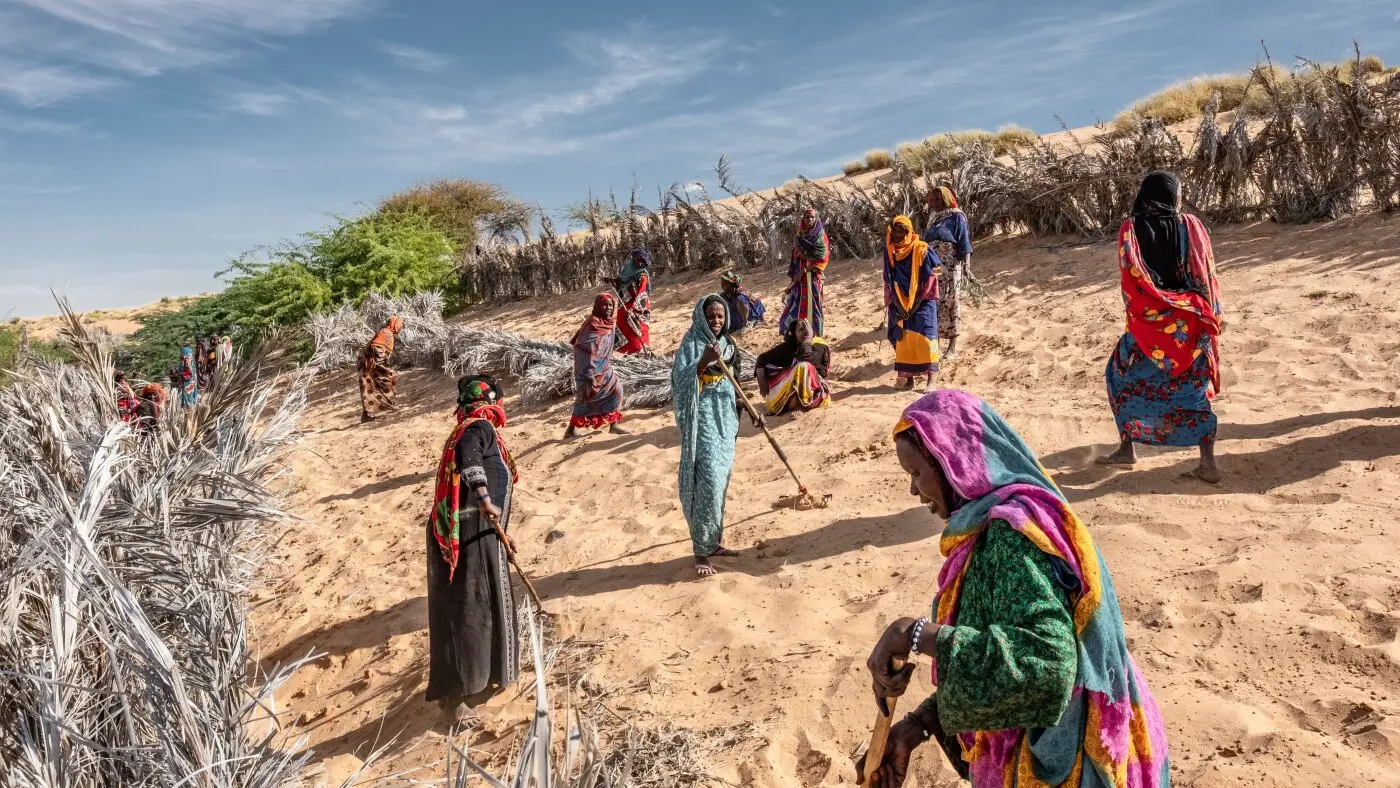
차드 카우 마을 외곽의 오아시스를 위협하는 모래 언덕의 이동을 막기 위해 여성들이 바리케이드를 설치한다. 오아시스는 그들의 유일한 농경지 공급원이지만, 지역의 오아시스들은 더 높은 기온과 강한 바람으로 인해 꾸준히 축소되고 있다고 마을 어른들은 말한다. 모래 언덕 고정은 위대한 녹색 장벽 이니셔티브로 알려진 더 넓은 농업 지원 개입의 일부다.
지부티 남부 쿠르티말레 마을 근처의 건조한 계곡에서 낡은 체인링크 펜스가 압디 겔레의 농장이 한때였던 경계를 표시한다. 그 안에는 녹색이 전혀 보이지 않는다. 부러진 관개 파이프 길이들이 먼지에 흩어져 있다. 황폐한 기상 관측소가 케이블 더미 속 모서리에 서 있다. 곳곳에 몇 년 동안 물을 본 적 없는 수도꼭지들이 땅에서 나와 있다.
이 황량한 2.5에이커의 땅이 한때 세계에서 가장 야심 찬 환경 프로젝트 중 하나인 아프리카의 위대한 녹색 장벽의 작은 한 부분이 될 예정이었다는 사실을 암시하는 것은 거의 없다.
이 수십억 달러 규모의 프로젝트는 2007년 아프리카 연합에 의해 시작되었다. 계획은 아프리카 전역에 걸쳐 있는 4,350마일 길이와 10마일 너비의 나무 "벽"을 심어 사하라 사막 남쪽의 건조 지역인 사헬의 사막화에 대항하는 것이었다.
장벽의 비전은 무한했으며, 그 지지자들은 그것을 "새로운 세계 경이"라고 불렀다. 그것은 세네갈에서 지부티까지 11개 국가에 걸쳐 거의 2억 5천만 에이커의 토지를 재녹화하고, 이렇게 하면서 2억 5천만 톤의 탄소를 격리하고, 1천만 명을 위해 "녹색 일자리"를 제공하며, 지역 전역의 빈곤, 식량 불안, 갈등을 완화할 것이었다.
장벽을 완성하기 위해 필요한 것으로 유엔이 추정한 가격표는 역시 거대했다: 330억 달러. 11개 국가 각각에서, 국가 기관이나 전담 장관 부서가 프로젝트를 실행하고 추적하기 위해 설립되었으며, 모리타니에 본부를 두고 있는 범아프리카 위대한 녹색 장벽 기구라는 조정 기구가 있었다. 국제 기구들 — 유엔 기구들, 세계은행, 아프리카 개발 은행, 유럽 연합, 녹색 기후 기금, 글로벌 환경 기구 등 — 이 수십억 달러를 약속했다.
18년 후, 막대한 금액이 지출되었지만, 계획된 장벽의 대부분은 압디 겔레의 황량한 들판보다 더 초록색이 되지 않았다. 세계에서 가장 야심 찬 생태적 사업 중 하나로 시작된 것이 많은 면에서 불충분하게 계획된 프로젝트, 지역 참여 부족, 불투명한 자금 조달의 미로에 얽혀 있는 경고의 이야기로 변질되었다.
겔레는 희망과 실망 모두에 대해 증언할 수 있다. 2014년 지부티 정부가 그의 마을에 와서 물 시스템을 설치하여 이 건조한 땅에 생명을 불어넣고 공동체를 위한 농장으로 바꿀 것이라고 말했을 때, 20명의 자녀를 둔 48세의 아버지는 기뻤다. 그 지역에는 일자리가 거의 없었고 그의 목축민으로서의 삶, 가축을 한 곳에서 다른 곳으로 방목하는 것은 힘들었다. 족히 먹을 것을 얻는 것은 투쟁이었다. 농사는 안전망이 될 것이었다.
글로벌 환경 기구(GEF)의 자금 지원을 받아 지부티 정부는 지하수에 접근하기 위해 관정 굴착에 150,000달러를 쓰고 큰 콘크리트 물 탱크 시리즈를 채울 태양광 펌프로 장착하는 데 100,000달러를 더 썼다. 그들은 존재하는 적은 지표수를 포집하기 위해 작은 개울을 댐으로 조성하는 데 추가로 50,000달러를 썼다.
시스템이 가동되자 새로운 농장이 번성했다. 겔레와 그의 동료 마을 주민들은 토마토, 콩류, 과일을 재배했다.
"나는 내 가족을 부양할 수 있었다," 겔레가 말한다. "우리는 음식이 있었고, 그것이 우리 공동체에 안정을 주었다." 쿠르티말레의 농부들은 심지어 잉여물을 팔아 약간의 돈을 벌었다.
그러나 몇 년 후, 물 공급이 줄어들기 시작했다. 댐이 지속적인 가뭄으로 좌절되었고, 누수가 생겼다. 지하수를 추출하는 태양광 펌프가 고장 났다. 관정이 새로운 정착민들을 계곡으로 가져왔고, 남은 공급에 대한 부담을 증가시킨 것도 도움이 되지 않았다. 결국 물이 완전히 말랐다.
오늘날, 정부가 지불한 물 트럭이 여전히 수도에서 주 1회 탱크를 채우러 오지만, 펌핑된 공급 없이는 가축에게도 거의 충분하지 않으며, 겔레의 들판을 관개할 여력은 더욱이다. 작물은 시들어서 죽었다. 곧이어 농장은 다시 사막으로 돌아갔다.
캐멜들이 한때 공동 농장을 관개했던 물 탱크에서 물을 마신다. 쿠르테말레의 지부티. 국가의 위대한 녹색 장벽 부서가 물을 탱크로 가져오기 위해 관정과 펌프를 설치했고, 농장이 번성하도록 허용했다. 하지만 펌프가 고장 난 후 아무도 수리하러 오지 않았다. 토지는 빠르게 사막으로 되돌아갔다.
지난 봄 월요일, 겔레는 한때 그의 들판에 물을 공급했던 물 탱크에서 목을 축이는 염소, 당나귀, 낙타의 행렬을 보며 서 있었다.
"하루의 음식이 있다면 무슨 소용인가," 그가 그런 단기 프로젝트의 허무함을 생각하며 말했다. "내일 음식이 없으면?"
겔레 같은 사람들은 세계에서 기후 변화에 가장 취약한 사람들 중 일부다. 사헬의 기온이 지구 평균보다 1.5배 더 빠르게 상승하고 있고 — 지부티는 이미 여름에 평균 화씨 106도에 도달한다 — 인구도 세계 어느 곳보다 더 빠르게 증가하고 있다. 유엔에 따르면, 현재 이 지역의 1억 3,500만 명 이상이 황폐화된 토지에 의존하여 생존한다. 식량 불안, 이동, 테러, 자원 분쟁이 모두 증가하고 있다.
소년들이 차드 카넴 성의 마오 마을 가장자리에 서 있다. 여기서 사막화와 토지 황폐화는 지역민들이 음식을 재배할 수 있는 능력에 대한 증가하는 위협이다. 약 1억 3,500만 명이 황폐화된 토지에 의존한다.
이러한 거대한 도전에 직면하여, 장벽은 생명줄이 되기로 되어 있었다. 처음에 2007년, 이 이니셔티브는 문자 그대로의 녹색 벽의 비전을 완성하기 위해 엄청난 수의 나무를 심기로 시작했다. 절대 다수는 죽었으며, 종종 그들이 잘못된 종이었기 때문이고 충분한 물이 없었기 때문이며 — 그리고 세계에서 가장 가난한 지역 중 하나인 지역 공동체들이 그들을 살리도록 할 거의 인센티브를 받지 못했기 때문이었다.
"과학적으로, 그것은 재앙적인 아이디어였다," 23년 동안 세계 농임학 센터를 이끈 농학자 데니스 개리티가 말한다. 그에 따르면, 많은 연구들이 이미 대규모 나무 심기 이니셔티브들, 특히 저강수 지역에서, 일반적으로 "계속해서 절대적인 재앙적 실패"로 이어졌다는 것을 보여주었다.
세네갈은 프로젝트의 주도 국가 중 하나였고 그 대표 사례였다. 관리들은 2007년 이후 약 850,000헥타르의 토지를 복원했다고 주장하며, 대략 델라웨어 주의 크기다. 프로젝트의 발상지는 국가 북부 페를로 계곡의 작은 마을 비두 티엔골리였다: 주로 목축민, 유목민들이 거주하는 건조 사바나.
"이것이 모두 시작된 곳이다," 비두 티엔골리 주변의 위대한 녹색 장벽 프로젝트를 감독하는 아마두 바지 상사가 말하며, 2008년에 심어진 1,700에이커의 소수한 아카시아 나무 재배지를 통해 우리를 안내한다.
아마두 바지 상사, 비두 티엔골리 지역의 위대한 녹색 장벽 노력을 이끄는 사람, 세네갈, 마을 외부의 프로젝트로부터 혜택을 받기로 되어 있었던 농장에서 묘목을 관리한다. 처음에는 실패했지만 모로코 인산염 채광 회사의 자금 지원으로 부활했다.
많은 심은 지 몇 년 이내에 10,000그루의 묘목이 죽었다고 바지는 인정하지만, "이 지역에서 우리가 받는 강우량을 고려할 때, 이 정도 식생을 얻는 것은 이미 좋다."
하지만 위에서 보면, 재산림 지역은 주변의 건조하고 아카시아로 가득한 풍경과 구별하기 어렵다. "차이가 없다," 2025년 1월 비두 티엔골리 주변 사이트를 둘러본 밀라노 대학의 지리학자이자 교수인 발레리오 비니가 말한다. "위대한 녹색 장벽은 존재하지 않는다."
차드 카넴 성 바르카드루수 오아시스 외부에 위대한 녹색 장벽 이니셔티브를 지원하기 위해 설치된 관정. 물은 오아시스의 300명의 농부들을 지원한다.
2025년 10월 토지 사용 정책 저널에 발표된 연구는 재산림 프로젝트가 실제로 얼마나 잘 작동했는지를 확인한다. 거의 45,000에이커를 다루는 세네갈의 36개 위대한 녹색 장벽 구획 중, 연구원들은 강수량으로 인해 자연적으로 그럴 것보다 더 초록색인 것은 단 하나뿐이라는 것을 발견했다. 장벽의 생태적 이점은 "최소에서 무에 가깝다,"고 그들은 썼다. 사회적 영향은 "주기적이고 단기적" — 주로 묘목을 준비하거나 작은 구획을 농사하는 단기 일자리로 제한되었다.
"그것은 아주 강력하고 설득력 있는 이야기이지만, 그것이 전부다," 저자 중 한 명인 환경 연구원 애너 주가 말한다. "그들은 사막에 나무를 심어 죽도록 하는 돈을 낭비하고 있을 뿐이다."
몇 년 안에, 위대한 녹색 장벽은 더 비유적인 "장벽"을 향해 초점을 바꿨다. 나무 심기는 여전히 중요한 구성 요소였지만, 비전은 더 넓어졌고, 쿠르티말레 주변의 산들이나 페를로 계곡처럼 건조하고 황폐화된 토지를 경작하는 데 더 많은 초점을 맞추었다. 그러나 문제에 계속 시달렸다. 2020년, 프로젝트 13년 후, 유엔 보고서는 토지의 단 4%만이 "복원되었다"는 것을 발견했다.
세네갈, 차드, 지부티의 위대한 녹색 장벽을 따라 우리는 15개의 프로젝트 사이트를 방문했다. 어떤 것은 다른 것보다 더 성공적이었다. 몇 가지 작은 녹색 농장들은 지역 공동체에 신선한 채소를 제공했으며, 다른 이니셔티브들은 훈련과 씨앗으로 지역 생산자들을 지원했다. 하지만 방문한 대부분의 사이트는 먼지로 돌아갔거나 시간이 지나도 지속될 수 있다는 신호를 보이지 않았다.
2021년, 진전의 부족을 인식한 국제 공여자들은 장벽의 완성을 위해 추가로 190억 달러를 약속했다. 녹색 기후 기금만 지난 10년 동안 144억 달러를 쏟아 부었다고 대변인 사이먼 윌슨이 말한다. EU는 2021년에서 2023년 사이 단 3년 만에 17억 8천만 달러 이상을 기여했다 — 정보자유 요청을 통해 얻은 정보. 세계은행, 아프리카 개발 은행, GEF, 유엔 등 다른 공여자들을 포함한 수십억 달러를 더 기여했다.
위대한 녹색 장벽을 지원하는 너무 많은 국제 공여자들과 수백 개의 크고 작은 조직들이 구현에 관여하고 있어서, 모든 돈이 어디로 갔는지 추적하는 것은 거의 불가능하다. 2023년, 약속된 190억 달러 중 80%가 "프로그래밍되었지만" 단 13%만이 지출되었다. 장벽을 따라 있는 국가들에서, 진행 상황을 관리하고 감독할 책임이 있는 국가 기구들은 지출된 돈의 일부만 받았다고 말한다.
NPR로부터 받은 질문에 대한 응답에서 범아프리카 위대한 녹색 장벽 기구는 이니셔티브의 주요 도전 과제들이 "야심에 맞는 자금 조달 문제, 조정, 국가 기술 역량, 상황의 이질성, 특정 국가의 공공 보안, 국가 수준에서의 자금 조달 조정"이라고 말했다.
"강화된 옹호 노력에도 불구하고 … 그리고 상당한 자금 지원 발표에도 불구하고, 동원된 자금 수준은 계획된 필요성보다 훨씬 낮게 유지되었다,"고 기구는 말했다.
사헬은 반복되는 정치적 불안정성과 봉기로 인해 아프리카의 "쿠데타 벨트"로 불리며, 여러 위대한 녹색 장벽 국가들도 이니셔티브가 시작된 이후 주요 정치적 격변을 겪었으며, 환경 우선순위를 옆으로 밀어냈다.
하지만 세네갈이나 지부티 같은 상대적으로 안정적인 국가에서도, 압디 겔레의 농장 같은 프로젝트들은 부양되기 위해 고심했다.
지부티 시티의 한 호텔에서 만난 국가의 위대한 녹색 장벽 부서 부서장 압둘파타 아랍은 쿠르티말레에서 무엇이 잘못되었는지에 대해 빛을 비췄다. 프로젝트는 겔레의 농장에 관개 시스템을 구축하기에 충분한 국제 자금만을 받았다고 그는 설명한다. 하지만 댐과 태양광 펌프가 고장 난 후 고칠 돈은 없었다.
아랍은 돈이 가용해지면 프로젝트를 부활시킬 수 있기를 희망하지만, 현재로서 그의 부서는 자금이 부족하다. 그들이 운영을 시작한 10년 동안, 그들은 단 3천만 달러를 받았다고 그는 말한다.
"그것은 우리가 예상했던 것의 10% 미만이다,"고 그가 말한다. "이 제한된 금액으로 우리 목표를 달성하려고 하는 것은 쉽지 않다."
쿠르티말레 프로젝트의 실패로 이어진 문제들 — 불충분한 계획, 다양한 이해관계자들 간의 조정 부족, 불충분한 자금 — 은 장벽의 길이를 따라 무수히 많이 반복되었다.
"지역 차원에서 심각한 조정 문제가 있기 때문에 당신이 땅에서 보는 결과가 실질적이지 못한 이유다,"고 유엔의 사막화 방지 협약(UNCCD)의 2021년에 시작된 프로젝트의 구현과 거버넌스를 지원하고 자금 조달을 추적하기 위한 도구인 위대한 녹색 장벽 액셀러레이터를 이끄는 질 웨드라오고가 인정한다.
국가 기구들은 "위대한 녹색 장벽 프로젝트의 구현에 체계적으로 관여하지 않으며" 자금이 대신 재무부 또는 다른 정부 기관으로 직접 갈 수 있다고 그가 설명한다.
"우리가 무엇을 하고 있는지 알지 못하는 수많은 행위자들이 있다,"고 세네갈의 위대한 녹색 장벽 기구의 실질적 부서장 아미나타 디알로가 확인한다. "진정으로 땅에서 무엇이 하고 있는지 모든 것을 평가하기 위해 모든 이 자금 조달과 모든 이 프로젝트들을 추적하는 것은 매우 어렵다."
하지만 웨드라오고는 희망의 이유가 있다고 믿는다.
지부티 남부 쿠르티말레 마을 근처의 건조한 계곡에서 낡은 체인링크 펜스가 압디 겔레의 농장이 한때였던 경계를 표시한다. 그 안에는 녹색이 전혀 보이지 않는다. 부러진 관개 파이프 길이들이 먼지에 흩어져 있다. 황폐한 기상 관측소가 케이블 더미 속 모서리에 서 있다. 곳곳에 몇 년 동안 물을 본 적 없는 수도꼭지들이 땅에서 나와 있다.
이 황량한 2.5에이커의 땅이 한때 세계에서 가장 야심 찬 환경 프로젝트 중 하나인 아프리카의 위대한 녹색 장벽의 작은 한 부분이 될 예정이었다는 사실을 암시하는 것은 거의 없다.
이 수십억 달러 규모의 프로젝트는 2007년 아프리카 연합에 의해 시작되었다. 계획은 아프리카 전역에 걸쳐 있는 4,350마일 길이와 10마일 너비의 나무 "벽"을 심어 사하라 사막 남쪽의 건조 지역인 사헬의 사막화에 대항하는 것이었다.
장벽의 비전은 무한했으며, 그 지지자들은 그것을 "새로운 세계 경이"라고 불렀다. 그것은 세네갈에서 지부티까지 11개 국가에 걸쳐 거의 2억 5천만 에이커의 토지를 재녹화하고, 이렇게 하면서 2억 5천만 톤의 탄소를 격리하고, 1천만 명을 위해 "녹색 일자리"를 제공하며, 지역 전역의 빈곤, 식량 불안, 갈등을 완화할 것이었다.
장벽을 완성하기 위해 필요한 것으로 유엔이 추정한 가격표는 역시 거대했다: 330억 달러. 11개 국가 각각에서, 국가 기관이나 전담 장관 부서가 프로젝트를 실행하고 추적하기 위해 설립되었으며, 모리타니에 본부를 두고 있는 범아프리카 위대한 녹색 장벽 기구라는 조정 기구가 있었다. 국제 기구들 — 유엔 기구들, 세계은행, 아프리카 개발 은행, 유럽 연합, 녹색 기후 기금, 글로벌 환경 기구 등 — 이 수십억 달러를 약속했다.
18년 후, 막대한 금액이 지출되었지만, 계획된 장벽의 대부분은 압디 겔레의 황량한 들판보다 더 초록색이 되지 않았다. 세계에서 가장 야심 찬 생태적 사업 중 하나로 시작된 것이 많은 면에서 불충분하게 계획된 프로젝트, 지역 참여 부족, 불투명한 자금 조달의 미로에 얽혀 있는 경고의 이야기로 변질되었다.
겔레는 희망과 실망 모두에 대해 증언할 수 있다. 2014년 지부티 정부가 그의 마을에 와서 물 시스템을 설치하여 이 건조한 땅에 생명을 불어넣고 공동체를 위한 농장으로 바꿀 것이라고 말했을 때, 20명의 자녀를 둔 48세의 아버지는 기뻤다. 그 지역에는 일자리가 거의 없었고 그의 목축민으로서의 삶, 가축을 한 곳에서 다른 곳으로 방목하는 것은 힘들었다. 족히 먹을 것을 얻는 것은 투쟁이었다. 농사는 안전망이 될 것이었다.
글로벌 환경 기구(GEF)의 자금 지원을 받아 지부티 정부는 지하수에 접근하기 위해 관정 굴착에 150,000달러를 쓰고 큰 콘크리트 물 탱크 시리즈를 채울 태양광 펌프로 장착하는 데 100,000달러를 더 썼다. 그들은 존재하는 적은 지표수를 포집하기 위해 작은 개울을 댐으로 조성하는 데 추가로 50,000달러를 썼다.
시스템이 가동되자 새로운 농장이 번성했다. 겔레와 그의 동료 마을 주민들은 토마토, 콩류, 과일을 재배했다.
"나는 내 가족을 부양할 수 있었다," 겔레가 말한다. "우리는 음식이 있었고, 그것이 우리 공동체에 안정을 주었다." 쿠르티말레의 농부들은 심지어 잉여물을 팔아 약간의 돈을 벌었다.
그러나 몇 년 후, 물 공급이 줄어들기 시작했다. 댐이 지속적인 가뭄으로 좌절되었고, 누수가 생겼다. 지하수를 추출하는 태양광 펌프가 고장 났다. 관정이 새로운 정착민들을 계곡으로 가져왔고, 남은 공급에 대한 부담을 증가시킨 것도 도움이 되지 않았다. 결국 물이 완전히 말랐다.
오늘날, 정부가 지불한 물 트럭이 여전히 수도에서 주 1회 탱크를 채우러 오지만, 펌핑된 공급 없이는 가축에게도 거의 충분하지 않으며, 겔레의 들판을 관개할 여력은 더욱이다. 작물은 시들어서 죽었다. 곧이어 농장은 다시 사막으로 돌아갔다.
캐멜들이 한때 공동 농장을 관개했던 물 탱크에서 물을 마신다. 쿠르테말레의 지부티. 국가의 위대한 녹색 장벽 부서가 물을 탱크로 가져오기 위해 관정과 펌프를 설치했고, 농장이 번성하도록 허용했다. 하지만 펌프가 고장 난 후 아무도 수리하러 오지 않았다. 토지는 빠르게 사막으로 되돌아갔다.
지난 봄 월요일, 겔레는 한때 그의 들판에 물을 공급했던 물 탱크에서 목을 축이는 염소, 당나귀, 낙타의 행렬을 보며 서 있었다.
"하루의 음식이 있다면 무슨 소용인가," 그가 그런 단기 프로젝트의 허무함을 생각하며 말했다. "내일 음식이 없으면?"
겔레 같은 사람들은 세계에서 기후 변화에 가장 취약한 사람들 중 일부다. 사헬의 기온이 지구 평균보다 1.5배 더 빠르게 상승하고 있고 — 지부티는 이미 여름에 평균 화씨 106도에 도달한다 — 인구도 세계 어느 곳보다 더 빠르게 증가하고 있다. 유엔에 따르면, 현재 이 지역의 1억 3,500만 명 이상이 황폐화된 토지에 의존하여 생존한다. 식량 불안, 이동, 테러, 자원 분쟁이 모두 증가하고 있다.
소년들이 차드 카넴 성의 마오 마을 가장자리에 서 있다. 여기서 사막화와 토지 황폐화는 지역민들이 음식을 재배할 수 있는 능력에 대한 증가하는 위협이다. 약 1억 3,500만 명이 황폐화된 토지에 의존한다.
이러한 거대한 도전에 직면하여, 장벽은 생명줄이 되기로 되어 있었다. 처음에 2007년, 이 이니셔티브는 문자 그대로의 녹색 벽의 비전을 완성하기 위해 엄청난 수의 나무를 심기로 시작했다. 절대 다수는 죽었으며, 종종 그들이 잘못된 종이었기 때문이고 충분한 물이 없었기 때문이며 — 그리고 세계에서 가장 가난한 지역 중 하나인 지역 공동체들이 그들을 살리도록 할 거의 인센티브를 받지 못했기 때문이었다.
"과학적으로, 그것은 재앙적인 아이디어였다," 23년 동안 세계 농임학 센터를 이끈 농학자 데니스 개리티가 말한다. 그에 따르면, 많은 연구들이 이미 대규모 나무 심기 이니셔티브들, 특히 저강수 지역에서, 일반적으로 "계속해서 절대적인 재앙적 실패"로 이어졌다는 것을 보여주었다.
세네갈은 프로젝트의 주도 국가 중 하나였고 그 대표 사례였다. 관리들은 2007년 이후 약 850,000헥타르의 토지를 복원했다고 주장하며, 대략 델라웨어 주의 크기다. 프로젝트의 발상지는 국가 북부 페를로 계곡의 작은 마을 비두 티엔골리였다: 주로 목축민, 유목민들이 거주하는 건조 사바나.
"이것이 모두 시작된 곳이다," 비두 티엔골리 주변의 위대한 녹색 장벽 프로젝트를 감독하는 아마두 바지 상사가 말하며, 2008년에 심어진 1,700에이커의 소수한 아카시아 나무 재배지를 통해 우리를 안내한다.
아마두 바지 상사, 비두 티엔골리 지역의 위대한 녹색 장벽 노력을 이끄는 사람, 세네갈, 마을 외부의 프로젝트로부터 혜택을 받기로 되어 있었던 농장에서 묘목을 관리한다. 처음에는 실패했지만 모로코 인산염 채광 회사의 자금 지원으로 부활했다.
많은 심은 지 몇 년 이내에 10,000그루의 묘목이 죽었다고 바지는 인정하지만, "이 지역에서 우리가 받는 강우량을 고려할 때, 이 정도 식생을 얻는 것은 이미 좋다."
하지만 위에서 보면, 재산림 지역은 주변의 건조하고 아카시아로 가득한 풍경과 구별하기 어렵다. "차이가 없다," 2025년 1월 비두 티엔골리 주변 사이트를 둘러본 밀라노 대학의 지리학자이자 교수인 발레리오 비니가 말한다. "위대한 녹색 장벽은 존재하지 않는다."
차드 카넴 성 바르카드루수 오아시스 외부에 위대한 녹색 장벽 이니셔티브를 지원하기 위해 설치된 관정. 물은 오아시스의 300명의 농부들을 지원한다.
2025년 10월 토지 사용 정책 저널에 발표된 연구는 재산림 프로젝트가 실제로 얼마나 잘 작동했는지를 확인한다. 거의 45,000에이커를 다루는 세네갈의 36개 위대한 녹색 장벽 구획 중, 연구원들은 강수량으로 인해 자연적으로 그럴 것보다 더 초록색인 것은 단 하나뿐이라는 것을 발견했다. 장벽의 생태적 이점은 "최소에서 무에 가깝다,"고 그들은 썼다. 사회적 영향은 "주기적이고 단기적" — 주로 묘목을 준비하거나 작은 구획을 농사하는 단기 일자리로 제한되었다.
"그것은 아주 강력하고 설득력 있는 이야기이지만, 그것이 전부다," 저자 중 한 명인 환경 연구원 애너 주가 말한다. "그들은 사막에 나무를 심어 죽도록 하는 돈을 낭비하고 있을 뿐이다."
몇 년 안에, 위대한 녹색 장벽은 더 비유적인 "장벽"을 향해 초점을 바꿨다. 나무 심기는 여전히 중요한 구성 요소였지만, 비전은 더 넓어졌고, 쿠르티말레 주변의 산들이나 페를로 계곡처럼 건조하고 황폐화된 토지를 경작하는 데 더 많은 초점을 맞추었다. 그러나 문제에 계속 시달렸다. 2020년, 프로젝트 13년 후, 유엔 보고서는 토지의 단 4%만이 "복원되었다"는 것을 발견했다.
세네갈, 차드, 지부티의 위대한 녹색 장벽을 따라 우리는 15개의 프로젝트 사이트를 방문했다. 어떤 것은 다른 것보다 더 성공적이었다. 몇 가지 작은 녹색 농장들은 지역 공동체에 신선한 채소를 제공했으며, 다른 이니셔티브들은 훈련과 씨앗으로 지역 생산자들을 지원했다. 하지만 방문한 대부분의 사이트는 먼지로 돌아갔거나 시간이 지나도 지속될 수 있다는 신호를 보이지 않았다.
2021년, 진전의 부족을 인식한 국제 공여자들은 장벽의 완성을 위해 추가로 190억 달러를 약속했다. 녹색 기후 기금만 지난 10년 동안 144억 달러를 쏟아 부었다고 대변인 사이먼 윌슨이 말한다. EU는 2021년에서 2023년 사이 단 3년 만에 17억 8천만 달러 이상을 기여했다 — 정보자유 요청을 통해 얻은 정보. 세계은행, 아프리카 개발 은행, GEF, 유엔 등 다른 공여자들을 포함한 수십억 달러를 더 기여했다.
위대한 녹색 장벽을 지원하는 너무 많은 국제 공여자들과 수백 개의 크고 작은 조직들이 구현에 관여하고 있어서, 모든 돈이 어디로 갔는지 추적하는 것은 거의 불가능하다. 2023년, 약속된 190억 달러 중 80%가 "프로그래밍되었지만" 단 13%만이 지출되었다. 장벽을 따라 있는 국가들에서, 진행 상황을 관리하고 감독할 책임이 있는 국가 기구들은 지출된 돈의 일부만 받았다고 말한다.
NPR로부터 받은 질문에 대한 응답에서 범아프리카 위대한 녹색 장벽 기구는 이니셔티브의 주요 도전 과제들이 "야심에 맞는 자금 조달 문제, 조정, 국가 기술 역량, 상황의 이질성, 특정 국가의 공공 보안, 국가 수준에서의 자금 조달 조정"이라고 말했다.
"강화된 옹호 노력에도 불구하고 … 그리고 상당한 자금 지원 발표에도 불구하고, 동원된 자금 수준은 계획된 필요성보다 훨씬 낮게 유지되었다,"고 기구는 말했다.
사헬은 반복되는 정치적 불안정성과 봉기로 인해 아프리카의 "쿠데타 벨트"로 불리며, 여러 위대한 녹색 장벽 국가들도 이니셔티브가 시작된 이후 주요 정치적 격변을 겪었으며, 환경 우선순위를 옆으로 밀어냈다.
하지만 세네갈이나 지부티 같은 상대적으로 안정적인 국가에서도, 압디 겔레의 농장 같은 프로젝트들은 부양되기 위해 고심했다.
지부티 시티의 한 호텔에서 만난 국가의 위대한 녹색 장벽 부서 부서장 압둘파타 아랍은 쿠르티말레에서 무엇이 잘못되었는지에 대해 빛을 비췄다. 프로젝트는 겔레의 농장에 관개 시스템을 구축하기에 충분한 국제 자금만을 받았다고 그는 설명한다. 하지만 댐과 태양광 펌프가 고장 난 후 고칠 돈은 없었다.
아랍은 돈이 가용해지면 프로젝트를 부활시킬 수 있기를 희망하지만, 현재로서 그의 부서는 자금이 부족하다. 그들이 운영을 시작한 10년 동안, 그들은 단 3천만 달러를 받았다고 그는 말한다.
"그것은 우리가 예상했던 것의 10% 미만이다,"고 그가 말한다. "이 제한된 금액으로 우리 목표를 달성하려고 하는 것은 쉽지 않다."
쿠르티말레 프로젝트의 실패로 이어진 문제들 — 불충분한 계획, 다양한 이해관계자들 간의 조정 부족, 불충분한 자금 — 은 장벽의 길이를 따라 무수히 많이 반복되었다.
"지역 차원에서 심각한 조정 문제가 있기 때문에 당신이 땅에서 보는 결과가 실질적이지 못한 이유다,"고 유엔의 사막화 방지 협약(UNCCD)의 2021년에 시작된 프로젝트의 구현과 거버넌스를 지원하고 자금 조달을 추적하기 위한 도구인 위대한 녹색 장벽 액셀러레이터를 이끄는 질 웨드라오고가 인정한다.
국가 기구들은 "위대한 녹색 장벽 프로젝트의 구현에 체계적으로 관여하지 않으며" 자금이 대신 재무부 또는 다른 정부 기관으로 직접 갈 수 있다고 그가 설명한다.
"우리가 무엇을 하고 있는지 알지 못하는 수많은 행위자들이 있다,"고 세네갈의 위대한 녹색 장벽 기구의 실질적 부서장 아미나타 디알로가 확인한다. "진정으로 땅에서 무엇이 하고 있는지 모든 것을 평가하기 위해 모든 이 자금 조달과 모든 이 프로젝트들을 추적하는 것은 매우 어렵다."
하지만 웨드라오고는 희망의 이유가 있다고 믿는다.
처리 완료 273 tokens · $0.0007
기사 수집 완료 · 20:25
매체 피드에서 기사 메타데이터 수집
헤드라인 번역 완료 · 20:37
제목/요약 한국어 번역 (fetch 시점 inline)
claude-haiku-4-5-20251001
273 tokens
$0.00070
3.1s
본문 추출 완료
19,602자 추출 완료
본문 한국어 번역 완료 · 20:37
6,444자 번역 완료
지정학적 엔티티 추출 완료 · 20:37
8개 엔티티 추출 완료
It's a global effort with a multibillion dollar price tag. Among its aims: re-greening nearly 250 million acres, planting 4,000 miles of trees, helping farmers, creating jobs, sequestering carbon.
Women install barricades to halt the shifting dunes that threaten to swamp the oasis outside their village of Kaou, Chad. The oasis feeds their only source of farmland, but oases in the region have been shrinking steadily, elders say, in the face of hotter temperatures and stronger winds. The dune fixing is part of a broader intervention to support farming known as the Great Green Wall initiative.Tommy Trenchard for NPR
hide caption
In an arid valley near the village of Kourtimale in southern Djibouti, a tattered chain link fence marks the boundaries of what was once Abdi Guelleh's farm. Within it, there's not a speck of greenery in sight. Broken lengths of irrigation piping lie scattered in the dust. A derelict weather station stands in a corner amid a tangle of cables. Here and there, taps that haven't seen water in years protrude from the earth.
There's little to hint at the fact that this lifeless 2.5-acre plot was once meant to be one tiny brick in one of the world's most ambitious environmental projects: Africa's Great Green Wall.
This multi-billion dollar project was launched by the African Union in 2007. The plan: to plant a "wall" of trees spanning the entire width of Africa — 4,350 miles long and 10 miles wide — to fight desertification in the Sahel, the arid region to the south of the Sahara desert.
The Wall's vision was boundless, and its backers called it a "new world wonder." It would re-green nearly 250 million acres of land across 11 countries from Senegal to Djibouti, and in doing so, would sequester 250 million tons of carbon, provide "green jobs" for 10 million people and alleviate poverty, food insecurity and conflict across the region.
Farmers at work on a farm outside Widou Thiengoly, Senegal, that was supposed to benefit from the Great Green Wall. The farm initially failed but was revived with funding from a Morocaan phosphate mining company.
Tommy Trenchard for NPR
hide caption
The price tag was also massive: the United Nations estimated that $33 billion would be needed to complete the Wall. In each of the 11 countries, a national agency or dedicated ministerial department was set up to implement and track the project, with a coordinating entity, the Pan-African Great Green Wall Agency, based in Mauritania. International organizations — United Nations agencies, the World Bank, the African Development Bank, the European Union, the Green Climate Fund, the Global Environment Facility and others — pledged billions.
Eighteen years later, vast amounts of money have been spent, yet most of the planned Wall remains no more green than Abdi Guelleh's barren field. What began as one of the world's most ambitious ecological undertakings has in many ways devolved into a cautionary tale of poorly planned projects, lacking in local participation and entangled in a labyrinth of opaque financing.
Guelleh can bear witness to the hope — and the letdown. When Djibouti's government came to his village in 2014 and told him they'd be installing a water system to bring life to this parched land, turning it into a farm for the community, the 48-year-old father of 20 was thrilled. There were few jobs in the area and his life as a pastoralist, herding his livestock from place to place, was tough. Getting enough to eat was a struggle. Farming would be a safety net.
With funding from the Global Environment Facility, or GEF, the Djibouti government spent $150,000 digging a borehole to access underground water and another $100,000 fitting it with a solar pump that would fill a series of large concrete water tanks. They spent a further $50,000 damming a small stream to capture what little surface water existed.
Abdi Guelleh's farm in Djibouti was supposed to benefit from the Great Green Wall project. Initially, it did. But today, there's not a speck of greenery in sight.
Tommy Trenchard for NPR
hide caption
With the system up and running, the new farm thrived. Guelleh and his fellow villagers grew tomatoes, legumes and fruits.
"I was able to feed my family," says Guelleh. "We had food, which gave our community security." Kourtimale's farmers even earned a little money selling the surplus.
But within a few years, the water supply began to dwindle. The dam had been thwarted by persistent drought, then sprung leaks. The solar pump extracting the groundwater broke. It didn't help that the borehole had brought new settlers to the valley, increasing strain on the remaining supply. Eventually, the water dried up altogether.
Today, a water truck paid for by the government still comes once a week from the capital to fill up the tanks, but without the pumped supply, there's barely enough to give the livestock, let alone to irrigate Guelleh's field. The crops withered and died. Before long, the farm reverted to desert.
Camels drink from a water tank that once irrigated a community farm in Kourtemale, Djibouti. The country's Great Green Wall department installed a borehole and pump to bring water to the tanks, allowing the farm to flourish. But after the pump broke, nobody came to fix it. The land rapidly reverted to desert.
Tommy Trenchard for NPR
hide caption
On a Monday last spring, Guelleh stood watching a procession of goats, donkeys and camels quenching their thirst at the water tank that once supplied his field.
"What's the point of having food for one day," he said, reflecting on the futility of such a short-lived project, "if I'll have no food tomorrow?"
People like Guelleh are among the world's most vulnerable to climate change. Just as temperatures in the Sahel are rising 1.5 times faster than the global average — Djibouti already reaches 106°F on average in summer — the population is also growing faster than anywhere else in the world. According to the U.N., over 135 million people in the region currently depend on degraded land for survival. Food insecurity, migration, terrorism and resource conflicts are all on the rise.
Boys stand on the edge of the town of Mao in Kanem Province, Chad, where desertifcation and land degradation are an increasing threat to the ability of locals to grow food. Some 135 million people in the region rely on the degraded land.
Tommy Trenchard for NPR
hide caption
In the face of these massive challenges, the Wall was supposed to be a lifeline. At first, in 2007, the initiative set out to plant trees in enormous numbers to complete the vision of a literal green wall. The vast majority died, often because they were the wrong species and there wasn't enough water — and because local communities in one of the world's poorest regions were given little incentive to keep them alive.
"Scientifically, it was a disastrous idea," says agronomist Dennis Garrity, who headed the World Agroforestry Center for 23 years. By then, he says, many studies had already shown that large scale tree-planting initiatives, especially in low-rainfall regions, typically led to "absolutely disastrous failure, over and over again."
A farmer displays a handful of sandy soil at his field outside Sakal, Senegal. The farm was part of a Great Green Wall project and thrived for a time before falling into disrepair and reverting to desert.
Tommy Trenchard for NPR
hide caption
Senegal was one of the driving countries behind the project, and its poster child. Officials claim to have restored some 850,000 hectares of land since 2007, roughly the size of the state of Delaware. The birthplace of the project was the small village of Widou Thiengoly, in the Ferlo valley in the north of the country: an arid savannah mainly inhabited by pastoralist, nomadic people.
"This is where it all started," says Sergeant Ahmadou Badji, who oversees the Great Green Wall projects around Widou Thiengoly, showing us through a 1,700-acre plantation of sparse acacia trees planted in 2008.
Sergeant Ahmadou Badji, head of Great Green Wall efforts in the region of Widou Thiengoly, Senegal, tends to seedlings on a farm outside the village that was supposed to benefit from the project. It initially failed, then was revived with funding from a Moroccan phosphate mining company.
Tommy Trenchard for NPR
hide caption
Many of the 10,000 saplings died within a few years of planting, Badji admits, but "considering how little rain we receive in this region, getting this kind of plant cover is already good."
Yet from above, the reforested area is hard to distinguish from the arid, acacia-studded landscape that surrounds it. "There is no difference between what is inside and outside the plots," says Valerio Bini, a geographer and professor at the University of Milan who toured the sites around Widou Thiengoly in January 2025. "The Great Green Wall does not exist."
An aerial view of a farm run by Senegal's Great Green Wall agency outside Widou Thiengoly in the Ferlo Desert. The farm failed at first and has now been resurrected.
Tommy Trenchard for NPR
hide caption
A study published in the Land Use Policy journal in October 2025 confirms just how little the reforestation projects actually worked. Out of 36 Great Green Wall plots surveyed in Senegal, covering nearly 45,000 acres, the researchers found that only one was more green than it would have been naturally due to rainfall. The ecological benefits of the Wall were "minimal to nonexistent," they wrote. The social impacts were "periodic and short-lived" — mainly limited to short-term jobs preparing the saplings or farming small plots.
"It's a very powerful, compelling narrative, but that's all it is," says one of the authors, environmental researcher Annah Zhu. "They're just throwing away money, planting trees in the desert for them to die."
Within a few years, the Great Green Wall switched focus toward a more metaphorical "wall." Tree planting remained an important component, but the vision became broader, with more focus on cultivating arid, degraded land — like the mountains around Kourtimale or the Ferlo valley. Yet it has continued to be beset by problems. By 2020, 13 years into the project, a U.N. report found that only 4% of the land had been "restored."
A borehole installed to support the Great Green Wall Initiative outside an oasis in Barkadroussou, Kanem province, Chad. The water supports 300 farmers in the oasis.
Tommy Trenchard for NPR
hide caption
In 2021, aware of the lack of progress, international donors pledged a further $19 billion to the completion of the Wall. The Green Climate Fund alone has poured in $14.4 billion over the past decade, according to spokesman Simon Wilson. The EU contributed over $1.78 billion in just three years between 2021 and 2023 — information obtained through a Freedom of Information request. Other donors, including the World Bank, the African Development Bank, the GEF and the U.N., have contributed billions more.
With so many international donors backing the project and hundreds of organizations large and small involved in implementing the Great Green Wall, it's almost impossible to keep track of where all the money has gone. In 2023, 80% of the $19 billion pledged had been "programmed" but only 13% had been disbursed. In the countries along the Wall, the national agencies responsible for administering and overseeing the progress say they have received just a fraction of the money spent.
In a response to questions sent by NPR, the Pan-African Great Green Wall Agency said the initiative's main challenges have been "funding issues to match the ambitions, coordination, national technical capacities, heterogeneity of contexts, public security in certain countries, and coordination of financing at the national level."
"Despite intensified advocacy efforts … and significant announcements of financial support, the level of funding mobilized has remained well below the planned needs," the agency said.
The Sahel is dubbed Africa's "Coup Belt" for its recurring political instability and insurrections, and several Great Green Wall countries have also undergone major political upheavals since the initiative began, pushing environmental priorities to the sidelines.
But even in countries with relative stability like Senegal or Djibouti, projects like Abdi Guelleh's farm have struggled to stay afloat.
Meeting in a hotel in Djibouti City, the head of the country's Great Green Wall department, Abdoulfatah Arab, shed light on what went wrong in Kourtimale. The project had received just enough international funding to build the irrigation system on Guelleh's farm, he explains, but didn't have money to fix the dam and the solar pump once they broke down.
Arab hopes to be able to resurrect the project once money becomes available, but for now his department lacks the funds. In the ten years since they began operations, he says they've received just $30 million.
"It's less than 10% of what we were expecting," he says. "Trying to hit our targets with this limited amount isn't easy."
The issues that led to the failure of the Kourtimale project — poor planning, lack of coordination between various stakeholders, inadequate funding — have been repeated countless times along the length of the Wall.
We visited 15 project sites along the Great Green Wall in Senegal, Chad and Djibouti. Some were more successful than others. A few small, green farms provided fresh vegetables to local communities, while other initiatives supported local producers with training and seeds. But most of the sites visited had returned to dust or showed no signs of being able to endure over time.
Young men eat slices of watermelon at a vendor's stall in a market in the village of Karnak, Chad. The village has seen Great Green Wall interventions from an nongovernmental group looking to plant acacia trees.
Tommy Trenchard for NPR
hide caption
"The reason you're seeing results on the ground in an unsubstantial manner is because there are serious problems with coordination at the national level," admits Gilles Ouedraogo, who heads the Great Green Wall Accelerator, an instrument of the U.N.'s Convention to Combat Desertification (UNCCD) launched in 2021 to support the implementation and governance of the project and track its funding.
The national agencies "are not systematically involved in the implementation of Great Green Wall projects" where funding may instead go directly through the ministry of finance or other government institutions, he explains.
"There's a myriad of actors involved without us being aware of what is being done," confirms Aminata Diallo, the acting head of Senegal's Great Green Wall Agency. "It is very difficult to track all this funding and all these projects in order to truly assess everything that is being done on the ground."
Aminata Diallo, acting head of Senegal's Great Green Wall Agency, at the agency's offices in Dakar, Senegal.
Tommy Trenchard for NPR
hide caption
But Ouedraogo believes there is cause for hope. After a leadership void for nearly two years, the Pan-African Agency now has a new executive secretary "who wants to advance the agenda," he says. "There is a lot of goodwill around the table. It's a huge, continual effort and we need everyone to play a part."
Deep in the rolling dunes of Chad's desertic Kanem province, north of the capital N'Djamena, the potential of the Great Green Wall can be seen in the green vegetable gardens growing in dozens of remote oasis villages.
An aerial view of the town of Mao and its oasis in Kanem province, Chad. Such oases feed farmable land for nearby communities — but hotter temperatures and stronger winds are taking a toll, say community elders.
Tommy Trenchard for NPR
hide caption
These deep-set oases, locally called wadis, once stretched for miles across the desert, remembers Issa Ousmane Tcharaba, the chief of Barkadroussou, a cluster of 14 villages that depend on a lush oasis surrounding a striking blue lake. Today, he says, rising temperatures and strong winds have seen much of the tree cover lost to the sand.
Village chief Issa Ousmane Tcharaba walks with village elders through the oasis of Barkadroussou in Kanem province, Chad. The oasis has benefited from support by the Great Green Wall Initiative, stabilizing the dunes that threaten to swamp the oasis as well as installing a borehole and providing seeds and technical assistance.
Tommy Trenchard for NPR
hide caption
"If the wadi disappears, we will be forced to leave," sighs the 79-year-old.
In 2014, the regional nonprofit group SOS Sahel came to Barkadroussou and taught villagers to stabilize the dunes by building palisades of palm fronds. It provided seeds and training and installed a solar water pump capable of irrigating up to 45 hectares of land.
Locals had been cultivating for generations, but the help was welcome, says Tcharaba. The extra irrigation now supports over 300 independent farmers. The oasis is packed with dense thickets of date palms and banana plantations. Green plots of sorghum, cassava, tomatoes and onions ring its edges. Young men who had left the village returned home for the promise of opportunities.
Gum arabic traders at a market in the village of Karnak, Chad. A nongovernmental group called SOS Sahel is planting acacia trees, which produce the gum, as a part of its work on the Great Green Wall initiative.
Tommy Trenchard for NPR
hide caption
It is a glimpse of what the Great Green Wall was once hoped to be. Yet it remains just one broken pump away from failure. In 2023, the project's funding ran out, says Mahamat Ali, the local operator who oversaw the work. Unless they can find more funding, if the solar pump breaks, the villagers will be on their own again.
In a statement sent in response to NPR's questions, the Pan-African Great Green Wall Agency notes that the project's problems "are not indicative of failure, but rather reflect the complexity of a multi-country, multi-sector initiative that is the first of its kind."
Sections of a broken irrigation system in what was once a thriving community farm backed by the Great Green Wall initiative in Kourtimale, Djibouti. The farm's irrigation system failed, and the land reverted to desert.
Tommy Trenchard for NPR
hide caption
After the failure of Abdi Guelleh's farm in Djibouti, the farmers gradually drifted away. Some began mining sand for the construction industry, to the frustration of the Great Green Wall department, which sees it as destructive to the environment. Others went back to roaming the hillsides with their livestock.
As Abdi Guelleh surveys the barren remains of his once-thriving farm, he says he's holding out hope that the government will one day fix the pump and give the farm a second chance. Until then, there's little he can do but wait.
This article was developed with the support of Journalismfund Europe.
Julie Bourdin is a freelance journalist based in South Africa and France. She covers human rights and climate-related stories across Africa and beyond.
Maya Misikir is a reporter and editor based in Ethiopia. She covers human rights stories with a focus on labor, migration, women's rights, conflicts and their impacts on communities.
Tommy Trenchard is an independent photojournalist based in Cape Town, South Africa. He has previously contributed photos and stories to NPR on the Mozambique cyclone of 2019, Indonesian death rituals and illegal miners in abandoned South African diamond mines and won a World Press Photo prize for the images in his story for NPR on clashes between elephants and people in Zambia.