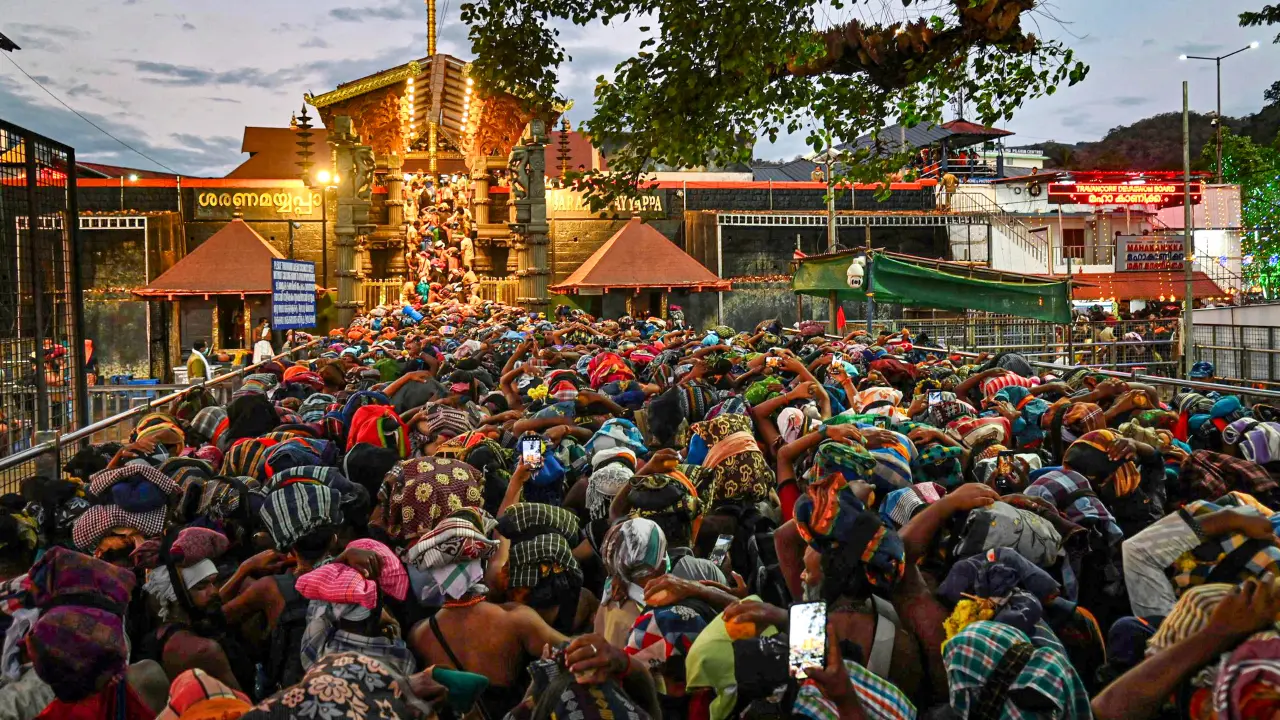
사바리말라 사건: 정부, 여성 출입 제한 지지...2018년 판결이 '남성 우월' 가정했다고 주장
Sabarimala case: Centre backs curbs on women’s entry, says 2018 verdict assumed 'men superior'
The Times of India
TOI NEWS DESK
EN
2026-04-09 07:47
Translated
중앙정부가 대법원에 월경 가능 나이 여성의 사바리말라 사원 출입 금지를 유지해야 한다고 주장했다. 정부 측 변론인 투샤르 메흐타 법무차관은 2018년 판결이 결함이 있다고 주장하며, 종교 관행이 순전히 성 문제만은 아니며 다양한 전통이 존재한다고 지적했다. 대법원은 평등 원칙과 종교의 자유가 어떻게 교차하는지 검토 중이다.
Nine-judge constitution bench hears review pleas. (PTI photo) NEW DELHI: The Centre on Thursday supported restrictions on the entry of women of menstruating age into Kerala’s Sabarimala temple, arguing before the Supreme Court that the 2018 verdict lifting the ban was based on an assumption of men being superor to women.A nine-judge Constitution bench, led by Chief Justice Surya Kant, is currently hearing a batch of petitions concerning the entry of women into places of worship and the broader scope of religious freedom across faiths.Appearing for the Centre, solicitor general Tushar Mehta submitted that religious practices cannot be viewed solely through a gender lens, citing examples where men are also barred or required to follow specific customs in certain temples.Referring to traditions linked to the deity, Mehta argued that the Sabarimala practice is rooted in faith rather than discrimination. He pointed to Kerala’s Kottankulangara Sree Devi Temple, where men dress as women during the Chamayavilakku festival, underscoring the diversity of religious customs.“It is not a question of male-centric or female-centric beliefs. In this case, it happens to be women-centric,” Mehta told the bench, which includes Justices B V Nagarathna, M M Sundresh, Ahsanuddin Amanullah, Aravind Kumar, Augustine George Masih, Prasanna B Varale, R Mahadevan and Joymalya Bagchi.Additional solicitor general K M Nataraj argued that “public morality,” rather than “constitutional morality” as interpreted earlier, should guide the court’s approach.The matter traces back to the Supreme Court’s 2018 ruling, which, by a 4:1 majority, struck down the ban on entry of women aged 10 to 50 at the Sabarimala Ayyappa temple, declaring the practice unconstitutional.In 2019, a subsequent five-judge bench led by former Chief Justice Ranjan Gogoi referred broader questions on gender discrimination in places of worship across religions to a larger bench, noting that such issues require deeper examination beyond individual cases.The ongoing hearings are expected to determine how constitutional principles of equality intersect with the right to practise religion.