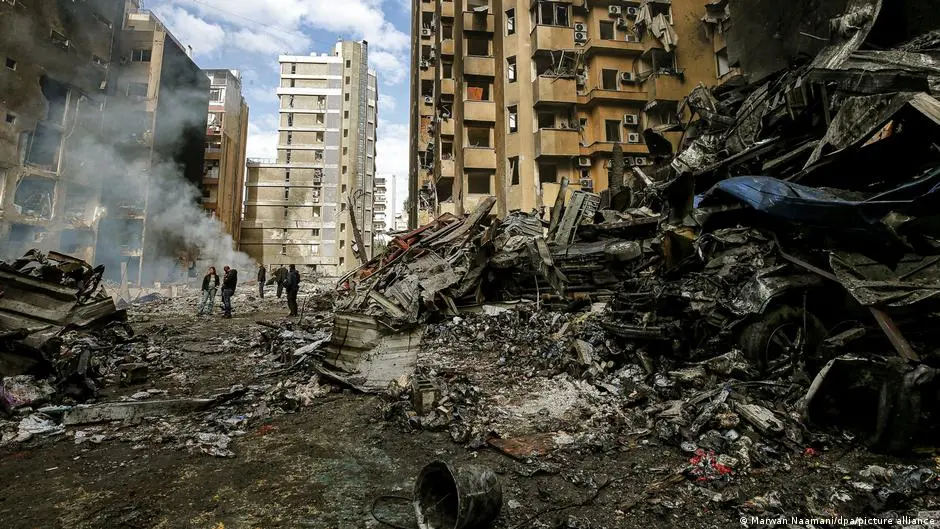
이스라엘, 남부 베이루트 주민들에 대피 명령 발표...이란 "레바논 공습, 휴전협정 위반" 주장
Israel tells residents to leave southern Beirut, coming after Iran says Lebanon strikes violate ceasefire. Follow DW
Deutsche Welle
Wesley Rahn Editor and reporter focusing on geopolitics and current affairs
DE
2026-04-09 12:46
Translated
미국, 이스라엘, 이란 간 2주간의 휴전협정에 금이 가기 시작했다. 레바논의 휴전협정 포함 여부를 놓고 의견이 엇갈리고 있는 가운데, 이스라엘은 헤즈볼라에 대한 공습을 계속하겠다는 입장을 밝혔다.
Welcome to DW's coverage of the US-Israel war with Iran and the wider conflicts in the Middle East on Thursday, April 9:
Confusion reigns over the status of the ceasefire between the US and Iran.
While the Iranians and mediator Pakistan have been clear — Lebanon is part of the agreement the US and Israel disagree.
To view this video please enable JavaScript, and consider upgrading to a web browser that supports HTML5 video
The Israeli military on Thursday issued an evacuation warning for the southern suburbs of Beirut, an area known as a stronghold for Hezbollah militants.
The IDF normally issues such warnings ahead of carrying out military strikes on a specific area.
The evacuation warning comes a day after Israel carried out its most widespread strikes on Lebanon since hostilities with Hezbollah reignited in early March after the Iran war was launched.
Meanwhile, in southern Lebanon, Hezbollah said it was clashing with Israeli forces in Bint Jbeil, a town located 5 kilometers (3 miles) from the Israeli border. The town holds symbolic value as the location of a fierce battle in the 2006 war between Hezbollah and Israel.
The Israeli military did not immediately comment on Thursday on fighting in the town.
On Tuesday, the IDF said it had completed the deployment of troops along a "defence line" in southern Lebanon to "strengthen the forward defensive posture and remove threats to the residents and communities of northern Israel."
A Lebanese military source speaking with AFP news agency on Tuesday said the Israeli army had advanced between 5 and 9 kilometres inside Lebanese territory.
Iran's President Masoud Pezeshkian said Thursday that Israel's continued strikes on Lebanon violate an already shaky ceasefire agreement and would render negotiations "meaningless," as talks with US officials in Pakistan are planned for Friday.
"This is a dangerous sign of deception and a failure to honor potential agreements," Pezeshkian posted on X. "We will keep our finger on the trigger. Iran will never abandon its Lebanese sisters and brothers."
Israel and the US both say that a pause in strikes against Hezbollah in Lebanon were not part of the ceasefire agreement unveiled Tuesday night.
At least 200 people were killed on Wednesday as Israel carried out its most extensive bombing of Lebanon since returned toconflict with Hezbollah again last month.
Iranian parliament speaker Mohammad Bagher Qalibaf also said the strikes violate the ceasefire and warned in a social media post of an "explicit and strong" response.
The Iranian comments come after Israeli Prime Minister Benjamin Netanyahu said on social media that Israel was continuing to "strike Hezbollah with force, precision, and determination."
"Our message is clear: anyone who acts against Israeli civilians, we will strike them. We will continue to hit Hezbollah wherever necessary."
To view this video please enable JavaScript, and consider upgrading to a web browser that supports HTML5 video
The head of Iran's nuclear agency has ruled out accepting any restrictions to the country's uranium enrichment program when peace talks with the United States begin in Islamabad, Pakistan, on Friday.
"The claims and demands of our enemies to restrict Iran's enrichment program are merely wishes that will be buried," said Mohammad Eslami, the head of the Atomic Energy Organization of Iran, during commemorations for the late Supreme Leader Ayatollah Ali Khamenei in Tehran on Thursday.
Acknowledgement of Iran's "right" to enrich uranium is one of the items listed in Tehran's ten-point plan for a permanent ceasefire. "It is one of the necessary [aspects] that nobody is talking about," Eslami said.
Iran began developing nuclear infrastructure in the 1960s and a program of uranium enrichment in the 1970s. It insists its enrichment of uranium is purely peaceful and geared solely towards nuclear energy for civilian use.
Regular nuclear power plants require uranium to be enriched to levels between 3.5 and 5%, as opposed to weapons-grade uranium which is enriched to over 90%. As of 2025, the International Atomic Energy Agency reported that Iran had just over 400 kilograms (882 lbs.) of 60% enriched uranium and estimated that it could potentially produce weapons-grade levels in less than three days.
In June 2025, the White House claimed that "Iran's Nuclear Facilities Have Been Obliterated," claims repeated by US President Donald Trump on numerous occasions since. The New York Times reported last month, however, that US intelligence services believe Iranian supplies of highly-enriched uranium could feasibly be retrieved from the ruins of the nuclear site Isfahan, which was bombed last June.
To view this video please enable JavaScript, and consider upgrading to a web browser that supports HTML5 video
Despite the conflict in the Middle East, authorities and some residents in Dubai insist life is going on as normal in the eternally-sunny, low-tax emirate.
Others proclaim the "Dubai dream" over, never to be recovered. Who's right? DW's Cathrin Schaer reports.
To view this video please enable JavaScript, and consider upgrading to a web browser that supports HTML5 video
The Israeli military said on Thursday that it had "eliminated" Ali Yusuf Harshi, a "close associate and personal advisor" to Hezbollah leader Naim Qassem, his uncle.
"Harshi played a key role in managing and securing Qassem's office," claimed the Israel Defense Forces (IDF) on social media.
Hezbollah is yet to confirm Harshi's death but Lebanese security sources had said on Wednesday evening that an attack took place on a flat in a 10-story building where he was reportedly staying.
Israeli Defense Minister Israel Katz has made it clear on several occasions that Harshi's boss, Qassem, is also a target.
Qassem has led Hezbollah since October 2024 after succeeding the long-serving Hassan Nasrallah, who was targeted and killed by Israel in September 2024.
On Tuesday, Air France had prolonged the suspension of flights to destinations in the Middle East until May 3. The airline cited security risks due to the war in Iran.
Since the start of the war, major airlines have halted flights to the Middle East. In late March, German carrier Lufthansasaid all services across the Middle East were canceled until April 30.
A source told AFP news agency on Thursday that the decision to extend the suspension was made before the ceasefire announcement between Washington and Tehran on Tuesday.
As of now, Air France and other major airlines have not said whether they will reinstate flights following the ceasefire announcement.
The death toll from massive Israeli air strikes on Lebanon on Wednesday, including on the capital, Beirut, has been officially raised to 203 – with over 1,000 more people injured.
"The death toll stands at 203 martyrs and more than 1,000 wounded in the aggression against Lebanon on Wednesday," said Health Minister Rakan Nassereddine before entering a cabinet meeting on Thursday.
Israeli strikes hit busy commercial and residential areas in central Beirut without warning on Wednesday, just hours after a ceasefire was announced between the United States, Israel and Iran. But while Iran has insisted that the truce also applied to Israeli operations against Hezbollah in Lebanon, US President Donald Trump said this was a "separate skirmish" while Vice President JD Vance referred to a "legitimate misunderstanding."
Hezbollah has accused Israel of a "violation of the ceasefire" but Israeli Prime Minister Benjamin Netanyahu said on Thursday that his forces would continue to attack the Iran-backed Islamist group "wherever necessary."
"We are continuing to strike Hezbollah with force, precision, and determination," he wrote on social media. "Our message is clear: anyone who acts against Israeli civilians – we will strike them. We will continue to hit Hezbollah wherever necessary until we fully restore security to the residents of the north [of Israel]."
According to one US think tank, the misinterpretation of the ceasefire deal as regards Lebanon, whether intentional or not, has the truce hovering "on the verge of collapse."
"Even if Lebanon was formally outside the deal, the scale of Israel's strikes was likely to be viewed as escalatory, nonetheless," wrote the New York-based Soufan Center in an analysis cited by the Associated Press.
"Israel's strikes can be understood both as an effort to drive a wedge between Iran and its proxies and as a response to being allegedly sidelined in the original ceasefire discussions."
Iranians marked the end of the 40-day mourning period for Ayatollah Ali Khamenei in Tehran. State television broadcasted footage from the city center of crowds mourning the former supreme leader.
Ayatollah Ali Khamenei was killed in an Israeli airstrike on February 28. The organizers of the memorial service chose 9:40 a.m. local time for the ceremony to begin, marking the exact time Israel bombed Khamenei's official residence in Tehran.
A prayer service for Khamenei is planned in Tehran for Friday. It remains unclear who will lead it. Mojtaba Khamenei, the son and successor of the late Khamenei, has yet to appear in public since his election as the new supreme leader. On Wednesday, US Secretary of Defense Pete Hegseth again claimed that the new leader is "disfigured."
It is unclear when the elder Khamenei will be buried in his hometown of Mashhad, the holiest city in Iran.
British Prime Minister Keir Starmer arrived in the United Arab Emirates (UAE) on Thursday, continuing a tour of the Gulf region aimed at maintaining the fragile ceasefire between the United States, Israel and Iran and reopening the Strait of Hormuz to maritime trade.
After meeting Saudi Crown Prince Mohammed Bin Salman in Jeddah on Wednesday, Starmer is set to meet UAE President Sheikh Mohamed bin Zayed Al Nahyan for further talks. He has welcomed the two-week truce but cautioned that it is still "early days."
Meanwhile, back in London, Starmer's foreign secretary has called for Lebanon to be included in the ceasefire.
"We do want to see the ceasefire extended to Lebanon," Yvette Cooper told Sky News in the UK. "I'm deeply troubled about the escalating attacks that we saw from Israel in Lebanon yesterday."
US Vice President JD Vance has said the agreement with Iran does not include Israeli operations against Hezbollah in Lebanon but that there had been a "legitimate misunderstanding" on the Iranian side that it did. The apparent confusion saw Iran close the Strait of Hormuz again on Wednesday in retaliation for continuing Israeli strikes on Lebanon.
"We've seen the humanitarian consequences, the huge mass displacement of people in Lebanon," said Cooper. "So we do strongly want to see the ceasefire extended to Lebanon."
To view this video please enable JavaScript, and consider upgrading to a web browser that supports HTML5 video
Cooper is expected to reiterate that message later on Thursday together with European allies and Canada in order to underline the importance of ensuring shipping through the strait remains unhindered and toll-free.
"We should start immediately to get international shipping moving again by supporting the International Maritime Organization's proposals to move the ships trapped in the Strait, and the 20,000 stranded seafarers," she will tell business leaders, according to the British Foreign Office.
"The full and unconditional re-opening of the strait must be a central part not just of the current ceasefire but of the long term future for the region," she will add.
"The fundamental freedoms of the seas must not be unilaterally withdrawn or sold off to individual bidders. Nor can there be any place for tolls on an international waterway."
The foreign ministers of Saudi Arabia and Iran have held their first telephone call since the start of the war, the Saudi foreign ministry said on Thursday.
"The call focused on reviewing developments in the situation and ways to slow the pace of tensions so as to help restore security and stability in the region," read a statement, issued by Riyadh the day after the announcement of a two-week ceasefire between Iran, the United States and Israel.
The call marks the first official diplomatic contact between the two countries since Tehran launched strikes against its Gulf neighbors, including Saudi Arabia, in retaliation for Israeli-American attacks.
At least two people (of Indian and Bangladeshi nationality) were killed in Saudi Arabia by Iranian strikes, which also targeted US military bases in the Kingdom.
Spain is set to reopen its embassy in Tehran following the ceasefire agreed between the United States, Israel and Iran this week.
"I've instructed our ambassador in Tehran to return, to take up his post again and reopen our embassy, and for us to join in this effort for peace from every possible quarter, including from the Iranian capital itself," Spanish Foreign Minister Jose Manuel Albares told reporters in Madrid.
Spain, a member of both the European Union and NATO, has emerged as one of the most vocal critics of US and Israeli military action in Iran and Lebanon, calling the conflict "illegal" and closing its airspace to any aircraft involved.
On Thursday, Albares also accused Israel of violating international law by continuing to carry out airstrikes in southern Lebanon.
"Yesterday we saw how Israel, flouting the ceasefire and in violation of international law, dropped hundreds of bombs on Lebanon," he told lawmakers in the Spanish parliament.
To view this video please enable JavaScript, and consider upgrading to a web browser that supports HTML5 video
US President Donald Trumpon Wednesday threatened to impose 50 percent tariffs on any country supplying weapons to Iran, though it’s not clear he has the legal authority to do so.
He also said in a separate post that his administration was "talking Tariff and Sanctions relief with Iran."
"A Country supplying Military Weapons to Iran will be immediately tariffed, on any and all goods sold to the United States of America, 50%, effective immediately. There will be no exclusions or exemptions! President DJT," he wrote in a post on Truth Social.
Lebanon announced a national day of mourning after Israeli strikes in Beirut killed nearly 200 people.
Following an agreement on a two-week-long pause on the war, both the US and Iran claimed victory. However, both sides are disputing the status of Lebanon's inclusion in the truce deal, which has highlighted the fragility of the ceasefire.
Following the announcement of the ceasefire, Israel carried out the deadliest strikes in Lebanon is recent weeks that killed at least 182 people and injured some 900 people across the Lebanese capital.
In Lebanon, where UN rights chief Volker Turk called the scale of killing "horrific," strikes across the capital Beirut that came without warning triggered horror and panic.
A delegation from Iran will arrive in Pakistan's capital Islamabad on Thursday night for negotiations with the US, Iran's ambassador to Pakistan Reza Amiri Moghadam said.
In a post on X, which appears to have been taken down, he said: "Despite skepticism of Iranian public opinion due to repeated ceasefire violations by Israeli regime to sabotage the diplomatic initiative, invited by Hon. PM Shehbaz Sharif, Iranian delegation arrives tonight in Islamabad for serious talks based on 10 points proposed by Iran."
Confusion reigns over the status of the ceasefire between the US and Iran.
While the Iranians and mediator Pakistan have been clear — Lebanon is part of the agreement the US and Israel disagree.
To view this video please enable JavaScript, and consider upgrading to a web browser that supports HTML5 video
The Israeli military on Thursday issued an evacuation warning for the southern suburbs of Beirut, an area known as a stronghold for Hezbollah militants.
The IDF normally issues such warnings ahead of carrying out military strikes on a specific area.
The evacuation warning comes a day after Israel carried out its most widespread strikes on Lebanon since hostilities with Hezbollah reignited in early March after the Iran war was launched.
Meanwhile, in southern Lebanon, Hezbollah said it was clashing with Israeli forces in Bint Jbeil, a town located 5 kilometers (3 miles) from the Israeli border. The town holds symbolic value as the location of a fierce battle in the 2006 war between Hezbollah and Israel.
The Israeli military did not immediately comment on Thursday on fighting in the town.
On Tuesday, the IDF said it had completed the deployment of troops along a "defence line" in southern Lebanon to "strengthen the forward defensive posture and remove threats to the residents and communities of northern Israel."
A Lebanese military source speaking with AFP news agency on Tuesday said the Israeli army had advanced between 5 and 9 kilometres inside Lebanese territory.
Iran's President Masoud Pezeshkian said Thursday that Israel's continued strikes on Lebanon violate an already shaky ceasefire agreement and would render negotiations "meaningless," as talks with US officials in Pakistan are planned for Friday.
"This is a dangerous sign of deception and a failure to honor potential agreements," Pezeshkian posted on X. "We will keep our finger on the trigger. Iran will never abandon its Lebanese sisters and brothers."
Israel and the US both say that a pause in strikes against Hezbollah in Lebanon were not part of the ceasefire agreement unveiled Tuesday night.
At least 200 people were killed on Wednesday as Israel carried out its most extensive bombing of Lebanon since returned toconflict with Hezbollah again last month.
Iranian parliament speaker Mohammad Bagher Qalibaf also said the strikes violate the ceasefire and warned in a social media post of an "explicit and strong" response.
The Iranian comments come after Israeli Prime Minister Benjamin Netanyahu said on social media that Israel was continuing to "strike Hezbollah with force, precision, and determination."
"Our message is clear: anyone who acts against Israeli civilians, we will strike them. We will continue to hit Hezbollah wherever necessary."
To view this video please enable JavaScript, and consider upgrading to a web browser that supports HTML5 video
The head of Iran's nuclear agency has ruled out accepting any restrictions to the country's uranium enrichment program when peace talks with the United States begin in Islamabad, Pakistan, on Friday.
"The claims and demands of our enemies to restrict Iran's enrichment program are merely wishes that will be buried," said Mohammad Eslami, the head of the Atomic Energy Organization of Iran, during commemorations for the late Supreme Leader Ayatollah Ali Khamenei in Tehran on Thursday.
Acknowledgement of Iran's "right" to enrich uranium is one of the items listed in Tehran's ten-point plan for a permanent ceasefire. "It is one of the necessary [aspects] that nobody is talking about," Eslami said.
Iran began developing nuclear infrastructure in the 1960s and a program of uranium enrichment in the 1970s. It insists its enrichment of uranium is purely peaceful and geared solely towards nuclear energy for civilian use.
Regular nuclear power plants require uranium to be enriched to levels between 3.5 and 5%, as opposed to weapons-grade uranium which is enriched to over 90%. As of 2025, the International Atomic Energy Agency reported that Iran had just over 400 kilograms (882 lbs.) of 60% enriched uranium and estimated that it could potentially produce weapons-grade levels in less than three days.
In June 2025, the White House claimed that "Iran's Nuclear Facilities Have Been Obliterated," claims repeated by US President Donald Trump on numerous occasions since. The New York Times reported last month, however, that US intelligence services believe Iranian supplies of highly-enriched uranium could feasibly be retrieved from the ruins of the nuclear site Isfahan, which was bombed last June.
To view this video please enable JavaScript, and consider upgrading to a web browser that supports HTML5 video
Despite the conflict in the Middle East, authorities and some residents in Dubai insist life is going on as normal in the eternally-sunny, low-tax emirate.
Others proclaim the "Dubai dream" over, never to be recovered. Who's right? DW's Cathrin Schaer reports.
To view this video please enable JavaScript, and consider upgrading to a web browser that supports HTML5 video
The Israeli military said on Thursday that it had "eliminated" Ali Yusuf Harshi, a "close associate and personal advisor" to Hezbollah leader Naim Qassem, his uncle.
"Harshi played a key role in managing and securing Qassem's office," claimed the Israel Defense Forces (IDF) on social media.
Hezbollah is yet to confirm Harshi's death but Lebanese security sources had said on Wednesday evening that an attack took place on a flat in a 10-story building where he was reportedly staying.
Israeli Defense Minister Israel Katz has made it clear on several occasions that Harshi's boss, Qassem, is also a target.
Qassem has led Hezbollah since October 2024 after succeeding the long-serving Hassan Nasrallah, who was targeted and killed by Israel in September 2024.
On Tuesday, Air France had prolonged the suspension of flights to destinations in the Middle East until May 3. The airline cited security risks due to the war in Iran.
Since the start of the war, major airlines have halted flights to the Middle East. In late March, German carrier Lufthansasaid all services across the Middle East were canceled until April 30.
A source told AFP news agency on Thursday that the decision to extend the suspension was made before the ceasefire announcement between Washington and Tehran on Tuesday.
As of now, Air France and other major airlines have not said whether they will reinstate flights following the ceasefire announcement.
The death toll from massive Israeli air strikes on Lebanon on Wednesday, including on the capital, Beirut, has been officially raised to 203 – with over 1,000 more people injured.
"The death toll stands at 203 martyrs and more than 1,000 wounded in the aggression against Lebanon on Wednesday," said Health Minister Rakan Nassereddine before entering a cabinet meeting on Thursday.
Israeli strikes hit busy commercial and residential areas in central Beirut without warning on Wednesday, just hours after a ceasefire was announced between the United States, Israel and Iran. But while Iran has insisted that the truce also applied to Israeli operations against Hezbollah in Lebanon, US President Donald Trump said this was a "separate skirmish" while Vice President JD Vance referred to a "legitimate misunderstanding."
Hezbollah has accused Israel of a "violation of the ceasefire" but Israeli Prime Minister Benjamin Netanyahu said on Thursday that his forces would continue to attack the Iran-backed Islamist group "wherever necessary."
"We are continuing to strike Hezbollah with force, precision, and determination," he wrote on social media. "Our message is clear: anyone who acts against Israeli civilians – we will strike them. We will continue to hit Hezbollah wherever necessary until we fully restore security to the residents of the north [of Israel]."
According to one US think tank, the misinterpretation of the ceasefire deal as regards Lebanon, whether intentional or not, has the truce hovering "on the verge of collapse."
"Even if Lebanon was formally outside the deal, the scale of Israel's strikes was likely to be viewed as escalatory, nonetheless," wrote the New York-based Soufan Center in an analysis cited by the Associated Press.
"Israel's strikes can be understood both as an effort to drive a wedge between Iran and its proxies and as a response to being allegedly sidelined in the original ceasefire discussions."
Iranians marked the end of the 40-day mourning period for Ayatollah Ali Khamenei in Tehran. State television broadcasted footage from the city center of crowds mourning the former supreme leader.
Ayatollah Ali Khamenei was killed in an Israeli airstrike on February 28. The organizers of the memorial service chose 9:40 a.m. local time for the ceremony to begin, marking the exact time Israel bombed Khamenei's official residence in Tehran.
A prayer service for Khamenei is planned in Tehran for Friday. It remains unclear who will lead it. Mojtaba Khamenei, the son and successor of the late Khamenei, has yet to appear in public since his election as the new supreme leader. On Wednesday, US Secretary of Defense Pete Hegseth again claimed that the new leader is "disfigured."
It is unclear when the elder Khamenei will be buried in his hometown of Mashhad, the holiest city in Iran.
British Prime Minister Keir Starmer arrived in the United Arab Emirates (UAE) on Thursday, continuing a tour of the Gulf region aimed at maintaining the fragile ceasefire between the United States, Israel and Iran and reopening the Strait of Hormuz to maritime trade.
After meeting Saudi Crown Prince Mohammed Bin Salman in Jeddah on Wednesday, Starmer is set to meet UAE President Sheikh Mohamed bin Zayed Al Nahyan for further talks. He has welcomed the two-week truce but cautioned that it is still "early days."
Meanwhile, back in London, Starmer's foreign secretary has called for Lebanon to be included in the ceasefire.
"We do want to see the ceasefire extended to Lebanon," Yvette Cooper told Sky News in the UK. "I'm deeply troubled about the escalating attacks that we saw from Israel in Lebanon yesterday."
US Vice President JD Vance has said the agreement with Iran does not include Israeli operations against Hezbollah in Lebanon but that there had been a "legitimate misunderstanding" on the Iranian side that it did. The apparent confusion saw Iran close the Strait of Hormuz again on Wednesday in retaliation for continuing Israeli strikes on Lebanon.
"We've seen the humanitarian consequences, the huge mass displacement of people in Lebanon," said Cooper. "So we do strongly want to see the ceasefire extended to Lebanon."
To view this video please enable JavaScript, and consider upgrading to a web browser that supports HTML5 video
Cooper is expected to reiterate that message later on Thursday together with European allies and Canada in order to underline the importance of ensuring shipping through the strait remains unhindered and toll-free.
"We should start immediately to get international shipping moving again by supporting the International Maritime Organization's proposals to move the ships trapped in the Strait, and the 20,000 stranded seafarers," she will tell business leaders, according to the British Foreign Office.
"The full and unconditional re-opening of the strait must be a central part not just of the current ceasefire but of the long term future for the region," she will add.
"The fundamental freedoms of the seas must not be unilaterally withdrawn or sold off to individual bidders. Nor can there be any place for tolls on an international waterway."
The foreign ministers of Saudi Arabia and Iran have held their first telephone call since the start of the war, the Saudi foreign ministry said on Thursday.
"The call focused on reviewing developments in the situation and ways to slow the pace of tensions so as to help restore security and stability in the region," read a statement, issued by Riyadh the day after the announcement of a two-week ceasefire between Iran, the United States and Israel.
The call marks the first official diplomatic contact between the two countries since Tehran launched strikes against its Gulf neighbors, including Saudi Arabia, in retaliation for Israeli-American attacks.
At least two people (of Indian and Bangladeshi nationality) were killed in Saudi Arabia by Iranian strikes, which also targeted US military bases in the Kingdom.
Spain is set to reopen its embassy in Tehran following the ceasefire agreed between the United States, Israel and Iran this week.
"I've instructed our ambassador in Tehran to return, to take up his post again and reopen our embassy, and for us to join in this effort for peace from every possible quarter, including from the Iranian capital itself," Spanish Foreign Minister Jose Manuel Albares told reporters in Madrid.
Spain, a member of both the European Union and NATO, has emerged as one of the most vocal critics of US and Israeli military action in Iran and Lebanon, calling the conflict "illegal" and closing its airspace to any aircraft involved.
On Thursday, Albares also accused Israel of violating international law by continuing to carry out airstrikes in southern Lebanon.
"Yesterday we saw how Israel, flouting the ceasefire and in violation of international law, dropped hundreds of bombs on Lebanon," he told lawmakers in the Spanish parliament.
To view this video please enable JavaScript, and consider upgrading to a web browser that supports HTML5 video
US President Donald Trumpon Wednesday threatened to impose 50 percent tariffs on any country supplying weapons to Iran, though it’s not clear he has the legal authority to do so.
He also said in a separate post that his administration was "talking Tariff and Sanctions relief with Iran."
"A Country supplying Military Weapons to Iran will be immediately tariffed, on any and all goods sold to the United States of America, 50%, effective immediately. There will be no exclusions or exemptions! President DJT," he wrote in a post on Truth Social.
Lebanon announced a national day of mourning after Israeli strikes in Beirut killed nearly 200 people.
Following an agreement on a two-week-long pause on the war, both the US and Iran claimed victory. However, both sides are disputing the status of Lebanon's inclusion in the truce deal, which has highlighted the fragility of the ceasefire.
Following the announcement of the ceasefire, Israel carried out the deadliest strikes in Lebanon is recent weeks that killed at least 182 people and injured some 900 people across the Lebanese capital.
In Lebanon, where UN rights chief Volker Turk called the scale of killing "horrific," strikes across the capital Beirut that came without warning triggered horror and panic.
A delegation from Iran will arrive in Pakistan's capital Islamabad on Thursday night for negotiations with the US, Iran's ambassador to Pakistan Reza Amiri Moghadam said.
In a post on X, which appears to have been taken down, he said: "Despite skepticism of Iranian public opinion due to repeated ceasefire violations by Israeli regime to sabotage the diplomatic initiative, invited by Hon. PM Shehbaz Sharif, Iranian delegation arrives tonight in Islamabad for serious talks based on 10 points proposed by Iran."