인도 뉴스: 케랄라, 아삼, 푸두체리 투표 마감
India news: Voting closes in Kerala, Assam and Puducherry
Deutsche Welle
Mahima Kapoor Digital journalist based in New Delhi@MahimaKapoor12
DE
2026-04-09 13:34
Translated
인도의 선거 시즌이 계속되고 있으며, 두 개 주와 연방직할구역의 유권자들이 투표소로 향했다. 한편, 다카는 방글라데시 전 총리 셰이크 하시나의 신병인도를 인도에 다시 요청했다. DW 팔로우하기
This blog has now closed. Here is a roundup of news headlines from India on Thursday, April 9:
We'll be back on Friday with more news, views and stories from India and the team in New Delhi!
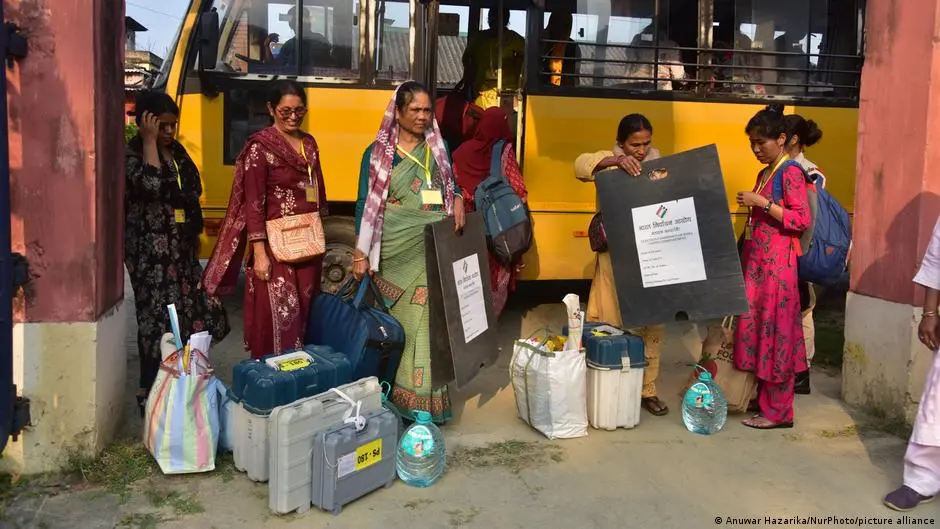
Voting has now concluded in the Kerala, Assam and Puducherry with results expected on May 4.
As of 3 p.m. India time (09:30 GMT), Assam recorded a voter turnout of nearly 76% and Kerala of 62.7%, as per Indian News outlet Hindustan Times. Puducherry logged a voter turnout of 72.4% by 1 p.m. (07:30 GMT)
Kerala's Chief Electoral officer Rathan U Kellar said the state's voting trend indicated a 90% voter turnout for the day. "If the current trend continues, by the time polling concludes, we are confident we will see a turnout of 90%" he told News agency PTI.
Prime Minister Narendra Modi on Thursday requested unanimous support for a bill which would increase reservation for women in India's parliament.
In a blog post, Modi said the Indian Parliament would discuss and pass the "important bill" on April 16.
"Women constitute nearly half of India’s population...Yet, their representation in the world of politics and legislative bodies has not always been commensurate with their role in Society," he said, calling the Statement an "op-ed."
"This is particularly unfortunate because when women participate in administration and decision-making, they bring with them experiences and insights that enrich public discourse and improve the quality of governance.
The bill proposes fast-tracking implementation of a 2023 law reserving 33% of seats for women both in the national parliament and state assemblies.
Last week, India's opposition said that Modi's push to have the bill passed in a special sitting of the parliament was meant to grab "political mileage" amid elections in sour states and one union territory.
That said, India's opposition has largely been in favor of the bill itself.
Modi appealed to all members of parliament, across party lines to "come together in support of this important step for the women of India."
India recently granted waivers to allow vessels, carrying Iranian cargo, to enter its ports despite them being old or under international sanctions, Reuters reported citing unnamed sources familiar with the matter.
The waivers were given with the aim of speeding the delivery of rnergy supplies from the Gulf amid the Middle East conflict.
India, the world's second-largest importer of liquified petroleum gas (LPG), is facing its worst gas crisis in decades. Since the war began, the Indian government has invoked special powers to ration gas supplies, to ensure a supply of cooking gas to households.
One of the sources told Reuters that LPG tanker Aurora was allowed to dock in the southern port of Mangalore despite it being 30 years old. Another crude tanker, called Jaya, was permitted to unload despite it being under US sanctions.
The officials said the waivers were given on a case-by-case basis and only to vessels which met safety parameters.
India typically requires tankers of over 20 years of age to get a seaworthiness certificate, and bars vessels under US sanctions from its ports.
To view this video please enable JavaScript, and consider upgrading to a web browser that supports HTML5 video
India's Foreign Minister Subrahmanyam Jaishankar is set to visit the United Arab Emirates from April 11-12, ministry spokesperson Randhir Jaiswal said in a press briefing.
"During the visit, he will meet the leadership of the UAE to review close cooperation and deepen the comprehensive strategic partnership between the two countries," he said.
Jaishankar's visit comes on the heels of a fragile and temporary US-Iran ceasefire which seems to be holding despite allegations of violations.
The UAE is India's third-largest trading partner after the US and China. It is also India's second-largest export destination after the US, as per trade data for financial year 2023-24. Apart from trade, the UAE is also home to millions of Indians working abroad.
India is likely to remain among the world's fastest growing major economies despite the war in Iran, the World Bank said, but warned that the country could face significant risks as the conflict fans inflation concerns.
The economy is insulated to a degree by strong macroeconomic fundamentals and policy buffers, the World Bank said.
"Substantial foreign reserves, low inflation, predominantly rupee-denominated public debt, a healthy financial sector, and trade diversification efforts play a major role in providing resilience from external headwinds," it said.
That said, India's reliance on energy imports from the Gulf leaves inflation and fiscal position vulnerable if the conflict were to extend much longer.
"A disrupted labor market in Gulf economies (the origin for nearly 38% of India’s remittance inflows) would lower the secondary income surplus. These factors would put additional pressure on the rupee," the report said.
"Fiscal risks would also rise if measures to limit fuel price pass-through to consumers—such as excise rate cuts and increased subsidies—are scaled up," it said. The report added that while policies would mitigate the risk, persistently high global energy prices would eventually lead to higher retail inflation and weigh on domestic demand.
The US-Israel war with Iran has constricted the flow of oil and gas to India, which imports the majority of its energy needs. Gas prices at home have marginally increased but the government and its oil companies have absorbed much of the impact so far.
To view this video please enable JavaScript, and consider upgrading to a web browser that supports HTML5 video
On the other hand, the Indian rupee has weakened against the dollar to become Asia's worst performing currency.
The World Bank's India economist Aurelien Kruse projected India retail inflation at 4.9%, reflecting higher food and energy prices. He was speaking at a press conference in New Delhi after the release of the report.
India's central bank left interest rates unchanged on Wednesday and projected retail inflation for the year at 4.6%. The Reserve Bank of India expects the nation's economy to grow at 6.9% in the financial year 2027, while the World Bank expects a 6.6% growth rate in the same time period.
Indian Prime Minister Narendra Modi on Thursday pledged to weed out corruption, reopen investigations into sexual assault, and expel illegal immigrants if voters elect his ruling Bharatiya Janata Party (BJP) to power in the eastern state of West Bengal later this month.
Speaking at a pre‑election rally, Modi Modi said the people of West Bengal would have "six guarantees" if they pressed the "lotus-stamped button," referring to his party's emblem, a pink lotus.
He took to social media to post pictures from the rally in the city of Haldia.
At the rally, Modi promised:
Modi accused the ruling Trinamool Congress (TMC) of spreading fear and lawlessness, claiming a BJP government would “re‑establish the rule of law” in the state.
West Bengal, one of India’s most populous and politically influential states, has been ruled since 2011 by the TMC under Chief Minister Mamata Banerjee.
While elaborating on his pledge to investigate sexual assault cases, Modi alluded to the rape and murder of a young female trainee doctor at one of the largest government-run hospitals in the eastern Indian city of Kolkata in August 2024. Details of the assault led to a nation-wide outcry and demonstrations across cities.
The mother of the victim is standing as a BJP candidate, and blames the TMC Chief Minister Mamata Banerjee for her daughter's murder.
To view this video please enable JavaScript, and consider upgrading to a web browser that supports HTML5 video
On illegal immigration, Modi referred to undocumented migrants from Bangladesh, an issue that has become a flashpoint in Indian politics. West Bengal shares a long and porous border with Bangladesh.
Modi’s final promise — to protect government employees and teachers — touched on a sensitive issue in the state. In 2025, India’s Supreme Court annulled the appointments of nearly 26,000 public‑sector school teachers after uncovering a large‑scale cash‑for‑jobs scam.
Theruling led to widespread protests and caused significant political damage to Chief Minister Banerjee and the TMC.
Petroleum Minister Hardeep Singh Puri has kicked off a two-day visit to Qatar, as the conflict in the Middle East continues to cause a rise in oil and gas prices.
Qatar is India's largest supplier of liquified petroleum gas (LPG).
Puri's visit comes a day after the US and Iran agreed to a temporary ceasefire, to allow the two sides to negotiate a more lasting truce. However, the status of the ceasefire is in doubt after Iran cited at least three US violations.
Qatar is also home to a sizable Indian diaspora, some of whom were brought back to India amid rising regional tensions and Iranian attacks.
India has increased subsidies for farming fertilizers by 11% compared to last year, in a bid to shield the country's agricultural sector from rising prices due to the war in the Middle East.
"The subsidy would be provided to the fertiliser companies as per approved and notified rates, so that fertilisers are made available to farmers at affordable prices," a Cabinet statement on Wednesday read.
"In view of the recent trends in the international prices of fertilisers and inputs like urea... the government has decided to approve the NBS (Nutrient Based Subsidy) rates," it added.
In India, about 45% of the population makes a living from the agricultural sector. That makes farmers an important voting bloc, especially as four states and a union territory are undergoing elections in April.
The Iran war is creating a one-two punch for the world's fertilizer supply, blocking both the export and one of its critical ingredients from leaving the Persian Gulf. Nearly half of the world's traded urea, the most widely used nitrogen-based fertilizer, comes from the Gulf. While India can afford to subsidize fertilizer, nearby Bangladesh, Nepal and Sri Lanka likely cannot.
In November, Bangladesh’s domestic war crimes tribunal sentenced both Hasina and former Home Minister Asaduzzaman Khan to death for their alleged role in ordering a deadly crackdown on the student‑led uprising of 2024, which ultimately ended Hasina’s 15‑year rule.
Delivering the verdict in absentia, Judge Golam Mortuza Mozumder said Hasina was “found guilty on three counts,” including incitement, ordering killings, and failing to prevent atrocities. The court declared both former leaders fugitives, paving the way for extradition requests.
Hasina has been living in exile in India since fleeing Bangladesh following the mass youth‑led protests that culminated in her removal from power.
India has long maintained close ties with Bangladesh, and with Sheikh Hasina and her family. This is also not the first time Hasina has sought refuge in India.
Following a military coup in the 1970s that killed her father, Bangladesh’s founding leader Sheikh Mujibur Rahman, and several other family members, Hasina and her sister were granted asylum by the then-Indian government.
However, Hasina’s latest stay in India has soured bilateral relations. Analysts say the situation has also contributed to Bangladesh moving closer to China, New Delhi’s regional rival.
To view this video please enable JavaScript, and consider upgrading to a web browser that supports HTML5 video
Bangladesh’s Foreign Minister Khalilur Rahman has renewed his country’s request for the extradition of former Prime Minister Sheikh Hasina, during a two‑day official visit to India.
Hasina is currently living in exile in India.
The request marks the first time Bangladesh’s newly-elected government has formally raised the issue with Indian authorities, signalling a sharper turn in diplomatic relations between the two neighbouring countries.
On his first visit to India, Rahman held meetings with Indian Foreign Minister Subrahmanyam Jaishankar, National Security Adviser Ajit Doval, and Petroleum Minister Hardeep Singh Puri.
Indian media reported that Rahman called on New Delhi to hand over Hasina as well as her former Home Minister Asaduzzaman Khan. However, India’s Ministry of External Affairs released only a brief statement on the meetings and made no mention of any extradition request.
Two states and one union territory have gone to polls, kicking off the Assembly election season in India. Voting in Kerala, Assam and Puducherry begun at 7 a.m. local time (01:30 GMT) and will go on till 5 p.m. (11:30 GMT).
Two other opposition-ruled states, West Bengal and Tamil Nadu, will vote later this month. The results for all five regions are expected May 4.
The high stakes elections will see Indian Prime Minister Narendra Modi's Hindu Nationalist Bharatiya Janata Party (BJP) fight regional parties for power. The BJP has never won an election in Kerala.
The polls come while the public is concerned about rising energy costs and tighter cooking gas supplies due to the war in the Middle East.
Modi took to social media on Thursday, urging voters — especially women and youth — to step out to fulfil their democratic duty.
Here's what you need to know:
Good morning! and welcome to DW's India blog.
This is Mahima Kapoor from the New Delhi Bureau and I will bring to you the day's biggest headlines and talking points from the country.
Parts of India, including the national capital, continue to see showers and thunderstorms due to a western disturbance rarely seen in the month of April. The atmospheric phenomenon has forced discussions of climate change all over the country.
Speaking of weather, it's election season in India as voters in two states and a union territory head to polls in high-stakes elections, which could see Prime Minister Narendra Modi's ruling BJP party extend ist power, both in terms of time and constituencies.
On the global front, Indians remain glued to their television sets as the fragile temporary ceasefire between the US,Israel and Iran seems to be coming undone. The war in the Middle East has significantly impacted Indian investments, businesses and critical supplies like cooking gas.
Stick with us as we break down the day's news for you.
We'll be back on Friday with more news, views and stories from India and the team in New Delhi!
Voting has now concluded in the Kerala, Assam and Puducherry with results expected on May 4.
As of 3 p.m. India time (09:30 GMT), Assam recorded a voter turnout of nearly 76% and Kerala of 62.7%, as per Indian News outlet Hindustan Times. Puducherry logged a voter turnout of 72.4% by 1 p.m. (07:30 GMT)
Kerala's Chief Electoral officer Rathan U Kellar said the state's voting trend indicated a 90% voter turnout for the day. "If the current trend continues, by the time polling concludes, we are confident we will see a turnout of 90%" he told News agency PTI.
Prime Minister Narendra Modi on Thursday requested unanimous support for a bill which would increase reservation for women in India's parliament.
In a blog post, Modi said the Indian Parliament would discuss and pass the "important bill" on April 16.
"Women constitute nearly half of India’s population...Yet, their representation in the world of politics and legislative bodies has not always been commensurate with their role in Society," he said, calling the Statement an "op-ed."
"This is particularly unfortunate because when women participate in administration and decision-making, they bring with them experiences and insights that enrich public discourse and improve the quality of governance.
The bill proposes fast-tracking implementation of a 2023 law reserving 33% of seats for women both in the national parliament and state assemblies.
Last week, India's opposition said that Modi's push to have the bill passed in a special sitting of the parliament was meant to grab "political mileage" amid elections in sour states and one union territory.
That said, India's opposition has largely been in favor of the bill itself.
Modi appealed to all members of parliament, across party lines to "come together in support of this important step for the women of India."
India recently granted waivers to allow vessels, carrying Iranian cargo, to enter its ports despite them being old or under international sanctions, Reuters reported citing unnamed sources familiar with the matter.
The waivers were given with the aim of speeding the delivery of rnergy supplies from the Gulf amid the Middle East conflict.
India, the world's second-largest importer of liquified petroleum gas (LPG), is facing its worst gas crisis in decades. Since the war began, the Indian government has invoked special powers to ration gas supplies, to ensure a supply of cooking gas to households.
One of the sources told Reuters that LPG tanker Aurora was allowed to dock in the southern port of Mangalore despite it being 30 years old. Another crude tanker, called Jaya, was permitted to unload despite it being under US sanctions.
The officials said the waivers were given on a case-by-case basis and only to vessels which met safety parameters.
India typically requires tankers of over 20 years of age to get a seaworthiness certificate, and bars vessels under US sanctions from its ports.
To view this video please enable JavaScript, and consider upgrading to a web browser that supports HTML5 video
India's Foreign Minister Subrahmanyam Jaishankar is set to visit the United Arab Emirates from April 11-12, ministry spokesperson Randhir Jaiswal said in a press briefing.
"During the visit, he will meet the leadership of the UAE to review close cooperation and deepen the comprehensive strategic partnership between the two countries," he said.
Jaishankar's visit comes on the heels of a fragile and temporary US-Iran ceasefire which seems to be holding despite allegations of violations.
The UAE is India's third-largest trading partner after the US and China. It is also India's second-largest export destination after the US, as per trade data for financial year 2023-24. Apart from trade, the UAE is also home to millions of Indians working abroad.
India is likely to remain among the world's fastest growing major economies despite the war in Iran, the World Bank said, but warned that the country could face significant risks as the conflict fans inflation concerns.
The economy is insulated to a degree by strong macroeconomic fundamentals and policy buffers, the World Bank said.
"Substantial foreign reserves, low inflation, predominantly rupee-denominated public debt, a healthy financial sector, and trade diversification efforts play a major role in providing resilience from external headwinds," it said.
That said, India's reliance on energy imports from the Gulf leaves inflation and fiscal position vulnerable if the conflict were to extend much longer.
"A disrupted labor market in Gulf economies (the origin for nearly 38% of India’s remittance inflows) would lower the secondary income surplus. These factors would put additional pressure on the rupee," the report said.
"Fiscal risks would also rise if measures to limit fuel price pass-through to consumers—such as excise rate cuts and increased subsidies—are scaled up," it said. The report added that while policies would mitigate the risk, persistently high global energy prices would eventually lead to higher retail inflation and weigh on domestic demand.
The US-Israel war with Iran has constricted the flow of oil and gas to India, which imports the majority of its energy needs. Gas prices at home have marginally increased but the government and its oil companies have absorbed much of the impact so far.
To view this video please enable JavaScript, and consider upgrading to a web browser that supports HTML5 video
On the other hand, the Indian rupee has weakened against the dollar to become Asia's worst performing currency.
The World Bank's India economist Aurelien Kruse projected India retail inflation at 4.9%, reflecting higher food and energy prices. He was speaking at a press conference in New Delhi after the release of the report.
India's central bank left interest rates unchanged on Wednesday and projected retail inflation for the year at 4.6%. The Reserve Bank of India expects the nation's economy to grow at 6.9% in the financial year 2027, while the World Bank expects a 6.6% growth rate in the same time period.
Indian Prime Minister Narendra Modi on Thursday pledged to weed out corruption, reopen investigations into sexual assault, and expel illegal immigrants if voters elect his ruling Bharatiya Janata Party (BJP) to power in the eastern state of West Bengal later this month.
Speaking at a pre‑election rally, Modi Modi said the people of West Bengal would have "six guarantees" if they pressed the "lotus-stamped button," referring to his party's emblem, a pink lotus.
He took to social media to post pictures from the rally in the city of Haldia.
At the rally, Modi promised:
Modi accused the ruling Trinamool Congress (TMC) of spreading fear and lawlessness, claiming a BJP government would “re‑establish the rule of law” in the state.
West Bengal, one of India’s most populous and politically influential states, has been ruled since 2011 by the TMC under Chief Minister Mamata Banerjee.
While elaborating on his pledge to investigate sexual assault cases, Modi alluded to the rape and murder of a young female trainee doctor at one of the largest government-run hospitals in the eastern Indian city of Kolkata in August 2024. Details of the assault led to a nation-wide outcry and demonstrations across cities.
The mother of the victim is standing as a BJP candidate, and blames the TMC Chief Minister Mamata Banerjee for her daughter's murder.
To view this video please enable JavaScript, and consider upgrading to a web browser that supports HTML5 video
On illegal immigration, Modi referred to undocumented migrants from Bangladesh, an issue that has become a flashpoint in Indian politics. West Bengal shares a long and porous border with Bangladesh.
Modi’s final promise — to protect government employees and teachers — touched on a sensitive issue in the state. In 2025, India’s Supreme Court annulled the appointments of nearly 26,000 public‑sector school teachers after uncovering a large‑scale cash‑for‑jobs scam.
Theruling led to widespread protests and caused significant political damage to Chief Minister Banerjee and the TMC.
Petroleum Minister Hardeep Singh Puri has kicked off a two-day visit to Qatar, as the conflict in the Middle East continues to cause a rise in oil and gas prices.
Qatar is India's largest supplier of liquified petroleum gas (LPG).
Puri's visit comes a day after the US and Iran agreed to a temporary ceasefire, to allow the two sides to negotiate a more lasting truce. However, the status of the ceasefire is in doubt after Iran cited at least three US violations.
Qatar is also home to a sizable Indian diaspora, some of whom were brought back to India amid rising regional tensions and Iranian attacks.
India has increased subsidies for farming fertilizers by 11% compared to last year, in a bid to shield the country's agricultural sector from rising prices due to the war in the Middle East.
"The subsidy would be provided to the fertiliser companies as per approved and notified rates, so that fertilisers are made available to farmers at affordable prices," a Cabinet statement on Wednesday read.
"In view of the recent trends in the international prices of fertilisers and inputs like urea... the government has decided to approve the NBS (Nutrient Based Subsidy) rates," it added.
In India, about 45% of the population makes a living from the agricultural sector. That makes farmers an important voting bloc, especially as four states and a union territory are undergoing elections in April.
The Iran war is creating a one-two punch for the world's fertilizer supply, blocking both the export and one of its critical ingredients from leaving the Persian Gulf. Nearly half of the world's traded urea, the most widely used nitrogen-based fertilizer, comes from the Gulf. While India can afford to subsidize fertilizer, nearby Bangladesh, Nepal and Sri Lanka likely cannot.
In November, Bangladesh’s domestic war crimes tribunal sentenced both Hasina and former Home Minister Asaduzzaman Khan to death for their alleged role in ordering a deadly crackdown on the student‑led uprising of 2024, which ultimately ended Hasina’s 15‑year rule.
Delivering the verdict in absentia, Judge Golam Mortuza Mozumder said Hasina was “found guilty on three counts,” including incitement, ordering killings, and failing to prevent atrocities. The court declared both former leaders fugitives, paving the way for extradition requests.
Hasina has been living in exile in India since fleeing Bangladesh following the mass youth‑led protests that culminated in her removal from power.
India has long maintained close ties with Bangladesh, and with Sheikh Hasina and her family. This is also not the first time Hasina has sought refuge in India.
Following a military coup in the 1970s that killed her father, Bangladesh’s founding leader Sheikh Mujibur Rahman, and several other family members, Hasina and her sister were granted asylum by the then-Indian government.
However, Hasina’s latest stay in India has soured bilateral relations. Analysts say the situation has also contributed to Bangladesh moving closer to China, New Delhi’s regional rival.
To view this video please enable JavaScript, and consider upgrading to a web browser that supports HTML5 video
Bangladesh’s Foreign Minister Khalilur Rahman has renewed his country’s request for the extradition of former Prime Minister Sheikh Hasina, during a two‑day official visit to India.
Hasina is currently living in exile in India.
The request marks the first time Bangladesh’s newly-elected government has formally raised the issue with Indian authorities, signalling a sharper turn in diplomatic relations between the two neighbouring countries.
On his first visit to India, Rahman held meetings with Indian Foreign Minister Subrahmanyam Jaishankar, National Security Adviser Ajit Doval, and Petroleum Minister Hardeep Singh Puri.
Indian media reported that Rahman called on New Delhi to hand over Hasina as well as her former Home Minister Asaduzzaman Khan. However, India’s Ministry of External Affairs released only a brief statement on the meetings and made no mention of any extradition request.
Two states and one union territory have gone to polls, kicking off the Assembly election season in India. Voting in Kerala, Assam and Puducherry begun at 7 a.m. local time (01:30 GMT) and will go on till 5 p.m. (11:30 GMT).
Two other opposition-ruled states, West Bengal and Tamil Nadu, will vote later this month. The results for all five regions are expected May 4.
The high stakes elections will see Indian Prime Minister Narendra Modi's Hindu Nationalist Bharatiya Janata Party (BJP) fight regional parties for power. The BJP has never won an election in Kerala.
The polls come while the public is concerned about rising energy costs and tighter cooking gas supplies due to the war in the Middle East.
Modi took to social media on Thursday, urging voters — especially women and youth — to step out to fulfil their democratic duty.
Here's what you need to know:
Good morning! and welcome to DW's India blog.
This is Mahima Kapoor from the New Delhi Bureau and I will bring to you the day's biggest headlines and talking points from the country.
Parts of India, including the national capital, continue to see showers and thunderstorms due to a western disturbance rarely seen in the month of April. The atmospheric phenomenon has forced discussions of climate change all over the country.
Speaking of weather, it's election season in India as voters in two states and a union territory head to polls in high-stakes elections, which could see Prime Minister Narendra Modi's ruling BJP party extend ist power, both in terms of time and constituencies.
On the global front, Indians remain glued to their television sets as the fragile temporary ceasefire between the US,Israel and Iran seems to be coming undone. The war in the Middle East has significantly impacted Indian investments, businesses and critical supplies like cooking gas.
Stick with us as we break down the day's news for you.