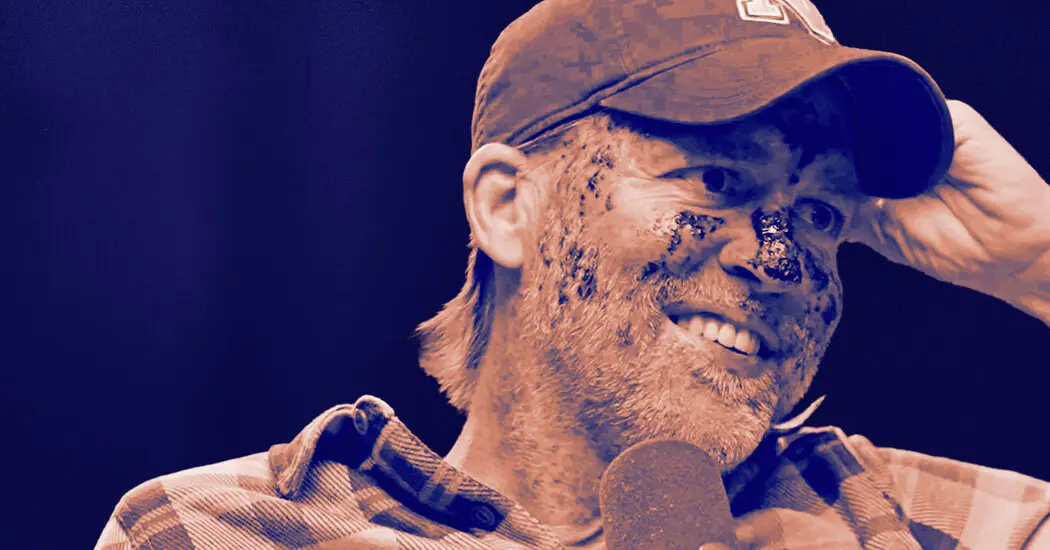
벤 새시, 죽음 앞에서 삶을 사는 법을 말하다
Ben Sasse on How to Live While Dying
The New York Times
Ross Douthat and Victoria Chamberlin
EN
2026-04-09 09:06
Translated
전직 상원의원이 자신이 떠나갈 미국을 치유하고 싶어 한다.
How would you live if you knew when you were going to die?
When Ben Sasse announced last December that he had been diagnosed with Stage 4 pancreatic cancer, he called it a death sentence, but he noted that he’d had one before the cancer too. We all do.
Sasse served the state of Nebraska in the U.S. Senate for eight years as a high-minded and, by his own account, sometimes ineffectual conservative. Then he quit politics to become the president of the University of Florida, pursuing a different model of civic reform.
Now he’s facing mortality.
For Sasse, the advance of his cancer has brought clarity, sharpening his focus on his wife and three children, and the God whom he expects to shortly meet.
At the same time, he’s doing a lot of talking. He’s running his own podcast, titled “Not Dead Yet,” and he’s doing interviews like this one about what life is like on the threshold of the undiscovered country.
Below is an edited transcript of an episode of “Interesting Times.” We recommend listening to it in its original form for the full effect. You can do so using the player above or on the NYTimes app, Apple, Spotify, Amazon Music, YouTube, iHeartRadio or wherever you get your podcasts.
Ross Douthat: Ben Sasse, welcome to “Interesting Times.”
Ben Sasse: These are interesting times. Good to be with you, Ross.
Douthat: It’s a pleasure to have you. I want to start with an important question, which is: Why are we here? And I don’t mean why we’re here in this physical location. We’re taping this in Austin, Texas. I also don’t mean the cosmic question. I think we’ll get to that at the end.
But here, taping this conversation — because people facing a terminal diagnosis have a lot of options: Travel the world, scratch items off the bucket list, seek out obscure therapies in western Tibet, just hunker down and spend time with their families.
And this is not the first interview you’ve done. You’ve chosen to spend time with journalists — and we’re grateful — but I want to know why.
Sasse: Well, you invited me, so I assume you had a cancellation. [Laughs.] Let’s be honest, the bar must be pretty low. I mean, I’m probably here for my looks.
Douthat: We actually had Clavicular, the looksmaxxer, scheduled, and he bailed.
Sasse: I don’t know that. “Cloaca” is a word I’ve been learning a lot lately, but I don’t know this fella.
Douthat: You don’t know about Clavicular? Then that is actually one of the small mercies of your own life. We’ll let viewers figure out for themselves who Clavicular is.
But in all seriousness, you’re doing a lot of talking. You’ve actually become a podcaster yourself, right? You have a podcast.
Sasse: I’m a Monty Python fan, and I’ve been looking to do I.P. theft on “Not dead yet” for a long time — and now I got a way to go.
Douthat: Now you have it.
Sasse: I did not decide to die in public. I obviously ended up with a calling to die. In mid-December I got a three- to four-month life expectancy, and I’m at Day 99 or something since then, and I’m doing a heck of a lot better than I was doing at Christmas.
But even at three to four months left to live, you have to redeem the time. There’s only so many bits of unsolicited advice I can give my children. So, you journalists want to talk, and if you don’t have anybody better, I’m your man. I’ll be your huckleberry.
Douthat: All right. All right. Well, we are very grateful.
Tell me a little bit about the diagnosis and how you ended up where you are right now.
Sasse: I just turned 54. You get into your 30s, 40s and 50s and you’re like, “How do I stay fit?” So, I used to do a lot of sprint triathlons. This fall, I’d been training for some short tris and I ended up with a ton of back pain.
I realized, “Oh, maybe it’s stupid to be wearing the 45-pound weighted vest all the time” — not just when you’re training for running events but also on your bike, because it turns out that’s not the right posture to be wearing a lot of weight.
So, I ended up in late October, Halloweenish, with a lot of back and abdominal pain, and I thought I just pulled some ab muscles from stupid forms of training.
Douthat: But you hadn’t had any pain before this training?
Sasse: Nothing. Nothing until the last couple days of October. But over the course of November, I ended up in significant enough pain that I went to my executive doc at the University of Florida and I said, “Something’s not right here.”
We did a bunch of tests, couldn’t find anything, and they said, “We’re going to refer you to a GI specialist. We’re going to figure out whether it’s undiagnosed celiac or lactose intolerance or something.”
And I said, “I’m a farm kid by upbringing, not the toughest guy on earth, but I don’t have a cheese allergy. There’s something really, really wrong in my back.”
They sent me for full body scans on the morning of Dec. 13 or 14, and they called me back 45 minutes later and you could just hear them hemming and hawing. I said, “Stop beating around the bush. Give me a hard fact.”
They start talking about not wanting to be too premature, and there’s been so many changes in oncology care — dude, you have not told me I have cancer yet, and you’re talking to me about how great oncology care is.
Douthat: “We’ve had so many changes in oncology care” is never what you want to hear.
Sasse: That’s not what you want to hear from the person who clearly is not shooting straight.
I said, “Would you give me a hard fact?” He said, “Are you sure?” I said, “Yeah.”
He was driving too. He said, “I’m going to pull over off the side of the road.” Then he said, “Here’s a hard fact: Ben Sasse’s torso is chock-full of tumors.”
I was like, “OK, you came in with the real stuff.”
So, I have pancreatic cancer — Stage 4, already metastasized. They told me right away on Day 1, “This is not operable, you’re way post-surgical.”
They told me over the course of the next couple of days that I already have five forms of cancer: lymphoma, vascular, lung cancer, bad liver cancer and pancreatic, where it originated. So, it was pretty clear that we’re dealing with a short number of months left to live.
Douthat: What did they tell you to do? What was their advice?
Sasse: I said I believe we’re all on the clock. We’re all dying. So, this is not the scariest thing to me. I’ve always known that we’re going to be pushing up daisies eventually. This is more finite.
I have two kids out of the house — our daughters are 24 and 22. But our providential surprise, our boy, is a decade younger. I was immediately thinking about Melissa, my best friend of 33 years.
Augustin is our son — but that’s theologically heavy for 14, it’s hard to shout at a baseball or football game, so we call him Breck. [Ross laughs.] So, I was thinking about Breck and I said, “How do I navigate this moment? I want the 101. Give me oncology navigation.”
They said three broad categories: There’s radiation, there’s surgery, and there’s chemo. There’s chemo writ small and chemo writ large. Chemo writ large is carpet-bombing your body’s ability to produce cells. Chemo writ small is what does it look like to try to do a targeted therapy and get on a clinical trial?
You have a definite death sentence, but there are some clinical trials that could extend life a little bit. I said, “Teach me how that works.” They said, “You want to figure out where there’s a genetic mutation, potentially.”
We did a bunch of procedures. We ended up with nine successful biopsies in the next couple days, and we sent them off to labs all over the country and we found two genetic mutations.
It turns out the two best places to do clinical trials around pancreatic are Memorial Sloan Kettering in the Upper East Side or M.D. Anderson in Houston. My wife and I flew to both places for 48 hours in the next six days and met all the docs and pounded on doors and said, “Teach us what we have to do to get in this automobile.”
Two weeks later we were admitted to a clinical trial at M.D. Anderson Houston, and we’re delivering super poison to my tumors and trying to beat the hell out of them.
Douthat: We’re having this conversation in Austin, Texas, where you were a long time ago — at U.T.-Austin. So, you’re using this as a kind of family base when you’re doing the treatments in Houston?
Sasse: You got it.
Douthat: How intense are the treatments? How much time are you spending getting the tumors carpet-bombed?
Sasse: We had been living in Florida — Nebraska’s emotional home, and except for Heaven, the eternal home, Austin is a community where we have a church and a lot of friends, and it’s two hours and 40 minutes from M.D. Anderson Houston.
I am blessed that the targeted clinical trial that I’m on only requires me to be in Houston a max of two days a week, and sometimes a lot less than that. So, we decamp from Houston to Austin most weeks. This week I was in Houston on Monday, Tuesday. We’re recording on a Thursday.
Douthat: And how are you getting the treatment? Is it chemo into the vein? What are you literally doing?
Sasse: There’s a company in Silicon Valley called Revolution Medicines, and they have a drug called daraxonrasib, and that’s my drug. I’m able to take it orally, as of now. So, I don’t have an infusion port right now.
I take it orally, but it’s a nasty drug. It causes crazy stuff like my body can’t grow skin and so I bleed all out of a whole bunch of parts of me that shouldn’t be bleeding.
Douthat: Yeah. You look terrible.
Sasse: Thank you.
Douthat: How do you feel?
Sasse: I feel better than I deserve.
Douthat: OK. But how do you feel in the moment, physically? Are you in pain all the time? Do you feel the cancer in your body?
Sasse: I have a really good hospice doc. I’m not dying right now, but I’m well in the category that you can be in those end-of-life months — and she’s spectacular. She’s just walking wisdom. She said to me early on, “When you’re dying of an abdominal disease, you’ve got an algorithm that’s managing four variables: You have tumor-driven pain, you have cancer- and treatment-driven nausea, you’re managing a diarrhea to constipation continuum, and you’ve got energy and fatigue.”
When you go talk to a doc — docs, especially those that don’t have the greatest bedside manner, like to talk about their specialty or they like to get you off the issue you’re talking about so they can talk again.
Douthat: I’ve never noticed that about our friends in the medical profession.
Sasse: She said, “If you lead with any of your four problems, there is a drug for that. We can manage medicine, we can manage any of those four problems — energy, undercarriage, nausea or pain.”
But the problem is the drug will probably mess up the other three variables. So you have to figure out how you want to manage the variables. I was in a ton of pain early on because I had some pancreatic tumors that were essentially pushing on my spinal column.
The liver and pancreas are at the rib cage in the front, and they’re pushing out the back into my spine. I was on 55 milligrams of morphine as soon as I was diagnosed. And that’s — you’re high as a kite. We drove down my pain a lot.
But since then, the drug has shrunk the tumors so much that I was willing to dial back up a little bit of pain to get a little bit of energy back and to be able to have a little more control of my nausea, etc.
I’m down to only about 30 milligrams a day of morphine. I’d say my pain is 80 percent reduced from where I started. I manage nausea a lot. There’s strong waves of desire to puke. And when my face isn’t bleeding, I’m actually pretty good with the puke. I mean, I don’t like it, but you can throw up and you’re through it. So, anyway, enough whining.
Douthat: What’s the pain on a zero to 10 scale right now, sitting here talking to me?
Sasse: Oh, it’s not bad. Four?
Douthat: OK. But it was up at eight?
Douthat: And how does your face and skin feel?
Sasse: Nuclear. [Laughs.]
Douthat: Like burning?
Douthat: Bubbling?
Sasse: Yeah. Yeah. I was at a — I mean, I’m in a pharmacy every day, I’m keeping a lot of that industry employed right now.
But you know there’s the drop-off part and then there’s the pickup part and then there’s that little weird curtain in the corner that says “consult”? I always figured that was just a place to talk about S.T.D.s. Like, I didn’t know what it was, but I just figured they called you over there if there was like some sexually transmitted ——
Douthat: An unusual wart.
Sasse: Yeah, exactly. “There’s something growing here that I don’t know how to make sense of.”
I had a pharmacist call me over there the other day, and she pulls the curtain. I don’t know what’s going on. I’m like, “Do I have a nether problem I don’t even know about?”
She leans in and she said, “Did they do something electrical to you?” [Laughs.]
I don’t even know what that is, but either acid or electric shocks produce a face that looks this hideous.
Douthat: Well, you told her that you’d gotten on the wrong side of like six different mafias. And they’d all taken turns.
Sasse: Exactly. I said, listen, I was at the local Walmart, and they’re going to have to get a handle on all those kids with the bowls of acid running around in the aisles. I’m a victim. [Both laugh.]
Douthat: So, the tumors are smaller right now?
Sasse: Crazy smaller. My tumors this week are down 76 percent from December 29th. Tumor volume in my torso is down 76 percent.
Douthat: If they can knock tumor volume down 76 percent, why can’t they keep you alive for 20 years?
Sasse: Great question. And I have to keep answering this one for my mama.
Douthat: No, I can imagine that some people closer to you than I am had that question.
Sasse: The way it’s been explained to me — and I don’t know squat about biology — but the way it’s been explained to me is you could look out at your yard lawn and there are only six dandelions out there. I could weed those.
But look at your neighbors to the north and to the south: Both of their yards are chock-full of dandelions. Two or three or four mornings from now, that’s your yard. You’ve already seeded everything.
So, even though my pancreas tumors look on the scans like “Let’s get these before and after images blown up and put them on the wall,” they’ve already seeded so many other kinds of cancer that it’s probably just not something you can ever catch up on. There’s too much Whac-A-Mole.
Douthat: Is there anyone who’s gotten better from Stage 4 ——
Sasse: Not from what I have, no.
I have an unbelievable team. Shubham Pant and Bob Wolff are two of my main lead oncologists at M.D. Anderson, and they’re rock stars. They describe their work as being up here with a little pickax on a giant Hoover Dam working on pancreatic cancer.
They get little cracks at the top and sometimes little bits of water splash over and there’s somebody else doing it 400 meters over. And another 300 meters over, there’s another team and there’s somebody at Memorial Sloan Kettering working on it, and they say someday these cracks are going to go big and they’re going to run together and the dam will crash. But, you know, maybe 10 years.
Douthat: OK. So, you’re not worried about a scenario where you do all these interviews and then you have to come back on this podcast in five years and explain why you’re still alive?
Sasse: Oops, I lived. April Fools! [Laughs.]
I think my kids might have that fear, frankly.
Douthat: Right. They’re like, “Not another podcast, Dad.”
Douthat: All right. We’re going to come back to cancer and death and subjects like that.
Sasse: I do want to start to create some memes, though — like, when I’m at M.D. Anderson — wouldn’t it be fun? I have lung cancer too, now. Wouldn’t it be fun to just start smoking cigarettes outside the front door of M.D. Anderson? Just have people post photos of that.
Douthat: For listeners and viewers who don’t know, there’s a famous — I don’t know if it’s technically a meme — but there’s a famous image of you when you were a senator, sitting outside the Senate. You were with Chuck Schumer, right?
Sasse: Yeah. What’s crazy is that the photographer, who I later found out was hiding behind a tree for like an hour.
Douthat: This is what journalism is.
Sasse: I want to give this dude credit. This is the hunt. I’m not interesting. But he was on a hunt.
I’m an early-to-bed guy. I mean, I sleep all the time now, but I used to be a 9 p.m. to bed guy, 4 a.m. wake up. I did a bunch of writing, I did a workout.
But by about 8 a.m., I would call and be a part of family worship around the breakfast table back in Nebraska as they were waking up and getting going.
And people arriving in suits might think I’m slothful and just woke up. I’ve already got four hours in. But I would sit outside a staff and senator door entrance to the Russell Building, where my office was.
I’d come out of the gym, and I looked like a dude who just either woke up hung over, just worked out.
Douthat: No, it looked like you were ready for a pickup basketball game. Or you had just lost a pickup basketball game.
Sasse: I was wearing Umbro shorts, 30 years out of date. But I was sitting there and a lot of my colleagues are coming in and we end up in a series of conversations where Schumer is standing there, perennially —
Douthat: In his full minority leader suit.
Sasse: But a lot of times he’d come in not having yet showered, but wearing the suit that he was going to wear for the day. So he’s got full-on bedhead.
Chuck’s standing there, I’m sitting on this marble rail, and a series of people — Tom Cotton, John McCain.
Chuck and I are standing there — and Schumer talks with his hands, very Brooklyn — and his hands are waving around and there’s this piece of metal that’s off the Russell Building that looks like a giant joint.
And because he keeps talking with his hands, at different points, it looks like he’s got a 13-inch reefer hanging out of his hand. And I’m talking there, clearly just high outside of a wedding — McCain is buttoned up, Tom Cotton is buttoned up.
It became a very fun meme, and people still give me versions of it as Christmas ornaments.
Douthat: That’s good. Well, we need to get someone to Photoshop, just as you were gesturing there, a giant blunt into your hand. This can be the equivalent of the — was it Joe Rogan where Elon Musk was smoking up?
Douthat: There’s some High Times/“Interesting Times” crossover we can do with this meme.
Sasse: Oh, that’s very good. Well done.
Douthat: We’ll get our people to work on it. You’ve got other more pressing concerns.
Before we talk more about human mortality and yours specifically — now that you’re dying, as far as we know, it’s a natural time to ask you big important questions about American politics and your experience thereof.
You have special wisdom because you’re ——
Sasse: Because you’re dying?
You’re 54, you become 94-years-old wise.
Douthat: You’re where Henry Kissinger was at a hundred.
I’ll let that thread drop.
Let’s talk about your political career and what you think about U.S. politics, what it taught you about U.S. politics.
I was in a room last month, with a bunch of very high-minded academics, many of them centrist and center-right — very small tribe. And for some reason, the conversation turned to the future of the Republican Party.
One of these academics said, in a kind of hopeful voice, “I don’t suppose there’s any chance that we’ll get a second act for Ben Sasse.” There was this pause, and then I had to be the one who said, “Well, probably not.” [Ben laughs.]
I wouldn’t go on Kalshi or Polymarket and bet on that.
Sasse: More morphine for the lot of you.
Douthat: This person had not heard about your cancer diagnosis. But I did think that moment was a good way of thinking about your own constituency in politics, which was that there were people who loved Ben Sasse. They tended to be what you might call civic-minded, not super partisan, conservative, centrist — and a few liberals.
But also, for a lot of those people, I think your career was a case study in the limits of a certain kind of civic-minded politics in a more populist age.
First of all, just tell me why you ran for office in the first place. You had done health policy, you’d been president of a small college — why did you decide to become a United States senator?
Sasse: Well, I got drafted into it — partly because I was president of a place called Midland University, a Lutheran liberal arts college in Nebraska. We had a great team. I got too much credit, as if I was Midas. But really, I put together a good team and we did a turnaround of a 130-year-old place that was in real financial trouble — and then it was booming.
So, the alumni of Midland — go, Warriors! — ended up drafting me into the Senate race in 2013 when there was going to be a vacancy. Mike Johanns — a very successful U.S. secretary of agriculture, two-term governor of Nebraska, new senator — surprised people by retiring at the end of his first term.
There wasn’t expected to be an open Senate seat in Nebraska. I wasn’t planning to run for anything. I’ve never run for anything before in my life. I got drafted to run for that, and I thought it’d be kind of fun to live on a campaign bus.
My kids were 12, 10 and two. I didn’t know that I wanted to be a politician, but I thought it’d be fun to be a candidate for a while.
Nebraska has 93 counties, and we went and pounded it. We did public events in all 93 counties. I don’t say that to be self-serving.
I say it to mean that not having intended to be a politician and just having a real conversation with my neighbors — Nebraska’s only 2 million people, it’s a lot of area to cover, but only 2 million people and I pretty much got to know everybody.
So, we had a great time as a family on the campaign trail, but I just want to acknowledge that I wasn’t a very good politician. I am way too idealistic about what I believe in America to be a very good deal maker.
If I had to do it over again, I would be a little more pragmatic and realist about some of the deal-making needs. But big picture, you asked what I learned.
Douthat: Well, just pause there.
Douthat: When you got into the Senate . . . every senator gives a maiden speech. And you just ——
Sasse: I waited a year because it was the old tradition.
Douthat: You waited a year, which was itself an example of what the Ben Sasse brand was at that moment. Tell the listeners and viewers what you said in that speech, roughly.
Sasse: I said the voters hate us all at the end of the day.
Archival clip of Ben Sasse: The people despise us all. And why is this? Because we are not doing our job. We’re not doing the primary things that the people sent us here to do. We’re not tackling the great national problems that worry our bosses at home.
Sasse: At that point, this is Thanksgiving of 2015 — the tribalism of 2020 or even 2017 wasn’t as apparent in 2015, but it was bubbling up fast.
People involved in politics love to do nutpicking about the crazy people at the other end of the continuum that aren’t in their party — and there’s a lot of truth to that. But it’s a definite subordinate story, in my mind, to the big things that are really happening.
So, in that speech, I just kind of wanted to contrast the idea that the public approval numbers for Congress bounced around between nine and 15 percent or so. When you ask people objectively what they think, they think everybody here’s bad at the job.
It isn’t that Republicans are right and that Democrats stink or Democrats are right and that Republicans stink. It’s that these institutions are not working very well at all.
The historian in me says 75 or 100 years from now, when you look back on our moment, we’re not going to talk about politics at all.
What we’re going to talk about is the fact that we were living through a technological revolution that was creating economic and cultural upheaval, and we were living through institutional collapse, and way, way, way, way, way below that, there’s a whole bunch of political institutions that are part of that institutional collapse.
But what’s really happening is these superdevices in our pockets — the largest tools any median individual’s ever had access to in all of human history — allow our consciousness to leave the time and place where we actually live, the places where we break bread, the people who are living next door to us, the people that you can physically touch and hug, the small platoons of real community, and we allow our consciousness to go really far away.
There are things that are awesome about the digital revolution. We’re the richest people in any time and place in all of human history. But there are also things that are horrific about this, and we don’t yet know how to navigate the economic and cultural and familial disruptions that are coming from this technology.
Politicians act like, because they work in politics, politics are the center of this. Politics barely matters for what we’re going through right now. This institution is filled with blowhards.
The Senate should be the world’s greatest deliberative body. It was filled with blowhards that want to pretend whatever we’re screaming about in a partisan, tribal way is really essential and central, and it’s a really peripheral thing almost every single day.
I said we should actually start to tell the truth about what it will look like to have institutional recovery in the Senate ——
Douthat: But what would it look like? Because what you’ve just described is a narrative that makes politicians seem pretty small, and I’m sympathetic to that narrative. But I also write about politics for a living. I at least pretend to give advice to politicians.
You just said before that maybe you were too idealistic and needed to think more about the nitty-gritty of deal making. But is that the advice?
After eight years in the Senate, say you were meeting someone who was just elected U.S. senator from Nebraska and you were giving them a couple of pieces of advice. What would you say?
Sasse: Well, I don’t want to be parochial about this or self-serving, but I’ll go from my personal experience a tiny little bit. Again, Nebraska’s only 2 million people. I don’t mean it’s generalizable and that it would work as an electoral strategy in California, Texas, New York.
But I’m by far the highest vote-getter in the history of Nebraska, as a nonpolitician who’d never done this before.
Something on the order of 60 times, my state party convened or county parties in Nebraska convened to condemn me for not being Trumpy or whatever.
Douthat: This was all after Trump was elected?
Sasse: It was after Trump mostly, but it started before. I got elected in November of 2014. And again, I was 93-0 across 93 counties in Nebraska in that general — which means as a Republican, I won Omaha.
I should define myself. At a policy level, I’m very conservative. At a dispositional and tonal level, I’m a moderate because I believe that American civics and the glories of being able to inherit a constitutional doctrine of anti-majoritarianism and restraints and a belief in pluralism — that stuff is so glorious.
It’s so much more interesting and important than our policy differences about one versus two cheers for this level of government intervention in the economy or regulatory X, Y or Z.
So, the policy fighting is so subordinate in my mind to the civic transmission obligations that we have that I won the whole continuum of Nebraska from very far right to pretty center-left in all four of my elections — two primaries and two generals. And yet, I was constantly condemned by my party.
It did start a little bit pre-Trump because I got elected in 2014, took office in 2015, and by the end of 2015, I was a little bit in trouble with my party at home for not hating Democrats enough. And I was like, “But I don’t. There are 330 million Americans” ——
Douthat: What was a concrete example of that that the party was pissed about?
Sasse: That I didn’t spend time going on the angriest tribal media channels to say that Obama wasn’t born in the U.S. The conspiracy theory versions of stuff became a really important marker for people to say, “I really dislike those other people.”
What I care about is the Ronald Reagan impulse to say, “Freedom is never more than one generation away from extinction,” and that you don’t pass it along in the bloodstream, you pass it along because we teach it — and we haven’t been teaching it since sometime between the late ’60s and the early ’80s.
Our civics experience is in collapse. At this point, I would talk about what was happening on college campuses — much worse in the decade since‚ but at that point, there was some polling that showed just over 35 percent of American college kids thought the First Amendment was dangerous because you might use your freedom of speech to say something that hurt somebody else’s feelings.
The whole dang point of America, the point of America is that we lay down our weapons outside the tent, and you go into the tent and you say: Speech cannot be violence, and violence is not a form of speech.
What we believe here is that everybody is created in the image of God. They have universal rights.
We need to celebrate the American civic tradition together, and we weren’t doing any of that, but I was in trouble with some of my voters for not being angry enough about something Barack Obama had just done.
Douthat: Well, is the problem then that there’s this widespread collapse of interest in or understanding of American civic values, or is it primarily a problem where most people are still on board with those values? Hence, Ben Sasse can win liberal-leaning Omaha, while also winning deep Republican counties, but people who are professionally tribally engaged in politics are tearing the country apart.
Sasse: The weirdos are crowding everybody else out. I think the professional political activist and consumer class, those who allow it to become a core community, are weird enough that almost all of our channels are narrow but deep.
The New York Times obviously still has millions and millions of daily consumers.
Douthat: You don’t have to flatter us, Ben. We have weird
Sasse: Oh, I believe. I think there’s a ton of fan service that happens in The New York Times.
But all of our outlets have an incentive to go narrow and deep because there isn’t any 60 percent audience that’s ever going to exist again, post-digital revolution.
My analogous way of thinking about it, as the son of a football coach, is when we went from three channels to four channels in the 1980s. Not Fox News, but Fox Local. When we went from three to four channels, it was pretty great because it meant on Saturday afternoon you got another football game.
When we went from four channels to 500 channels, it seemed pretty great. When we go from 500 channels to 2,000 channels, it’s pretty obvious that every individual can find something that they think they really want to watch.
But it means tomorrow around the water cooler, you don’t have anything in common that anybody else watched together.
“I Love Lucy” wasn’t important content, but it was shared content. And it meant that tomorrow morning you had a whole bunch of topics you could go to with your neighbor or your co-worker that was just shared cultural data.
We don’t have any of that anymore. So, in a world where everybody is incentivized to go narrow but deep, there’s not a lot of need to call out B.S. and crazy on your own end of the continuum.
There’s a ton of incentive for both political addicts on the right to find some nut job on the left who did or said something crazy — “They’re all going to grab our guns” — or there’s some nut job on the left who says everybody on the right wants to do this horrible thing to you because they found some idiot on Twitter or on a podcast who said that thing.
The problem with that kind of nut picking is it doesn’t ever solve a problem.
It does create a delusional othering of the rest of your community, but it also takes the whole middle and says: These freaks are not people you should really pay attention to.
Douthat: This seems like, for politicians, for the next would-be Ben Sasse, the next high-minded, civic-minded senator, this seems like a pretty pessimistic description. Is there some concrete response to this from politicians?
Sasse: Well, I do think in Nebraska, you could do a long-term version of what I did for less than two terms, but two full election cycles — two primaries, two generals — which is, despite the fact that it looked like the most politically addicted people really, really disliked me, the voters did like me because I was a dad first.
I was a husband, I was a Christian, I was a Husker sports addict. I was talking about the technological disruptions to the nature of their work, but I never pretended there was a piece of legislation that the day after tomorrow apocalypticism or salvation is coming by legislative process.
That’s bullshit. And I would never lie to my people like that. And they know it’s bullshit, and they don’t want to be lied to.
So, they’re like: Why can’t politics do a small number of important long-term things? Tell the truth about the F.I.S.C., figure out what our national security priorities should be. Do a small number of things, shut up and get off the stage.
I think normie politicians have an opportunity, at least in small enough electorates, where people can get to know who you are as a person. Again, I don’t know that this works if you’ve got all the media markets of California, but I think it’s possible.
Big picture — 15 years, 25 years from now, does the Republic survive or not? I think it’s an open question, but I think we do. But if we do, I don’t know the mechanistic steps by which it happened.
If we survive, one thing that I’m nearly certain of is we will figure out how to have discussions in spite of all of the noise of social media chaos, of a lot of lying and a lot of screaming, and just a whole lot of conspiracy stupid all across the continuum.
There’s going to be a lot more normies who show up and roll their eyes and say, “Yeah, Grandma, I know you got a text that some terrible thing’s going to happen if you don’t click this link by tomorrow.”
We’ve figured out how to deal with a lot of that kind of fraud on your digital devices. A lot of the so-called content is also fraudulent nonsense.
And people are going to figure out how to tune out more of the fan service crazy that says only bad people are at the other end of the continuum.
Now, there’s some crazy people everywhere, always have been.
Douthat: But there is a horrible way in which people like that, right?
Sasse: Dopamine hits.
Douthat: Well, it’s dopamine hits, but also — there’s a famous C.S. Lewis quote, right, about the man who reads the newspaper and learns that his enemies overseas have committed atrocities. And then he reads another story that says actually maybe there were fewer atrocities committed. And there’s part of him that’s disappointed.
There is some way in which people respond to the idea that their enemies are even worse than they imagined before. I’ve watched this happen with the Jeffrey Epstein stuff.
As a conservative, I lived for a long time with people on the right who were obsessed with Jeffrey Epstein, and I have my own sort of moderate conspiracy theories about it.
But then as soon as it became about Donald Trump, there was this flip that happened and suddenly I had all of these liberal friends for whom this story was amazing.
They’d never thought about it before, but now it was occupying all this brain space because it became a way to think that the other side was bad. I feel like there’s an element of that where it’s just such a part of human nature that it’s challenging to deal with.
Why didn’t you stick around if you thought this model was workable, that you could have been re-elected in spite of having the base of your party mad at you? Why did you leave?
Sasse: It’s a little weird to say when you’ve just gotten an actual terminal diagnosis, but I will confess that I’ve always felt mortality heavy on my shoulders. I’ve always thought time was short.
The Senate is a very, very, very important institution. It has been in the past, and it will be again in the future, I’m relatively confident. But it doesn’t do anything right now.
So, when you have kids and you’ve watched two of the three of them graduate out and you go two-thirds empty nester while you were commuting every week and you still have another kid left with you, and you just think it’s super unlikely that the Senate’s going to tackle any real stuff this year or next year or the year after that or the year after that — like, why am I still doing this?
I had been recruited for a few college presidencies and none of them seemed like the right fit. I was in the process of running for re-election, etc. But ultimately, I left the Senate for the opportunity to help steer the University of Florida for a time.
Douthat: And was it great to leave politics for a world of friendliness and ideological comity? Everybody loves higher education. I mean, this must have been a big relief, right?
Sasse: We’re recording this interview in Austin. I was on faculty at the University of Texas at Austin from 2004 to 2009, and I remember the old quote — it’s attributed to dozens of people, but one of them is Kissinger: “Academic politics are the most brutal because the stakes are so small.”
I remember when I was on faculty — I’m a historian by training, but I taught at the Lyndon B. Johnson School of Public Affairs in the aughts. We were going through a building renovation, and we had some faculty members basically chain themselves to the dean’s desk because one of them was going to go from 16 and a half feet of window to 15 feet of window, was going to lose like 18 inches of window.
Douthat: Well, I assume their departmental rival was getting the extra foot of glass.
Sasse: Exactly. If I was losing a foot, but you were losing two feet — fine. But not if I lose and you gain.
Academia’s a total mess, obviously. And yet we need institutions to help people go from being 15 to 17 to 19 to 21.
You have to do home leaving, you have to do family formation, you have to do first job, you have to do a ton of habit and character formation stuff.
Higher education could be a really, really useful transitional institution. Right now, it enables lots of endlessly deferred adolescent behaviors and not enough rigor and not enough clarity about either research or teaching or character formation.
But we need to build new institutions in that space, and that was appealing.
Douthat: Tell me just a little bit about the part of your job at Florida that was connected to this larger effort by conservatives to perform a transformation of more liberal academic institutions.
University of Florida started the Hamilton Center, which is one of these institutes of civic thought that double as places where people with moderate and right-of-center views can get hired.
Tell me how you think or what you think about that project.
Sasse: Lots of people deserve credit for the founding of the Hamilton Center, which became the Hamilton School. It will eventually be some form of Hamilton College.
I think it’s worth backing up one step to one of the inherent tensions in the American research university. The American research university is a hybrid of an English teaching college model, Oxbridge, and a German research institute model.
There’s a lot about that that’s great. One of the things that are always a little under-resolved is: Are our research universities preparing people for life or preparing people for jobs? The right answer should be: Yes, both.
We should be preparing the mind and the character for all of the various vocations and callings in life — and to be prepared for the first job, but also for the third job in an industry that doesn’t even exist yet and won’t for 15 or 20 years.
So, we need a lot more rigor. We need a lot more both/and.
So many universities have had liberal arts colleges captured by ideological activists that really only want to speak to eight or 10 or 17 other ideological activists that liberal arts colleges — and I say this as a historian, I say this as somebody who loves the liberal arts — have so obviously abdicated any responsibility for preparing a next generation that we’re now five consecutive decades into higher ed in America having students choose by major, voting with their feet, to move from liberal arts majors to more STEM majors.
Five consecutive decades, students migrating from liberal arts toward STEM disciplines. But the liberal arts, instead of then saying, “Well, let’s use the core curriculum as a way to prepare people for the rest of life, not just the jobs that they may have that may be in engineering or health professions or whatever,” are getting smaller and smaller and smaller and smaller.
Their power, the power of those faculties, is increasingly just to compel students to take their classes through the core curriculum. But the classes aren’t very good. They aren’t very big, they aren’t very rigorous. They aren’t big in terms of grand questions. They’re not trying to help people fall in love with the good, the true and the beautiful.
The answer is not to hate on the liberal arts. The answer is to recover the liberal arts.
Ross Douthat: Right. We’ll talk about the left in a sec, but there is a conservative temptation that you, as a politician and an academic, I’m sure have seen, to look at that story and say: “Oh, we should just accelerate the process. The liberal arts are all just socialist identity politics, deconstructionist rot and let’s just cut their budgets and encourage people onto pure preprofessional vocational tracks.”
I feel like you see that a lot from a certain kind of Republican politician.
Sasse: Burn it all down is the impulse of a lot of folks.
Douthat: And just leave the business school standing.
Douthat: How do you persuade conservatives that they need to be invested in these institutions?
Sasse: One of the ways is by building a better college of liberal arts, which is functionally what Hamilton is.
You asked what do I think of this project? There have been a lot of these schools. They’re very important as reform germs.
But what you really want is to go much bigger and ask: What does great history look like? Why is it that almost all the history books that show up on a New York Times best-seller list are written by people that are not practicing historians in academic departments? Because they want to write identity politics’ narrow, narrow, narrow, narrow, narrow questions that aren’t ever going to be read by people.
You really want to ask questions about why does a generally educated American adult, citizen, neighbor, voter, lover need to read history? What is the point of learning history? You’re not going to hear that argument in most history departments right now.
So, what you’d like to see is great history, great literature, great love for music and the arts, etc. And those things are not being done in universities right now, by and large.
Let’s build better liberal arts colleges at the center of these institutions.
Douthat: Do you think you can get buy-in for that project from people who aren’t conservatives or conservative sympathizers within academia?
Sasse: Well, I’ll give you an example. At Hamilton, when I got there, I think Hamilton had so many — I mean, thousands — of applicants, and lots of them were Ivy League liberals, professors who taught in the most prestigious universities in big departments, and they would quietly reach out like they were doing something scandalous: “Do you think I would be considered if I applied for a job at Hamilton?”
They had the idea that had been repeated by some lazy media that Hamilton was a conservative project. Hamilton wasn’t a conservative project. It was a liberal arts project.
Douthat: Wait, wait. It was a conservative political project in the sense that the people who wanted it the most, the instigators and originators of the idea, some of them were classical liberals, plenty of them didn’t vote for Donald Trump, but it was still clearly a right-coded, conservative-coded project.
I agree with you.
Sasse: If you love Shakespeare, does that make you a conservative?
Douthat: I mean, under certain current academic conditions, that is coded as conservative. I mean, you were in charge. You were a Republican senator brought in to be president of the University of Florida.
I’m not disagreeing with you that this perspective and approach should be able to bring in people who are not conservative. I’m just saying it is part of the challenge.
Sasse: There’s no theological litmus test for hiring anybody in any of those disciplines.
Douthat: Right. I’m just saying part of the challenge is that, if you’re in a red state, then sometimes it’s coming out of Republican policymaking in the state legislature and so on. The ideological element is there, and it’s sort of what you’re trying to transcend.
Sasse: Fair. But I think the 101 question is: What is the best use of 45 months of an 18- to 22-year-old’s time? Why would we compel people to do anything? It better dang well benefit them and benefit the broader society in terms of the economic output they’re going to produce, but more importantly, the civic engagement that they’re going to be able to have and the love of neighbor and the engagement with a republic — a small-r republic of pluralists who say, “We don’t want a polity that’s based on power, we want a whole bunch of people who want to flourish and thrive and build great things in their community.”
And that requires you to be acquainted with some of the wonderful ideas and with beauty in the past — and most of that is way more interesting than anything that is political.
Douthat: Yeah. One thing that has made me maybe more optimistic about this “save the humanities” project is actually watching left-wing academia react to artificial intelligence.
Douthat: Part of the reaction, I think, is mistaken. I think there’s part of the reaction that underrates the technology and wants to say it’s not that important, it’s all fakery, it’s just Silicon Valley hype. I think that part is wrong.
But there is also a reaction I’ve seen that is a humanist reaction that is trying to emphasize human exceptionalism, which is not where parts of the academic left have been.
It’s made me wonder whether there is a kind of left-right humanist dialogue around the bigger question — that I know you have thoughts on because you were talking earlier about the technological challenge we’re living through — of what is a human being and what makes human beings distinct from a computer or a machine?
Those seem like questions that maybe get us out of current polarization a little bit. What do you think?
Sasse: Well said. In my precancer life, where you sometimes dance for your dinner or you’re raising money for a university and you’re asked to give generalist speeches on a lot of topics, 90 percent of the time, somebody will ask you some version of the question, “Do you think A.I. is going to bring heaven or A.I. is going to bring hell?”
And the right answer is: “Yes.”
A.I. is going to be human activity and behavior at warp speed for good and for ill. A lot of the stuff that we’ve been good at, we’re going to get more of it faster, cheaper and more broadly distributed. But a lot of what’s horrible about human addictions and distractions, we’re also going to get a lot more of it faster, cheaper more ubiquitous.
I think the grand divide that is coming, sociologically or demographically, is not chiefly a class divide. I think the grand divide that’s coming is about intentionality and what you do with your affections and these supertools.
The people who use the tools and get to capture the ability to drive marginal computing costs toward zero, we’re either going to make the quantification of routinizable tasks either actually free or so close to free that we won’t bother to meter it anymore — that’s going to be extraordinary. It’s going to be a transformation of the way economics has worked for human history.
Past economics was a discipline about scarcity. Economics is going to become a discipline about ubiquitous abundance.
Or your people who agree to outsource your attention and affections to somebody else’s algorithm — that’s hell. Who would’ve ever thought that we’d be living in a sex collapse — less premarital sex, less extramarital sex, less marital sex — because people are so addicted to not just pornography proper, but digital distraction from bodily goodness? That’s weird.
I think that the digital revolution that we’re going to live through is going to bring all of that at a faster speed.
For a small number of people with lots of intentionality, lots of habits and fit communities of accountability and Sabbaths, these tools are probably going to be pretty great. For the majority of people, I think they’re going to be disastrous.
Douthat: What do you try to give to the normal people in that scenario? Is it a different philosophy of life? Is it a religious vision? It’s an 80:20 scenario where it’s heaven for 20 percent and hell for 80 percent. What’s the path up for the 80 percent?
Sasse: Communities that can do shared deferred gratification, that can say self-discipline, self-restraint, self-control are the only antidotes to other constraint, other discipline and others’ control.
I think we want to think very, very intentionally about our affections. What are your loves?
We have to think deeply about rank-ordered loves. I don’t think we do that right now.
Our temptation to allow these tools to algorithmically tempt me into an eternal now, now, now, now, now, now slot machine of dopamine hits is super dangerous. We have been, for 150 years, tempted toward generational segregation, which loses wisdom.
Douthat: Meaning the young don’t encounter the old and vice versa, actually.
Sasse: Exactly. I think that in my pantheon of American greats and villains, we radically underappreciate the downsides of John Dewey.
I think John Dewey did many, many, many, many terrible things. And one of them was to say: Well, the economy went from craftwork and agriculture to industrialized scale. We should make childhood on an industrialized scale, and we should institutionalize children for the vast majority of the time, indoors, sitting still, passive, “Mother, may I?” — and only around people with their same birth year.
One of the least significant factors about life is people that just happen to have my same birth year — except when you’re 14 or 16, then it’s really terrible because our frontal lobes aren’t done. And what a horrible thing to segregate 16-year-olds only with 16-year-olds. Those people are idiots.
They deserve the benefits of 80-year-old wisdom. And by the way, 80-year-olds deserve the benefits of the reward of seeing 16-year-old vitality again.
One of the things I think the digital revolution does is it takes our generational segregation and puts it on speed, and we lose lots of wisdom.
We need a lot more communitarian thickness to get at some of these self-restraints and self-controls that can use the tools instead of being used by the tools.
Douthat: Let’s talk about your loves, your little platoons.
I’ve never had a cancer diagnosis. I was very ill 5, 7, 10 years ago. Early on in that, I had a bunch of phantom heart attacks where I went to the emergency room and I would think briefly that I was going to die. And what was striking in those moments was actually how little I was personally afraid of my own mortality, and how much fear I had about my family and my kids.
Your kids are older now than mine were then. Two of them are grown — or as grown as young people can be. But just tell me how you’re thinking about your relationship to them and your own family life in the shadow of death.
Sasse: I got my diagnosis in mid-December.
Similar to when you were going through your health episodes, I was incredibly blessed to be quickly at peace. I kept hearing the Pauline phrase “To live as Christ, to die is gain.”
Death is terrible. We should never sugarcoat it. It is not how things are meant to be. But it is great that death can be called the final enemy. It’s an enemy, but it’s a final enemy, and there will then be no more tears.
I believe in the Resurrection, and I believe in a restoration of this world. So, I did not feel great fear about my death. I didn’t want the pain I was going through. I didn’t want to be a pansy ass in the final moments.
Douthat: You’re doing OK right now in that. So far.
Sasse: Oh, thank you. But I did immediately feel regrets about a lot of misprioritization. You jokingly referred earlier to my podcast, which takes its name from Monty Python: “Not Dead Yet.”
We’re all on the clock, and I wanted to have prioritized better. Whether I really only have three or four months left, or if I get nine to 12 months left, I want to prioritize better from then.
But in my tradition, in Christianity, the need for daily repentance is just a truth. “I am broken. I leave undone those things which I ought to have done, and I do those things which I ought not to have done and there is no health in us.”
I get to repent every day of both my sins of omission and commission. And yet, at a slightly bigger level, if you’re only going to get three or four months, you really want to get some of your affairs in order.
My boy is only 14, and I felt a heaviness. I knew that God wasn’t surprised by the diagnosis. There is not a maverick molecule in the universe, but I didn’t like the idea of my 14-year-old son not having a dad around at 16. I didn’t like the idea of my daughters, who are 22 and 24, not having their dad there to walk them down the aisle.
I felt a real heaviness about that. But I’ve continued to feel a peace about the fact that death is something that we should hate. We should call it a wicked thief. And yet, it’s pretty good that you pass through the veil of tears one time and then there will be no more tears, there will be no more cancer.
Douthat: Can I ask how you think your kids are processing the experience?
Sasse: They have a great mom and they are theologically rooted and their hope is in Jesus. All three are doing really well. My girls are 22 and 24, and I know that our conversations are the true and accurate conversations.
My 14-year-old son is gritty enough and tough enough that I think even if he wasn’t doing well, he could probably fake it. I don’t fully know, so I covet prayers on that, but he seems to be doing well.
Douthat: Just on the front of having something like this change how you think about your own priorities, is there advice that you would give to someone who is the Ben Sasse father of three at age 40 or age 35, when the kids are young and everything’s stressful and chaotic? In light of where you are now?
Sasse: Happy to go fire hose on this one.
Number one, honor the Sabbath and keep it holy. Man, I wish I’d treated the Lord’s Day differently over the course of my life. I’ve always known it, believed in it and thought: Maybe next week we’ll get better.
We’ve been at Sunday worship every morning forever, but man, am I tempted by 12:45 or 1:30 in the afternoon to get back to work or, to an addictive level, work about the N.F.L.
Boy, I would treat Sabbaths differently — and especially digital intrusions into the Sabbath.
Dinnertime is precious. Man, lock up your devices and keep them away from the table and prioritize that time.
There is a limit to how many trips a month are really worth it. I lived a road warrior life for a long time, and I kind of had a rule of thumb that seven nights a month in a hotel was the ceiling. But, boy, there’s a difference between seven and nine and there’s a difference between seven and five — and I took way, way, way, way too many trips.
Douthat: That might be convicting for the man interviewing you, but go on.
Sasse: Family compounds. Have more cousins and figure out how to live thick with them. There’s so many times when we optimize around things that are not nearly as important as more family thickness. Boy, I wish we lived down the block from my folks.
Douthat: One of my recent guests was Bart Ehrman, who’s a New Testament scholar, well known as a skeptic, who was a Christian, was evangelical Christian for a time and lost his Christian faith.
And in our conversation, he talked about the idea that he didn’t lose his faith because he decided that the Gospels weren’t historically reliable — though that was mostly what we argued about — but because of the problem of evil, of human suffering. He specifically talked about unanswered prayers. I assume you’ve prayed for healing?
Not to be the guy who just beats the odds, but to be the miracle story, right? God hasn’t answered those prayers yet. Are you angry at God ever?
Douthat: Not at all?
I wouldn’t want a sovereign God to defer to all of my prayers with a yes. I’m not omniscient. I don’t know what the weaving together of the tapestry of full redemption should look like, but I know going through the period of suffering that I’m going through is a benefit because it is a winnowing.
I’m filled with dross. This suffering is not salvific, but it’s sanctifying, and I’m grateful for it.
Tim Keller, who I know you knew, who’s in my denomination — a Presbyterian pastor in New York who also died of pancreatic cancer — said: I hate pancreatic cancer. I would never wish it on anyone, but I would never want to go back to a time in my life where I didn’t know the prayer of pancreatic cancer.
Meaning I now, in the midst of this disease, know much more the truth of my finitude than I ever let myself believe in the past. The hubristic nonsense — I believe in God and I’m grateful and blessed, but I can build a storehouse that can be pretty deistically persuasive.
My storehouse can have enough resources that I can operate without a need, but that’s not true. I can’t keep the planets in orbit. I can’t even grow skin on my face.
Douthat: For the listener or viewer who — whether for Ehrman’s reasons or others — doesn’t believe in God and finds your cosmic optimism admirable, but maybe thinks that you’re deluding yourself on the brink of actual finitude, what would you say to that person?
Sasse: Let’s read the book of Romans together. In Romans 1, where Paul’s essentially laying out a catechetical argument for the structure of Christianity against a Jewish messianic hopeful backdrop, he says there are lots of intellectual arguments you can make against God, but you have to start with a fundamental question about what do you do with this moral issue of our own conscience?
And does the individual in your hypothetical really start with the claim that things are right in your soul? Because I can’t relate to that. Things are not right in my soul.
My soul thinks Ben should be God, and I want that to die. Cancer sucks. But I’m pretty grateful that cancer is a stake against my delusional self-idolatry.
Douthat: Do you think you’re ready to die? Do you feel ready?
Sasse: I don’t feel ready. But to whom would I go? I have confidence that when Jesus says to the disciples he didn’t want to be identified as the Messiah yet, keep these crowds away, don’t tell about the water-into-wine miracle at the feast — how amazing is it that Jesus’ first miracle is a big-ass party? Let’s drink more together.
But he says: You can’t keep the children from me. And we’re told that we get to approach the Almighty, we get to approach the divine and call him Daddy, Abba, Father? That’s pretty glorious. And I know that that’s what I need.
Douthat: Ben. [Voice breaks.] Sorry.
Sasse: Happy to get him, to get him to open up a can of pansy ass.
Douthat: Yeah, you got me at the end. Got me. Ben Sasse, thank you for joining me.
Sasse: Thanks for having me.
Thoughts? Email us at interestingtimes@nytimes.com.
This episode of “Interesting Times” was produced by Victoria Chamberlin , Sophia Alvarez Boyd, and Emily Holzknecht. It was edited by Jordana Hochman. Mixing and engineering by Efim Shapiro. Cinematography by Marina King and Logan Lepper, AE Studio. Video
The Times is committed to publishing a diversity of letters to the editor. We’d like to hear what you think about this or any of our articles. Here are some tips. And here’s our email: letters@nytimes.com.
Follow the New York Times Opinion section on Facebook, Instagram, TikTok, Bluesky, WhatsApp and Threads.
Ross Douthat has been an Opinion columnist for The Times since 2009. He is also the host of the Opinion podcast “Interesting Times.” He is the author, most recently, of “Believe: Why Everyone Should Be Religious.” @DouthatNYT • Facebook
When Ben Sasse announced last December that he had been diagnosed with Stage 4 pancreatic cancer, he called it a death sentence, but he noted that he’d had one before the cancer too. We all do.
Sasse served the state of Nebraska in the U.S. Senate for eight years as a high-minded and, by his own account, sometimes ineffectual conservative. Then he quit politics to become the president of the University of Florida, pursuing a different model of civic reform.
Now he’s facing mortality.
For Sasse, the advance of his cancer has brought clarity, sharpening his focus on his wife and three children, and the God whom he expects to shortly meet.
At the same time, he’s doing a lot of talking. He’s running his own podcast, titled “Not Dead Yet,” and he’s doing interviews like this one about what life is like on the threshold of the undiscovered country.
Below is an edited transcript of an episode of “Interesting Times.” We recommend listening to it in its original form for the full effect. You can do so using the player above or on the NYTimes app, Apple, Spotify, Amazon Music, YouTube, iHeartRadio or wherever you get your podcasts.
Ross Douthat: Ben Sasse, welcome to “Interesting Times.”
Ben Sasse: These are interesting times. Good to be with you, Ross.
Douthat: It’s a pleasure to have you. I want to start with an important question, which is: Why are we here? And I don’t mean why we’re here in this physical location. We’re taping this in Austin, Texas. I also don’t mean the cosmic question. I think we’ll get to that at the end.
But here, taping this conversation — because people facing a terminal diagnosis have a lot of options: Travel the world, scratch items off the bucket list, seek out obscure therapies in western Tibet, just hunker down and spend time with their families.
And this is not the first interview you’ve done. You’ve chosen to spend time with journalists — and we’re grateful — but I want to know why.
Sasse: Well, you invited me, so I assume you had a cancellation. [Laughs.] Let’s be honest, the bar must be pretty low. I mean, I’m probably here for my looks.
Douthat: We actually had Clavicular, the looksmaxxer, scheduled, and he bailed.
Sasse: I don’t know that. “Cloaca” is a word I’ve been learning a lot lately, but I don’t know this fella.
Douthat: You don’t know about Clavicular? Then that is actually one of the small mercies of your own life. We’ll let viewers figure out for themselves who Clavicular is.
But in all seriousness, you’re doing a lot of talking. You’ve actually become a podcaster yourself, right? You have a podcast.
Sasse: I’m a Monty Python fan, and I’ve been looking to do I.P. theft on “Not dead yet” for a long time — and now I got a way to go.
Douthat: Now you have it.
Sasse: I did not decide to die in public. I obviously ended up with a calling to die. In mid-December I got a three- to four-month life expectancy, and I’m at Day 99 or something since then, and I’m doing a heck of a lot better than I was doing at Christmas.
But even at three to four months left to live, you have to redeem the time. There’s only so many bits of unsolicited advice I can give my children. So, you journalists want to talk, and if you don’t have anybody better, I’m your man. I’ll be your huckleberry.
Douthat: All right. All right. Well, we are very grateful.
Tell me a little bit about the diagnosis and how you ended up where you are right now.
Sasse: I just turned 54. You get into your 30s, 40s and 50s and you’re like, “How do I stay fit?” So, I used to do a lot of sprint triathlons. This fall, I’d been training for some short tris and I ended up with a ton of back pain.
I realized, “Oh, maybe it’s stupid to be wearing the 45-pound weighted vest all the time” — not just when you’re training for running events but also on your bike, because it turns out that’s not the right posture to be wearing a lot of weight.
So, I ended up in late October, Halloweenish, with a lot of back and abdominal pain, and I thought I just pulled some ab muscles from stupid forms of training.
Douthat: But you hadn’t had any pain before this training?
Sasse: Nothing. Nothing until the last couple days of October. But over the course of November, I ended up in significant enough pain that I went to my executive doc at the University of Florida and I said, “Something’s not right here.”
We did a bunch of tests, couldn’t find anything, and they said, “We’re going to refer you to a GI specialist. We’re going to figure out whether it’s undiagnosed celiac or lactose intolerance or something.”
And I said, “I’m a farm kid by upbringing, not the toughest guy on earth, but I don’t have a cheese allergy. There’s something really, really wrong in my back.”
They sent me for full body scans on the morning of Dec. 13 or 14, and they called me back 45 minutes later and you could just hear them hemming and hawing. I said, “Stop beating around the bush. Give me a hard fact.”
They start talking about not wanting to be too premature, and there’s been so many changes in oncology care — dude, you have not told me I have cancer yet, and you’re talking to me about how great oncology care is.
Douthat: “We’ve had so many changes in oncology care” is never what you want to hear.
Sasse: That’s not what you want to hear from the person who clearly is not shooting straight.
I said, “Would you give me a hard fact?” He said, “Are you sure?” I said, “Yeah.”
He was driving too. He said, “I’m going to pull over off the side of the road.” Then he said, “Here’s a hard fact: Ben Sasse’s torso is chock-full of tumors.”
I was like, “OK, you came in with the real stuff.”
So, I have pancreatic cancer — Stage 4, already metastasized. They told me right away on Day 1, “This is not operable, you’re way post-surgical.”
They told me over the course of the next couple of days that I already have five forms of cancer: lymphoma, vascular, lung cancer, bad liver cancer and pancreatic, where it originated. So, it was pretty clear that we’re dealing with a short number of months left to live.
Douthat: What did they tell you to do? What was their advice?
Sasse: I said I believe we’re all on the clock. We’re all dying. So, this is not the scariest thing to me. I’ve always known that we’re going to be pushing up daisies eventually. This is more finite.
I have two kids out of the house — our daughters are 24 and 22. But our providential surprise, our boy, is a decade younger. I was immediately thinking about Melissa, my best friend of 33 years.
Augustin is our son — but that’s theologically heavy for 14, it’s hard to shout at a baseball or football game, so we call him Breck. [Ross laughs.] So, I was thinking about Breck and I said, “How do I navigate this moment? I want the 101. Give me oncology navigation.”
They said three broad categories: There’s radiation, there’s surgery, and there’s chemo. There’s chemo writ small and chemo writ large. Chemo writ large is carpet-bombing your body’s ability to produce cells. Chemo writ small is what does it look like to try to do a targeted therapy and get on a clinical trial?
You have a definite death sentence, but there are some clinical trials that could extend life a little bit. I said, “Teach me how that works.” They said, “You want to figure out where there’s a genetic mutation, potentially.”
We did a bunch of procedures. We ended up with nine successful biopsies in the next couple days, and we sent them off to labs all over the country and we found two genetic mutations.
It turns out the two best places to do clinical trials around pancreatic are Memorial Sloan Kettering in the Upper East Side or M.D. Anderson in Houston. My wife and I flew to both places for 48 hours in the next six days and met all the docs and pounded on doors and said, “Teach us what we have to do to get in this automobile.”
Two weeks later we were admitted to a clinical trial at M.D. Anderson Houston, and we’re delivering super poison to my tumors and trying to beat the hell out of them.
Douthat: We’re having this conversation in Austin, Texas, where you were a long time ago — at U.T.-Austin. So, you’re using this as a kind of family base when you’re doing the treatments in Houston?
Sasse: You got it.
Douthat: How intense are the treatments? How much time are you spending getting the tumors carpet-bombed?
Sasse: We had been living in Florida — Nebraska’s emotional home, and except for Heaven, the eternal home, Austin is a community where we have a church and a lot of friends, and it’s two hours and 40 minutes from M.D. Anderson Houston.
I am blessed that the targeted clinical trial that I’m on only requires me to be in Houston a max of two days a week, and sometimes a lot less than that. So, we decamp from Houston to Austin most weeks. This week I was in Houston on Monday, Tuesday. We’re recording on a Thursday.
Douthat: And how are you getting the treatment? Is it chemo into the vein? What are you literally doing?
Sasse: There’s a company in Silicon Valley called Revolution Medicines, and they have a drug called daraxonrasib, and that’s my drug. I’m able to take it orally, as of now. So, I don’t have an infusion port right now.
I take it orally, but it’s a nasty drug. It causes crazy stuff like my body can’t grow skin and so I bleed all out of a whole bunch of parts of me that shouldn’t be bleeding.
Douthat: Yeah. You look terrible.
Sasse: Thank you.
Douthat: How do you feel?
Sasse: I feel better than I deserve.
Douthat: OK. But how do you feel in the moment, physically? Are you in pain all the time? Do you feel the cancer in your body?
Sasse: I have a really good hospice doc. I’m not dying right now, but I’m well in the category that you can be in those end-of-life months — and she’s spectacular. She’s just walking wisdom. She said to me early on, “When you’re dying of an abdominal disease, you’ve got an algorithm that’s managing four variables: You have tumor-driven pain, you have cancer- and treatment-driven nausea, you’re managing a diarrhea to constipation continuum, and you’ve got energy and fatigue.”
When you go talk to a doc — docs, especially those that don’t have the greatest bedside manner, like to talk about their specialty or they like to get you off the issue you’re talking about so they can talk again.
Douthat: I’ve never noticed that about our friends in the medical profession.
Sasse: She said, “If you lead with any of your four problems, there is a drug for that. We can manage medicine, we can manage any of those four problems — energy, undercarriage, nausea or pain.”
But the problem is the drug will probably mess up the other three variables. So you have to figure out how you want to manage the variables. I was in a ton of pain early on because I had some pancreatic tumors that were essentially pushing on my spinal column.
The liver and pancreas are at the rib cage in the front, and they’re pushing out the back into my spine. I was on 55 milligrams of morphine as soon as I was diagnosed. And that’s — you’re high as a kite. We drove down my pain a lot.
But since then, the drug has shrunk the tumors so much that I was willing to dial back up a little bit of pain to get a little bit of energy back and to be able to have a little more control of my nausea, etc.
I’m down to only about 30 milligrams a day of morphine. I’d say my pain is 80 percent reduced from where I started. I manage nausea a lot. There’s strong waves of desire to puke. And when my face isn’t bleeding, I’m actually pretty good with the puke. I mean, I don’t like it, but you can throw up and you’re through it. So, anyway, enough whining.
Douthat: What’s the pain on a zero to 10 scale right now, sitting here talking to me?
Sasse: Oh, it’s not bad. Four?
Douthat: OK. But it was up at eight?
Douthat: And how does your face and skin feel?
Sasse: Nuclear. [Laughs.]
Douthat: Like burning?
Douthat: Bubbling?
Sasse: Yeah. Yeah. I was at a — I mean, I’m in a pharmacy every day, I’m keeping a lot of that industry employed right now.
But you know there’s the drop-off part and then there’s the pickup part and then there’s that little weird curtain in the corner that says “consult”? I always figured that was just a place to talk about S.T.D.s. Like, I didn’t know what it was, but I just figured they called you over there if there was like some sexually transmitted ——
Douthat: An unusual wart.
Sasse: Yeah, exactly. “There’s something growing here that I don’t know how to make sense of.”
I had a pharmacist call me over there the other day, and she pulls the curtain. I don’t know what’s going on. I’m like, “Do I have a nether problem I don’t even know about?”
She leans in and she said, “Did they do something electrical to you?” [Laughs.]
I don’t even know what that is, but either acid or electric shocks produce a face that looks this hideous.
Douthat: Well, you told her that you’d gotten on the wrong side of like six different mafias. And they’d all taken turns.
Sasse: Exactly. I said, listen, I was at the local Walmart, and they’re going to have to get a handle on all those kids with the bowls of acid running around in the aisles. I’m a victim. [Both laugh.]
Douthat: So, the tumors are smaller right now?
Sasse: Crazy smaller. My tumors this week are down 76 percent from December 29th. Tumor volume in my torso is down 76 percent.
Douthat: If they can knock tumor volume down 76 percent, why can’t they keep you alive for 20 years?
Sasse: Great question. And I have to keep answering this one for my mama.
Douthat: No, I can imagine that some people closer to you than I am had that question.
Sasse: The way it’s been explained to me — and I don’t know squat about biology — but the way it’s been explained to me is you could look out at your yard lawn and there are only six dandelions out there. I could weed those.
But look at your neighbors to the north and to the south: Both of their yards are chock-full of dandelions. Two or three or four mornings from now, that’s your yard. You’ve already seeded everything.
So, even though my pancreas tumors look on the scans like “Let’s get these before and after images blown up and put them on the wall,” they’ve already seeded so many other kinds of cancer that it’s probably just not something you can ever catch up on. There’s too much Whac-A-Mole.
Douthat: Is there anyone who’s gotten better from Stage 4 ——
Sasse: Not from what I have, no.
I have an unbelievable team. Shubham Pant and Bob Wolff are two of my main lead oncologists at M.D. Anderson, and they’re rock stars. They describe their work as being up here with a little pickax on a giant Hoover Dam working on pancreatic cancer.
They get little cracks at the top and sometimes little bits of water splash over and there’s somebody else doing it 400 meters over. And another 300 meters over, there’s another team and there’s somebody at Memorial Sloan Kettering working on it, and they say someday these cracks are going to go big and they’re going to run together and the dam will crash. But, you know, maybe 10 years.
Douthat: OK. So, you’re not worried about a scenario where you do all these interviews and then you have to come back on this podcast in five years and explain why you’re still alive?
Sasse: Oops, I lived. April Fools! [Laughs.]
I think my kids might have that fear, frankly.
Douthat: Right. They’re like, “Not another podcast, Dad.”
Douthat: All right. We’re going to come back to cancer and death and subjects like that.
Sasse: I do want to start to create some memes, though — like, when I’m at M.D. Anderson — wouldn’t it be fun? I have lung cancer too, now. Wouldn’t it be fun to just start smoking cigarettes outside the front door of M.D. Anderson? Just have people post photos of that.
Douthat: For listeners and viewers who don’t know, there’s a famous — I don’t know if it’s technically a meme — but there’s a famous image of you when you were a senator, sitting outside the Senate. You were with Chuck Schumer, right?
Sasse: Yeah. What’s crazy is that the photographer, who I later found out was hiding behind a tree for like an hour.
Douthat: This is what journalism is.
Sasse: I want to give this dude credit. This is the hunt. I’m not interesting. But he was on a hunt.
I’m an early-to-bed guy. I mean, I sleep all the time now, but I used to be a 9 p.m. to bed guy, 4 a.m. wake up. I did a bunch of writing, I did a workout.
But by about 8 a.m., I would call and be a part of family worship around the breakfast table back in Nebraska as they were waking up and getting going.
And people arriving in suits might think I’m slothful and just woke up. I’ve already got four hours in. But I would sit outside a staff and senator door entrance to the Russell Building, where my office was.
I’d come out of the gym, and I looked like a dude who just either woke up hung over, just worked out.
Douthat: No, it looked like you were ready for a pickup basketball game. Or you had just lost a pickup basketball game.
Sasse: I was wearing Umbro shorts, 30 years out of date. But I was sitting there and a lot of my colleagues are coming in and we end up in a series of conversations where Schumer is standing there, perennially —
Douthat: In his full minority leader suit.
Sasse: But a lot of times he’d come in not having yet showered, but wearing the suit that he was going to wear for the day. So he’s got full-on bedhead.
Chuck’s standing there, I’m sitting on this marble rail, and a series of people — Tom Cotton, John McCain.
Chuck and I are standing there — and Schumer talks with his hands, very Brooklyn — and his hands are waving around and there’s this piece of metal that’s off the Russell Building that looks like a giant joint.
And because he keeps talking with his hands, at different points, it looks like he’s got a 13-inch reefer hanging out of his hand. And I’m talking there, clearly just high outside of a wedding — McCain is buttoned up, Tom Cotton is buttoned up.
It became a very fun meme, and people still give me versions of it as Christmas ornaments.
Douthat: That’s good. Well, we need to get someone to Photoshop, just as you were gesturing there, a giant blunt into your hand. This can be the equivalent of the — was it Joe Rogan where Elon Musk was smoking up?
Douthat: There’s some High Times/“Interesting Times” crossover we can do with this meme.
Sasse: Oh, that’s very good. Well done.
Douthat: We’ll get our people to work on it. You’ve got other more pressing concerns.
Before we talk more about human mortality and yours specifically — now that you’re dying, as far as we know, it’s a natural time to ask you big important questions about American politics and your experience thereof.
You have special wisdom because you’re ——
Sasse: Because you’re dying?
You’re 54, you become 94-years-old wise.
Douthat: You’re where Henry Kissinger was at a hundred.
I’ll let that thread drop.
Let’s talk about your political career and what you think about U.S. politics, what it taught you about U.S. politics.
I was in a room last month, with a bunch of very high-minded academics, many of them centrist and center-right — very small tribe. And for some reason, the conversation turned to the future of the Republican Party.
One of these academics said, in a kind of hopeful voice, “I don’t suppose there’s any chance that we’ll get a second act for Ben Sasse.” There was this pause, and then I had to be the one who said, “Well, probably not.” [Ben laughs.]
I wouldn’t go on Kalshi or Polymarket and bet on that.
Sasse: More morphine for the lot of you.
Douthat: This person had not heard about your cancer diagnosis. But I did think that moment was a good way of thinking about your own constituency in politics, which was that there were people who loved Ben Sasse. They tended to be what you might call civic-minded, not super partisan, conservative, centrist — and a few liberals.
But also, for a lot of those people, I think your career was a case study in the limits of a certain kind of civic-minded politics in a more populist age.
First of all, just tell me why you ran for office in the first place. You had done health policy, you’d been president of a small college — why did you decide to become a United States senator?
Sasse: Well, I got drafted into it — partly because I was president of a place called Midland University, a Lutheran liberal arts college in Nebraska. We had a great team. I got too much credit, as if I was Midas. But really, I put together a good team and we did a turnaround of a 130-year-old place that was in real financial trouble — and then it was booming.
So, the alumni of Midland — go, Warriors! — ended up drafting me into the Senate race in 2013 when there was going to be a vacancy. Mike Johanns — a very successful U.S. secretary of agriculture, two-term governor of Nebraska, new senator — surprised people by retiring at the end of his first term.
There wasn’t expected to be an open Senate seat in Nebraska. I wasn’t planning to run for anything. I’ve never run for anything before in my life. I got drafted to run for that, and I thought it’d be kind of fun to live on a campaign bus.
My kids were 12, 10 and two. I didn’t know that I wanted to be a politician, but I thought it’d be fun to be a candidate for a while.
Nebraska has 93 counties, and we went and pounded it. We did public events in all 93 counties. I don’t say that to be self-serving.
I say it to mean that not having intended to be a politician and just having a real conversation with my neighbors — Nebraska’s only 2 million people, it’s a lot of area to cover, but only 2 million people and I pretty much got to know everybody.
So, we had a great time as a family on the campaign trail, but I just want to acknowledge that I wasn’t a very good politician. I am way too idealistic about what I believe in America to be a very good deal maker.
If I had to do it over again, I would be a little more pragmatic and realist about some of the deal-making needs. But big picture, you asked what I learned.
Douthat: Well, just pause there.
Douthat: When you got into the Senate . . . every senator gives a maiden speech. And you just ——
Sasse: I waited a year because it was the old tradition.
Douthat: You waited a year, which was itself an example of what the Ben Sasse brand was at that moment. Tell the listeners and viewers what you said in that speech, roughly.
Sasse: I said the voters hate us all at the end of the day.
Archival clip of Ben Sasse: The people despise us all. And why is this? Because we are not doing our job. We’re not doing the primary things that the people sent us here to do. We’re not tackling the great national problems that worry our bosses at home.
Sasse: At that point, this is Thanksgiving of 2015 — the tribalism of 2020 or even 2017 wasn’t as apparent in 2015, but it was bubbling up fast.
People involved in politics love to do nutpicking about the crazy people at the other end of the continuum that aren’t in their party — and there’s a lot of truth to that. But it’s a definite subordinate story, in my mind, to the big things that are really happening.
So, in that speech, I just kind of wanted to contrast the idea that the public approval numbers for Congress bounced around between nine and 15 percent or so. When you ask people objectively what they think, they think everybody here’s bad at the job.
It isn’t that Republicans are right and that Democrats stink or Democrats are right and that Republicans stink. It’s that these institutions are not working very well at all.
The historian in me says 75 or 100 years from now, when you look back on our moment, we’re not going to talk about politics at all.
What we’re going to talk about is the fact that we were living through a technological revolution that was creating economic and cultural upheaval, and we were living through institutional collapse, and way, way, way, way, way below that, there’s a whole bunch of political institutions that are part of that institutional collapse.
But what’s really happening is these superdevices in our pockets — the largest tools any median individual’s ever had access to in all of human history — allow our consciousness to leave the time and place where we actually live, the places where we break bread, the people who are living next door to us, the people that you can physically touch and hug, the small platoons of real community, and we allow our consciousness to go really far away.
There are things that are awesome about the digital revolution. We’re the richest people in any time and place in all of human history. But there are also things that are horrific about this, and we don’t yet know how to navigate the economic and cultural and familial disruptions that are coming from this technology.
Politicians act like, because they work in politics, politics are the center of this. Politics barely matters for what we’re going through right now. This institution is filled with blowhards.
The Senate should be the world’s greatest deliberative body. It was filled with blowhards that want to pretend whatever we’re screaming about in a partisan, tribal way is really essential and central, and it’s a really peripheral thing almost every single day.
I said we should actually start to tell the truth about what it will look like to have institutional recovery in the Senate ——
Douthat: But what would it look like? Because what you’ve just described is a narrative that makes politicians seem pretty small, and I’m sympathetic to that narrative. But I also write about politics for a living. I at least pretend to give advice to politicians.
You just said before that maybe you were too idealistic and needed to think more about the nitty-gritty of deal making. But is that the advice?
After eight years in the Senate, say you were meeting someone who was just elected U.S. senator from Nebraska and you were giving them a couple of pieces of advice. What would you say?
Sasse: Well, I don’t want to be parochial about this or self-serving, but I’ll go from my personal experience a tiny little bit. Again, Nebraska’s only 2 million people. I don’t mean it’s generalizable and that it would work as an electoral strategy in California, Texas, New York.
But I’m by far the highest vote-getter in the history of Nebraska, as a nonpolitician who’d never done this before.
Something on the order of 60 times, my state party convened or county parties in Nebraska convened to condemn me for not being Trumpy or whatever.
Douthat: This was all after Trump was elected?
Sasse: It was after Trump mostly, but it started before. I got elected in November of 2014. And again, I was 93-0 across 93 counties in Nebraska in that general — which means as a Republican, I won Omaha.
I should define myself. At a policy level, I’m very conservative. At a dispositional and tonal level, I’m a moderate because I believe that American civics and the glories of being able to inherit a constitutional doctrine of anti-majoritarianism and restraints and a belief in pluralism — that stuff is so glorious.
It’s so much more interesting and important than our policy differences about one versus two cheers for this level of government intervention in the economy or regulatory X, Y or Z.
So, the policy fighting is so subordinate in my mind to the civic transmission obligations that we have that I won the whole continuum of Nebraska from very far right to pretty center-left in all four of my elections — two primaries and two generals. And yet, I was constantly condemned by my party.
It did start a little bit pre-Trump because I got elected in 2014, took office in 2015, and by the end of 2015, I was a little bit in trouble with my party at home for not hating Democrats enough. And I was like, “But I don’t. There are 330 million Americans” ——
Douthat: What was a concrete example of that that the party was pissed about?
Sasse: That I didn’t spend time going on the angriest tribal media channels to say that Obama wasn’t born in the U.S. The conspiracy theory versions of stuff became a really important marker for people to say, “I really dislike those other people.”
What I care about is the Ronald Reagan impulse to say, “Freedom is never more than one generation away from extinction,” and that you don’t pass it along in the bloodstream, you pass it along because we teach it — and we haven’t been teaching it since sometime between the late ’60s and the early ’80s.
Our civics experience is in collapse. At this point, I would talk about what was happening on college campuses — much worse in the decade since‚ but at that point, there was some polling that showed just over 35 percent of American college kids thought the First Amendment was dangerous because you might use your freedom of speech to say something that hurt somebody else’s feelings.
The whole dang point of America, the point of America is that we lay down our weapons outside the tent, and you go into the tent and you say: Speech cannot be violence, and violence is not a form of speech.
What we believe here is that everybody is created in the image of God. They have universal rights.
We need to celebrate the American civic tradition together, and we weren’t doing any of that, but I was in trouble with some of my voters for not being angry enough about something Barack Obama had just done.
Douthat: Well, is the problem then that there’s this widespread collapse of interest in or understanding of American civic values, or is it primarily a problem where most people are still on board with those values? Hence, Ben Sasse can win liberal-leaning Omaha, while also winning deep Republican counties, but people who are professionally tribally engaged in politics are tearing the country apart.
Sasse: The weirdos are crowding everybody else out. I think the professional political activist and consumer class, those who allow it to become a core community, are weird enough that almost all of our channels are narrow but deep.
The New York Times obviously still has millions and millions of daily consumers.
Douthat: You don’t have to flatter us, Ben. We have weird
Sasse: Oh, I believe. I think there’s a ton of fan service that happens in The New York Times.
But all of our outlets have an incentive to go narrow and deep because there isn’t any 60 percent audience that’s ever going to exist again, post-digital revolution.
My analogous way of thinking about it, as the son of a football coach, is when we went from three channels to four channels in the 1980s. Not Fox News, but Fox Local. When we went from three to four channels, it was pretty great because it meant on Saturday afternoon you got another football game.
When we went from four channels to 500 channels, it seemed pretty great. When we go from 500 channels to 2,000 channels, it’s pretty obvious that every individual can find something that they think they really want to watch.
But it means tomorrow around the water cooler, you don’t have anything in common that anybody else watched together.
“I Love Lucy” wasn’t important content, but it was shared content. And it meant that tomorrow morning you had a whole bunch of topics you could go to with your neighbor or your co-worker that was just shared cultural data.
We don’t have any of that anymore. So, in a world where everybody is incentivized to go narrow but deep, there’s not a lot of need to call out B.S. and crazy on your own end of the continuum.
There’s a ton of incentive for both political addicts on the right to find some nut job on the left who did or said something crazy — “They’re all going to grab our guns” — or there’s some nut job on the left who says everybody on the right wants to do this horrible thing to you because they found some idiot on Twitter or on a podcast who said that thing.
The problem with that kind of nut picking is it doesn’t ever solve a problem.
It does create a delusional othering of the rest of your community, but it also takes the whole middle and says: These freaks are not people you should really pay attention to.
Douthat: This seems like, for politicians, for the next would-be Ben Sasse, the next high-minded, civic-minded senator, this seems like a pretty pessimistic description. Is there some concrete response to this from politicians?
Sasse: Well, I do think in Nebraska, you could do a long-term version of what I did for less than two terms, but two full election cycles — two primaries, two generals — which is, despite the fact that it looked like the most politically addicted people really, really disliked me, the voters did like me because I was a dad first.
I was a husband, I was a Christian, I was a Husker sports addict. I was talking about the technological disruptions to the nature of their work, but I never pretended there was a piece of legislation that the day after tomorrow apocalypticism or salvation is coming by legislative process.
That’s bullshit. And I would never lie to my people like that. And they know it’s bullshit, and they don’t want to be lied to.
So, they’re like: Why can’t politics do a small number of important long-term things? Tell the truth about the F.I.S.C., figure out what our national security priorities should be. Do a small number of things, shut up and get off the stage.
I think normie politicians have an opportunity, at least in small enough electorates, where people can get to know who you are as a person. Again, I don’t know that this works if you’ve got all the media markets of California, but I think it’s possible.
Big picture — 15 years, 25 years from now, does the Republic survive or not? I think it’s an open question, but I think we do. But if we do, I don’t know the mechanistic steps by which it happened.
If we survive, one thing that I’m nearly certain of is we will figure out how to have discussions in spite of all of the noise of social media chaos, of a lot of lying and a lot of screaming, and just a whole lot of conspiracy stupid all across the continuum.
There’s going to be a lot more normies who show up and roll their eyes and say, “Yeah, Grandma, I know you got a text that some terrible thing’s going to happen if you don’t click this link by tomorrow.”
We’ve figured out how to deal with a lot of that kind of fraud on your digital devices. A lot of the so-called content is also fraudulent nonsense.
And people are going to figure out how to tune out more of the fan service crazy that says only bad people are at the other end of the continuum.
Now, there’s some crazy people everywhere, always have been.
Douthat: But there is a horrible way in which people like that, right?
Sasse: Dopamine hits.
Douthat: Well, it’s dopamine hits, but also — there’s a famous C.S. Lewis quote, right, about the man who reads the newspaper and learns that his enemies overseas have committed atrocities. And then he reads another story that says actually maybe there were fewer atrocities committed. And there’s part of him that’s disappointed.
There is some way in which people respond to the idea that their enemies are even worse than they imagined before. I’ve watched this happen with the Jeffrey Epstein stuff.
As a conservative, I lived for a long time with people on the right who were obsessed with Jeffrey Epstein, and I have my own sort of moderate conspiracy theories about it.
But then as soon as it became about Donald Trump, there was this flip that happened and suddenly I had all of these liberal friends for whom this story was amazing.
They’d never thought about it before, but now it was occupying all this brain space because it became a way to think that the other side was bad. I feel like there’s an element of that where it’s just such a part of human nature that it’s challenging to deal with.
Why didn’t you stick around if you thought this model was workable, that you could have been re-elected in spite of having the base of your party mad at you? Why did you leave?
Sasse: It’s a little weird to say when you’ve just gotten an actual terminal diagnosis, but I will confess that I’ve always felt mortality heavy on my shoulders. I’ve always thought time was short.
The Senate is a very, very, very important institution. It has been in the past, and it will be again in the future, I’m relatively confident. But it doesn’t do anything right now.
So, when you have kids and you’ve watched two of the three of them graduate out and you go two-thirds empty nester while you were commuting every week and you still have another kid left with you, and you just think it’s super unlikely that the Senate’s going to tackle any real stuff this year or next year or the year after that or the year after that — like, why am I still doing this?
I had been recruited for a few college presidencies and none of them seemed like the right fit. I was in the process of running for re-election, etc. But ultimately, I left the Senate for the opportunity to help steer the University of Florida for a time.
Douthat: And was it great to leave politics for a world of friendliness and ideological comity? Everybody loves higher education. I mean, this must have been a big relief, right?
Sasse: We’re recording this interview in Austin. I was on faculty at the University of Texas at Austin from 2004 to 2009, and I remember the old quote — it’s attributed to dozens of people, but one of them is Kissinger: “Academic politics are the most brutal because the stakes are so small.”
I remember when I was on faculty — I’m a historian by training, but I taught at the Lyndon B. Johnson School of Public Affairs in the aughts. We were going through a building renovation, and we had some faculty members basically chain themselves to the dean’s desk because one of them was going to go from 16 and a half feet of window to 15 feet of window, was going to lose like 18 inches of window.
Douthat: Well, I assume their departmental rival was getting the extra foot of glass.
Sasse: Exactly. If I was losing a foot, but you were losing two feet — fine. But not if I lose and you gain.
Academia’s a total mess, obviously. And yet we need institutions to help people go from being 15 to 17 to 19 to 21.
You have to do home leaving, you have to do family formation, you have to do first job, you have to do a ton of habit and character formation stuff.
Higher education could be a really, really useful transitional institution. Right now, it enables lots of endlessly deferred adolescent behaviors and not enough rigor and not enough clarity about either research or teaching or character formation.
But we need to build new institutions in that space, and that was appealing.
Douthat: Tell me just a little bit about the part of your job at Florida that was connected to this larger effort by conservatives to perform a transformation of more liberal academic institutions.
University of Florida started the Hamilton Center, which is one of these institutes of civic thought that double as places where people with moderate and right-of-center views can get hired.
Tell me how you think or what you think about that project.
Sasse: Lots of people deserve credit for the founding of the Hamilton Center, which became the Hamilton School. It will eventually be some form of Hamilton College.
I think it’s worth backing up one step to one of the inherent tensions in the American research university. The American research university is a hybrid of an English teaching college model, Oxbridge, and a German research institute model.
There’s a lot about that that’s great. One of the things that are always a little under-resolved is: Are our research universities preparing people for life or preparing people for jobs? The right answer should be: Yes, both.
We should be preparing the mind and the character for all of the various vocations and callings in life — and to be prepared for the first job, but also for the third job in an industry that doesn’t even exist yet and won’t for 15 or 20 years.
So, we need a lot more rigor. We need a lot more both/and.
So many universities have had liberal arts colleges captured by ideological activists that really only want to speak to eight or 10 or 17 other ideological activists that liberal arts colleges — and I say this as a historian, I say this as somebody who loves the liberal arts — have so obviously abdicated any responsibility for preparing a next generation that we’re now five consecutive decades into higher ed in America having students choose by major, voting with their feet, to move from liberal arts majors to more STEM majors.
Five consecutive decades, students migrating from liberal arts toward STEM disciplines. But the liberal arts, instead of then saying, “Well, let’s use the core curriculum as a way to prepare people for the rest of life, not just the jobs that they may have that may be in engineering or health professions or whatever,” are getting smaller and smaller and smaller and smaller.
Their power, the power of those faculties, is increasingly just to compel students to take their classes through the core curriculum. But the classes aren’t very good. They aren’t very big, they aren’t very rigorous. They aren’t big in terms of grand questions. They’re not trying to help people fall in love with the good, the true and the beautiful.
The answer is not to hate on the liberal arts. The answer is to recover the liberal arts.
Ross Douthat: Right. We’ll talk about the left in a sec, but there is a conservative temptation that you, as a politician and an academic, I’m sure have seen, to look at that story and say: “Oh, we should just accelerate the process. The liberal arts are all just socialist identity politics, deconstructionist rot and let’s just cut their budgets and encourage people onto pure preprofessional vocational tracks.”
I feel like you see that a lot from a certain kind of Republican politician.
Sasse: Burn it all down is the impulse of a lot of folks.
Douthat: And just leave the business school standing.
Douthat: How do you persuade conservatives that they need to be invested in these institutions?
Sasse: One of the ways is by building a better college of liberal arts, which is functionally what Hamilton is.
You asked what do I think of this project? There have been a lot of these schools. They’re very important as reform germs.
But what you really want is to go much bigger and ask: What does great history look like? Why is it that almost all the history books that show up on a New York Times best-seller list are written by people that are not practicing historians in academic departments? Because they want to write identity politics’ narrow, narrow, narrow, narrow, narrow questions that aren’t ever going to be read by people.
You really want to ask questions about why does a generally educated American adult, citizen, neighbor, voter, lover need to read history? What is the point of learning history? You’re not going to hear that argument in most history departments right now.
So, what you’d like to see is great history, great literature, great love for music and the arts, etc. And those things are not being done in universities right now, by and large.
Let’s build better liberal arts colleges at the center of these institutions.
Douthat: Do you think you can get buy-in for that project from people who aren’t conservatives or conservative sympathizers within academia?
Sasse: Well, I’ll give you an example. At Hamilton, when I got there, I think Hamilton had so many — I mean, thousands — of applicants, and lots of them were Ivy League liberals, professors who taught in the most prestigious universities in big departments, and they would quietly reach out like they were doing something scandalous: “Do you think I would be considered if I applied for a job at Hamilton?”
They had the idea that had been repeated by some lazy media that Hamilton was a conservative project. Hamilton wasn’t a conservative project. It was a liberal arts project.
Douthat: Wait, wait. It was a conservative political project in the sense that the people who wanted it the most, the instigators and originators of the idea, some of them were classical liberals, plenty of them didn’t vote for Donald Trump, but it was still clearly a right-coded, conservative-coded project.
I agree with you.
Sasse: If you love Shakespeare, does that make you a conservative?
Douthat: I mean, under certain current academic conditions, that is coded as conservative. I mean, you were in charge. You were a Republican senator brought in to be president of the University of Florida.
I’m not disagreeing with you that this perspective and approach should be able to bring in people who are not conservative. I’m just saying it is part of the challenge.
Sasse: There’s no theological litmus test for hiring anybody in any of those disciplines.
Douthat: Right. I’m just saying part of the challenge is that, if you’re in a red state, then sometimes it’s coming out of Republican policymaking in the state legislature and so on. The ideological element is there, and it’s sort of what you’re trying to transcend.
Sasse: Fair. But I think the 101 question is: What is the best use of 45 months of an 18- to 22-year-old’s time? Why would we compel people to do anything? It better dang well benefit them and benefit the broader society in terms of the economic output they’re going to produce, but more importantly, the civic engagement that they’re going to be able to have and the love of neighbor and the engagement with a republic — a small-r republic of pluralists who say, “We don’t want a polity that’s based on power, we want a whole bunch of people who want to flourish and thrive and build great things in their community.”
And that requires you to be acquainted with some of the wonderful ideas and with beauty in the past — and most of that is way more interesting than anything that is political.
Douthat: Yeah. One thing that has made me maybe more optimistic about this “save the humanities” project is actually watching left-wing academia react to artificial intelligence.
Douthat: Part of the reaction, I think, is mistaken. I think there’s part of the reaction that underrates the technology and wants to say it’s not that important, it’s all fakery, it’s just Silicon Valley hype. I think that part is wrong.
But there is also a reaction I’ve seen that is a humanist reaction that is trying to emphasize human exceptionalism, which is not where parts of the academic left have been.
It’s made me wonder whether there is a kind of left-right humanist dialogue around the bigger question — that I know you have thoughts on because you were talking earlier about the technological challenge we’re living through — of what is a human being and what makes human beings distinct from a computer or a machine?
Those seem like questions that maybe get us out of current polarization a little bit. What do you think?
Sasse: Well said. In my precancer life, where you sometimes dance for your dinner or you’re raising money for a university and you’re asked to give generalist speeches on a lot of topics, 90 percent of the time, somebody will ask you some version of the question, “Do you think A.I. is going to bring heaven or A.I. is going to bring hell?”
And the right answer is: “Yes.”
A.I. is going to be human activity and behavior at warp speed for good and for ill. A lot of the stuff that we’ve been good at, we’re going to get more of it faster, cheaper and more broadly distributed. But a lot of what’s horrible about human addictions and distractions, we’re also going to get a lot more of it faster, cheaper more ubiquitous.
I think the grand divide that is coming, sociologically or demographically, is not chiefly a class divide. I think the grand divide that’s coming is about intentionality and what you do with your affections and these supertools.
The people who use the tools and get to capture the ability to drive marginal computing costs toward zero, we’re either going to make the quantification of routinizable tasks either actually free or so close to free that we won’t bother to meter it anymore — that’s going to be extraordinary. It’s going to be a transformation of the way economics has worked for human history.
Past economics was a discipline about scarcity. Economics is going to become a discipline about ubiquitous abundance.
Or your people who agree to outsource your attention and affections to somebody else’s algorithm — that’s hell. Who would’ve ever thought that we’d be living in a sex collapse — less premarital sex, less extramarital sex, less marital sex — because people are so addicted to not just pornography proper, but digital distraction from bodily goodness? That’s weird.
I think that the digital revolution that we’re going to live through is going to bring all of that at a faster speed.
For a small number of people with lots of intentionality, lots of habits and fit communities of accountability and Sabbaths, these tools are probably going to be pretty great. For the majority of people, I think they’re going to be disastrous.
Douthat: What do you try to give to the normal people in that scenario? Is it a different philosophy of life? Is it a religious vision? It’s an 80:20 scenario where it’s heaven for 20 percent and hell for 80 percent. What’s the path up for the 80 percent?
Sasse: Communities that can do shared deferred gratification, that can say self-discipline, self-restraint, self-control are the only antidotes to other constraint, other discipline and others’ control.
I think we want to think very, very intentionally about our affections. What are your loves?
We have to think deeply about rank-ordered loves. I don’t think we do that right now.
Our temptation to allow these tools to algorithmically tempt me into an eternal now, now, now, now, now, now slot machine of dopamine hits is super dangerous. We have been, for 150 years, tempted toward generational segregation, which loses wisdom.
Douthat: Meaning the young don’t encounter the old and vice versa, actually.
Sasse: Exactly. I think that in my pantheon of American greats and villains, we radically underappreciate the downsides of John Dewey.
I think John Dewey did many, many, many, many terrible things. And one of them was to say: Well, the economy went from craftwork and agriculture to industrialized scale. We should make childhood on an industrialized scale, and we should institutionalize children for the vast majority of the time, indoors, sitting still, passive, “Mother, may I?” — and only around people with their same birth year.
One of the least significant factors about life is people that just happen to have my same birth year — except when you’re 14 or 16, then it’s really terrible because our frontal lobes aren’t done. And what a horrible thing to segregate 16-year-olds only with 16-year-olds. Those people are idiots.
They deserve the benefits of 80-year-old wisdom. And by the way, 80-year-olds deserve the benefits of the reward of seeing 16-year-old vitality again.
One of the things I think the digital revolution does is it takes our generational segregation and puts it on speed, and we lose lots of wisdom.
We need a lot more communitarian thickness to get at some of these self-restraints and self-controls that can use the tools instead of being used by the tools.
Douthat: Let’s talk about your loves, your little platoons.
I’ve never had a cancer diagnosis. I was very ill 5, 7, 10 years ago. Early on in that, I had a bunch of phantom heart attacks where I went to the emergency room and I would think briefly that I was going to die. And what was striking in those moments was actually how little I was personally afraid of my own mortality, and how much fear I had about my family and my kids.
Your kids are older now than mine were then. Two of them are grown — or as grown as young people can be. But just tell me how you’re thinking about your relationship to them and your own family life in the shadow of death.
Sasse: I got my diagnosis in mid-December.
Similar to when you were going through your health episodes, I was incredibly blessed to be quickly at peace. I kept hearing the Pauline phrase “To live as Christ, to die is gain.”
Death is terrible. We should never sugarcoat it. It is not how things are meant to be. But it is great that death can be called the final enemy. It’s an enemy, but it’s a final enemy, and there will then be no more tears.
I believe in the Resurrection, and I believe in a restoration of this world. So, I did not feel great fear about my death. I didn’t want the pain I was going through. I didn’t want to be a pansy ass in the final moments.
Douthat: You’re doing OK right now in that. So far.
Sasse: Oh, thank you. But I did immediately feel regrets about a lot of misprioritization. You jokingly referred earlier to my podcast, which takes its name from Monty Python: “Not Dead Yet.”
We’re all on the clock, and I wanted to have prioritized better. Whether I really only have three or four months left, or if I get nine to 12 months left, I want to prioritize better from then.
But in my tradition, in Christianity, the need for daily repentance is just a truth. “I am broken. I leave undone those things which I ought to have done, and I do those things which I ought not to have done and there is no health in us.”
I get to repent every day of both my sins of omission and commission. And yet, at a slightly bigger level, if you’re only going to get three or four months, you really want to get some of your affairs in order.
My boy is only 14, and I felt a heaviness. I knew that God wasn’t surprised by the diagnosis. There is not a maverick molecule in the universe, but I didn’t like the idea of my 14-year-old son not having a dad around at 16. I didn’t like the idea of my daughters, who are 22 and 24, not having their dad there to walk them down the aisle.
I felt a real heaviness about that. But I’ve continued to feel a peace about the fact that death is something that we should hate. We should call it a wicked thief. And yet, it’s pretty good that you pass through the veil of tears one time and then there will be no more tears, there will be no more cancer.
Douthat: Can I ask how you think your kids are processing the experience?
Sasse: They have a great mom and they are theologically rooted and their hope is in Jesus. All three are doing really well. My girls are 22 and 24, and I know that our conversations are the true and accurate conversations.
My 14-year-old son is gritty enough and tough enough that I think even if he wasn’t doing well, he could probably fake it. I don’t fully know, so I covet prayers on that, but he seems to be doing well.
Douthat: Just on the front of having something like this change how you think about your own priorities, is there advice that you would give to someone who is the Ben Sasse father of three at age 40 or age 35, when the kids are young and everything’s stressful and chaotic? In light of where you are now?
Sasse: Happy to go fire hose on this one.
Number one, honor the Sabbath and keep it holy. Man, I wish I’d treated the Lord’s Day differently over the course of my life. I’ve always known it, believed in it and thought: Maybe next week we’ll get better.
We’ve been at Sunday worship every morning forever, but man, am I tempted by 12:45 or 1:30 in the afternoon to get back to work or, to an addictive level, work about the N.F.L.
Boy, I would treat Sabbaths differently — and especially digital intrusions into the Sabbath.
Dinnertime is precious. Man, lock up your devices and keep them away from the table and prioritize that time.
There is a limit to how many trips a month are really worth it. I lived a road warrior life for a long time, and I kind of had a rule of thumb that seven nights a month in a hotel was the ceiling. But, boy, there’s a difference between seven and nine and there’s a difference between seven and five — and I took way, way, way, way too many trips.
Douthat: That might be convicting for the man interviewing you, but go on.
Sasse: Family compounds. Have more cousins and figure out how to live thick with them. There’s so many times when we optimize around things that are not nearly as important as more family thickness. Boy, I wish we lived down the block from my folks.
Douthat: One of my recent guests was Bart Ehrman, who’s a New Testament scholar, well known as a skeptic, who was a Christian, was evangelical Christian for a time and lost his Christian faith.
And in our conversation, he talked about the idea that he didn’t lose his faith because he decided that the Gospels weren’t historically reliable — though that was mostly what we argued about — but because of the problem of evil, of human suffering. He specifically talked about unanswered prayers. I assume you’ve prayed for healing?
Not to be the guy who just beats the odds, but to be the miracle story, right? God hasn’t answered those prayers yet. Are you angry at God ever?
Douthat: Not at all?
I wouldn’t want a sovereign God to defer to all of my prayers with a yes. I’m not omniscient. I don’t know what the weaving together of the tapestry of full redemption should look like, but I know going through the period of suffering that I’m going through is a benefit because it is a winnowing.
I’m filled with dross. This suffering is not salvific, but it’s sanctifying, and I’m grateful for it.
Tim Keller, who I know you knew, who’s in my denomination — a Presbyterian pastor in New York who also died of pancreatic cancer — said: I hate pancreatic cancer. I would never wish it on anyone, but I would never want to go back to a time in my life where I didn’t know the prayer of pancreatic cancer.
Meaning I now, in the midst of this disease, know much more the truth of my finitude than I ever let myself believe in the past. The hubristic nonsense — I believe in God and I’m grateful and blessed, but I can build a storehouse that can be pretty deistically persuasive.
My storehouse can have enough resources that I can operate without a need, but that’s not true. I can’t keep the planets in orbit. I can’t even grow skin on my face.
Douthat: For the listener or viewer who — whether for Ehrman’s reasons or others — doesn’t believe in God and finds your cosmic optimism admirable, but maybe thinks that you’re deluding yourself on the brink of actual finitude, what would you say to that person?
Sasse: Let’s read the book of Romans together. In Romans 1, where Paul’s essentially laying out a catechetical argument for the structure of Christianity against a Jewish messianic hopeful backdrop, he says there are lots of intellectual arguments you can make against God, but you have to start with a fundamental question about what do you do with this moral issue of our own conscience?
And does the individual in your hypothetical really start with the claim that things are right in your soul? Because I can’t relate to that. Things are not right in my soul.
My soul thinks Ben should be God, and I want that to die. Cancer sucks. But I’m pretty grateful that cancer is a stake against my delusional self-idolatry.
Douthat: Do you think you’re ready to die? Do you feel ready?
Sasse: I don’t feel ready. But to whom would I go? I have confidence that when Jesus says to the disciples he didn’t want to be identified as the Messiah yet, keep these crowds away, don’t tell about the water-into-wine miracle at the feast — how amazing is it that Jesus’ first miracle is a big-ass party? Let’s drink more together.
But he says: You can’t keep the children from me. And we’re told that we get to approach the Almighty, we get to approach the divine and call him Daddy, Abba, Father? That’s pretty glorious. And I know that that’s what I need.
Douthat: Ben. [Voice breaks.] Sorry.
Sasse: Happy to get him, to get him to open up a can of pansy ass.
Douthat: Yeah, you got me at the end. Got me. Ben Sasse, thank you for joining me.
Sasse: Thanks for having me.
Thoughts? Email us at interestingtimes@nytimes.com.
This episode of “Interesting Times” was produced by Victoria Chamberlin , Sophia Alvarez Boyd, and Emily Holzknecht. It was edited by Jordana Hochman. Mixing and engineering by Efim Shapiro. Cinematography by Marina King and Logan Lepper, AE Studio. Video
The Times is committed to publishing a diversity of letters to the editor. We’d like to hear what you think about this or any of our articles. Here are some tips. And here’s our email: letters@nytimes.com.
Follow the New York Times Opinion section on Facebook, Instagram, TikTok, Bluesky, WhatsApp and Threads.
Ross Douthat has been an Opinion columnist for The Times since 2009. He is also the host of the Opinion podcast “Interesting Times.” He is the author, most recently, of “Believe: Why Everyone Should Be Religious.” @DouthatNYT • Facebook