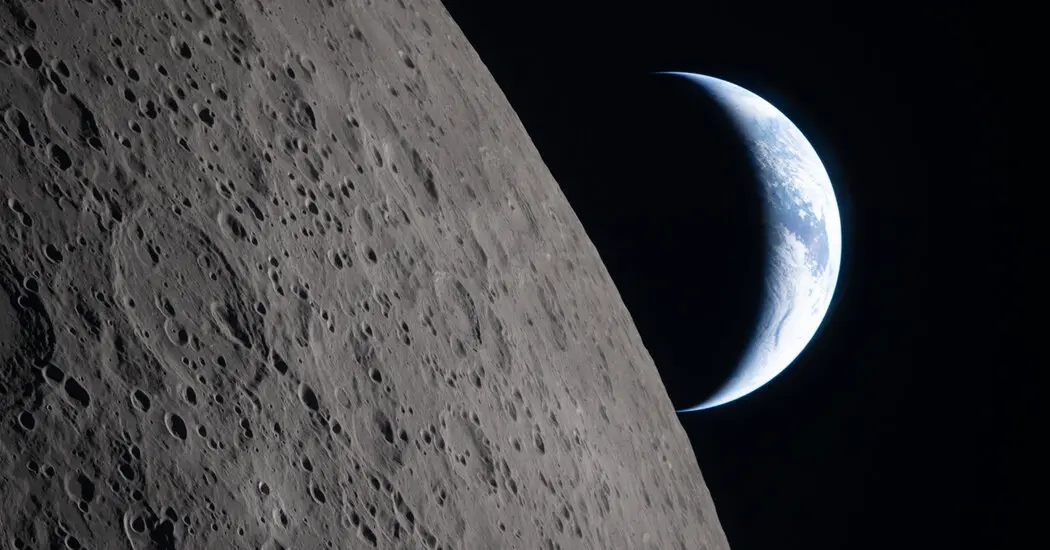
또 다른 거대한 도약은 우리가 얼마나 작은지 상기시켜 준다
Another Giant Leap Reminds Us How Small We Are
The New York Times
Ruth Graham
EN
2026-04-11 18:02
Translated
인류 역사상 어떤 인간도 여행한 것보다 더 멀리 간 네 명의 우주비행사를 탑승시킨 임무는 수십만 마일 떨어진 곳에서 그들을 확인한 수백만 명의 사람들을 약간 어지럽게 만들었다.
달 뒤쪽에서 본 집의 모습. 사진...NASA, 게티 이미지 경유
처음에 아르테미스 II는 과학에 관한 것이었다. 금요일에 태평양에 깔끔하게 착수하면서 끝난 이 임무는 달 주위를 공전하면서 데이터를 수집하고, 사진을 촬영하고, 생명 유지 시스템을 테스트한 네 명의 우주비행사를 태웠다.
하지만 우주비행사들 자신과 수십만 마일 떨어진 곳에서 그들을 확인한 수백만 명의 사람들에게, 이 임무는 또한 더 깊은 문제에 대한 명상을 이끌어냈다.
"당신은 그저 위를 보고 동시에 경이로움, 웅장함, 그리고 작음을 느낀다"고 플로리다 올랜도의 목사인 짐 데이비스가 말했다. 그는 4월 1일 임무가 출발했을 때 그의 교회에서 온 작은 그룹과 함께 레스토랑에서 저녁을 먹고 있었다. 그 그룹은 주차장으로 나가 로켓이 초저녁 하늘로 폭발적으로 올라가는 것을 감상했다.
10일 동안 사람들은 우주의 광대함을 감탄했다. 인류의 취약성과 상호 의존성. 달의 단순한 멋진 점.
"달을 보는 것에서 비롯된 압도적인 감정을 느꼈다"고 아르테미스 II의 임무 전문가인 크리스티나 코흐가 이번 주 임무 관제실에 보고했다. "그것은 단 1초 또는 2초 정도 지속되었고, 나는 실제로 그것이 다시 일어나도록 만들 수 없었지만, 뭔가가 나를 갑자기 달 풍경으로 던졌고 그것이 현실이 되었다."
지구에 남아 있는 많은 사람들에게, 이 임무는 외우주의 순전한 규모에 대한 간단한 상기이자, 우리의 힘과 무력함 모두를 숙고하는 계기였다. 그것은 우리 모두를 캠프의 아이들처럼 만들었고, 누워서 별들을 올려다보며 매우 큰 생각을 했다.
그것은 과학자, 철학자, 그리고 시인들이 수세기 동안 포착하려고 노력해온 역설이다.
"내가 당신의 하늘, 당신의 손가락의 일, 당신이 세운 달과 별들을 볼 때, 인간이 무엇이기에 당신이 그들을 마음에 두고, 필멸자가 무엇이기에 당신이 그들을 돌보는가?"라고 시편의 저자가 신께 물었다.
"내가 별들의 수많은 회전 나선을 검색할 때, 나는 더 이상 지구에 발을 딛지 않고 있지만 제우스 자신 옆에 있다"고 2세기 천문학자 톨레마이오스로 여겨지는 텍스트에 적혀 있다.
외계 생명의 함축을 다룬 저작을 한 옥스포드 대학교의 신학자 앤드류 데이비슨은 인터뷰에서 우주의 "위대한 도발" 중 하나는 "인간이 믿을 수 없을 정도로 작아 보이지만, 그것은 또한 우리의 위대함을 증거한다"고 말했다.
그는 "우리는 그 전체 우주를 우리 안에, 우리의 생각 속에 담을 수 있는 종류의 존재이다"라고 덧붙였다.
많은 우주비행사들에게, 과학적 노력으로 시작된 것은 영적인 것이 된다. 우주 철학자 프랭크 화이트는 1987년 "개요 효과"라는 용어를 만들었는데, 이는 일부 우주비행사들이 지구를 끝없는 광활함 속의 하나의 작은 구체로 보는 것에서 비롯된 관점의 변화를 설명하기 위한 것이다.
론 가란은 1969년 아폴로 11호 달 착륙을 어린 소년으로 가족과 함께 지켜봤고, "우리가 방금 다른 종족이 되었다"는 느낌에 깜짝 놀랐다. 인류 역사의 수천 년 동안, 지구의 모든 생명은 그곳에 제약을 받았다. 그러다가 갑자기 규칙이 바뀌었고 경계가 확장되었다.
가란은 2011년 국제 우주 정거장에서 6개월을 보낸 우주비행사가 되어 자라났다. 우주에서, 그는 지구의 모든 사람도 이미 우주에 있고 함께 있다는 깨달음에 압도당했다.
이제 단단한 지면에 돌아와 컨설턴트이자 작가로 일하고 있는 그는 우주 여행의 정서적 영향을 부분적으로 무중력 현상으로 돌린다. 만약 사람이 해변에 앉아 석양을 보고 있거나, 그랜드 캐니언의 가장자리에 우뚝 서 있다면, 중력은 그들을 그들이 감탄하고 있는 장면에 붙인다고 가란은 말했다.
"하지만 내가 우주에 있었을 때, 내 인생에서 처음으로, 나는 걸작의 틀 밖에 있었고 안을 보고 있었다"고 그는 말했다. "그것이 모든 것을 바꾼다."
가란은 우주 여행을 향정신성 경험에 비유했다(다만 자신이 이를 직접 알고 있는지는 밝히기를 거절했다). 우주비행사들은 수년에 걸쳐 울고, 신을 예배하고, 우주에 있는 동안 거의 육체를 벗어난 경이로움의 완전히 새로운 감정을 경험했다고 설명했다.
아폴로 14호 조종사 에드거 미첼이 1971년 달에서 돌아오는 길에 있었을 때, 그는 "내 신체의 분자와 우주선의 분자가 별의 고대 세대에서 제조되었다"는 생각에 압도당했으며, 나중에 인터뷰어에게 말했다. "그것은 황홀경을 동반한 주관적인 내장 경험이었다."
지구로 돌아온 그는 경험을 이해하기 위해 다양한 영적 전통을 연구했고 결국 그것을 포착한 산스크리트어의 용어를 찾았다: savikalpa samadhi, 깊은 명상의 상태.
아르테미스 II 우주비행사들은 때때로 마음을 확장하는 유사한 현실의 재정렬을 겪고 있는 것처럼 보였다.
"당신들이 우리와 얘기를 하고 있는 이유는 우리가 정말 지구에서 멀리 떨어진 우주선에 타고 있기 때문이다"라고 조종사 빅터 글로버는 부활절 일요일 CBS 뉴스와의 인터뷰에서 생각했다. "하지만 당신들은 우주, 우주에서 우리에게 살 장소를 제공하기 위해 만들어진 지구라는 우주선에 타고 있다."
회의론자들은 개요 효과가 일시적인 감정 이상의 것인지 의문을 제기한다.
우주 여행은 매우 드문 인간의 경험이다. Blue Origin 같은 민간 우주 여행 회사들은 카르만 선(지구에서 약 62마일 떨어진 국제적으로 인정된 우주의 경계)을 넘어 수십 명의 관광객을 짧은 비행으로 데려갔다. 더 멀리, 지구 궤도 이상으로 여행하는 것은 여전히 정부가 후원하는 우주비행사와 가장 부유한 우주 관광객을 제외한 모든 사람들의 손이 닿지 않는 곳이다.
우주에 기술적으로 간 사람들의 증가하는 목록에는 제프 베조스 같은 억만장자, 케이티 페리 같은 팝스타, 윌리엄 셔트너 같은 우주 코드화된 셀러브리티가 포함되어 있으며, 그는 우주의 "악독한 추위"가 지구의 온기와 대조를 이루고 그에게 "압도적인 슬픔"을 채웠다고 결론지었다.
하지만 천체 계시는 항상 지구의 대기 밖으로 물리적으로 여행할 수 없는 사람들에게 접근 가능했다.
"우리 종이 새벽부터, 모든 인류 사회는 별들을 올려다봤다"고 "The Human Cosmos: Civilization and the Stars"의 저자 조 마르샹트가 말했다.
별 관찰은 종교, 철학, 예술, 과학 및 정치에 영향을 미쳤다. 아이작 뉴턴의 운동과 중력의 법칙이 모든 것에 똑같이 영향을 미친다는 발견은 왕에서 평민까지 같은 규칙의 적용을 받아야 한다는 민주적 신념에 영향을 미쳤다고 마르샹트는 말했다.
빛 공해와 화면 기반 산만함의 물리침에 따라, 21세기 인류는 아마도 이전보다 밤하늘을 명상하는 데 더 적은 시간을 보낸다.
트로이 D. 알란은 아프가니스탄에서 육군 군목이었을 때 의도적으로 밤에 외부에서 시간을 보내기 시작했다. 그는 천문학이나 별자리에 대해 거의 알지 못했지만, 단순히 하늘을 올려다보는 것이 다른 방식으로 혼란로 표시된 그의 삶의 기간에 평화를 찾는 데 도움이 된다는 것을 발견했다.
알란은 이제 청소년 및 기타 사람들을 위해 밤하늘을 명상하고 그 아래의 위치를 명상하기 위해 캠핑 여행을 용이하게 하는 유타 주립 대학의 프로그램을 이끌고 있다. 그의 캠프들은 텐트를 설치한 다음 누워서 별들이 나오는 것을 본다. 처음에는 TikTok 속도로 삶을 클릭하는 데 익숙한 젊은이들에게 시간이 천천히 흘러간다. 하지만 점차 그들은 경험을 따뜻하게 한다.
"인간이 광활함, 침묵, 아름다움 그리고 신비를 만날 때 무슨 일이 일어날까?"라고 알란은 말했다. "그것은 우리의 삶의 재보정이다."
별들이 나온 후, 알란의 그룹은 그들 위에 펼쳐진 은하수와 함께 하이킹을 간다. 그러면 그들은 다시 오랫동안 멈추고 올려다본다.
루스 그레이엄은 종교, 신앙 및 가치를 위해 뉴욕 타임즈를 커버하는 달라스에 거주하는 전국 기자이다.
처음에 아르테미스 II는 과학에 관한 것이었다. 금요일에 태평양에 깔끔하게 착수하면서 끝난 이 임무는 달 주위를 공전하면서 데이터를 수집하고, 사진을 촬영하고, 생명 유지 시스템을 테스트한 네 명의 우주비행사를 태웠다.
하지만 우주비행사들 자신과 수십만 마일 떨어진 곳에서 그들을 확인한 수백만 명의 사람들에게, 이 임무는 또한 더 깊은 문제에 대한 명상을 이끌어냈다.
"당신은 그저 위를 보고 동시에 경이로움, 웅장함, 그리고 작음을 느낀다"고 플로리다 올랜도의 목사인 짐 데이비스가 말했다. 그는 4월 1일 임무가 출발했을 때 그의 교회에서 온 작은 그룹과 함께 레스토랑에서 저녁을 먹고 있었다. 그 그룹은 주차장으로 나가 로켓이 초저녁 하늘로 폭발적으로 올라가는 것을 감상했다.
10일 동안 사람들은 우주의 광대함을 감탄했다. 인류의 취약성과 상호 의존성. 달의 단순한 멋진 점.
"달을 보는 것에서 비롯된 압도적인 감정을 느꼈다"고 아르테미스 II의 임무 전문가인 크리스티나 코흐가 이번 주 임무 관제실에 보고했다. "그것은 단 1초 또는 2초 정도 지속되었고, 나는 실제로 그것이 다시 일어나도록 만들 수 없었지만, 뭔가가 나를 갑자기 달 풍경으로 던졌고 그것이 현실이 되었다."
지구에 남아 있는 많은 사람들에게, 이 임무는 외우주의 순전한 규모에 대한 간단한 상기이자, 우리의 힘과 무력함 모두를 숙고하는 계기였다. 그것은 우리 모두를 캠프의 아이들처럼 만들었고, 누워서 별들을 올려다보며 매우 큰 생각을 했다.
그것은 과학자, 철학자, 그리고 시인들이 수세기 동안 포착하려고 노력해온 역설이다.
"내가 당신의 하늘, 당신의 손가락의 일, 당신이 세운 달과 별들을 볼 때, 인간이 무엇이기에 당신이 그들을 마음에 두고, 필멸자가 무엇이기에 당신이 그들을 돌보는가?"라고 시편의 저자가 신께 물었다.
"내가 별들의 수많은 회전 나선을 검색할 때, 나는 더 이상 지구에 발을 딛지 않고 있지만 제우스 자신 옆에 있다"고 2세기 천문학자 톨레마이오스로 여겨지는 텍스트에 적혀 있다.
외계 생명의 함축을 다룬 저작을 한 옥스포드 대학교의 신학자 앤드류 데이비슨은 인터뷰에서 우주의 "위대한 도발" 중 하나는 "인간이 믿을 수 없을 정도로 작아 보이지만, 그것은 또한 우리의 위대함을 증거한다"고 말했다.
그는 "우리는 그 전체 우주를 우리 안에, 우리의 생각 속에 담을 수 있는 종류의 존재이다"라고 덧붙였다.
많은 우주비행사들에게, 과학적 노력으로 시작된 것은 영적인 것이 된다. 우주 철학자 프랭크 화이트는 1987년 "개요 효과"라는 용어를 만들었는데, 이는 일부 우주비행사들이 지구를 끝없는 광활함 속의 하나의 작은 구체로 보는 것에서 비롯된 관점의 변화를 설명하기 위한 것이다.
론 가란은 1969년 아폴로 11호 달 착륙을 어린 소년으로 가족과 함께 지켜봤고, "우리가 방금 다른 종족이 되었다"는 느낌에 깜짝 놀랐다. 인류 역사의 수천 년 동안, 지구의 모든 생명은 그곳에 제약을 받았다. 그러다가 갑자기 규칙이 바뀌었고 경계가 확장되었다.
가란은 2011년 국제 우주 정거장에서 6개월을 보낸 우주비행사가 되어 자라났다. 우주에서, 그는 지구의 모든 사람도 이미 우주에 있고 함께 있다는 깨달음에 압도당했다.
이제 단단한 지면에 돌아와 컨설턴트이자 작가로 일하고 있는 그는 우주 여행의 정서적 영향을 부분적으로 무중력 현상으로 돌린다. 만약 사람이 해변에 앉아 석양을 보고 있거나, 그랜드 캐니언의 가장자리에 우뚝 서 있다면, 중력은 그들을 그들이 감탄하고 있는 장면에 붙인다고 가란은 말했다.
"하지만 내가 우주에 있었을 때, 내 인생에서 처음으로, 나는 걸작의 틀 밖에 있었고 안을 보고 있었다"고 그는 말했다. "그것이 모든 것을 바꾼다."
가란은 우주 여행을 향정신성 경험에 비유했다(다만 자신이 이를 직접 알고 있는지는 밝히기를 거절했다). 우주비행사들은 수년에 걸쳐 울고, 신을 예배하고, 우주에 있는 동안 거의 육체를 벗어난 경이로움의 완전히 새로운 감정을 경험했다고 설명했다.
아폴로 14호 조종사 에드거 미첼이 1971년 달에서 돌아오는 길에 있었을 때, 그는 "내 신체의 분자와 우주선의 분자가 별의 고대 세대에서 제조되었다"는 생각에 압도당했으며, 나중에 인터뷰어에게 말했다. "그것은 황홀경을 동반한 주관적인 내장 경험이었다."
지구로 돌아온 그는 경험을 이해하기 위해 다양한 영적 전통을 연구했고 결국 그것을 포착한 산스크리트어의 용어를 찾았다: savikalpa samadhi, 깊은 명상의 상태.
아르테미스 II 우주비행사들은 때때로 마음을 확장하는 유사한 현실의 재정렬을 겪고 있는 것처럼 보였다.
"당신들이 우리와 얘기를 하고 있는 이유는 우리가 정말 지구에서 멀리 떨어진 우주선에 타고 있기 때문이다"라고 조종사 빅터 글로버는 부활절 일요일 CBS 뉴스와의 인터뷰에서 생각했다. "하지만 당신들은 우주, 우주에서 우리에게 살 장소를 제공하기 위해 만들어진 지구라는 우주선에 타고 있다."
회의론자들은 개요 효과가 일시적인 감정 이상의 것인지 의문을 제기한다.
우주 여행은 매우 드문 인간의 경험이다. Blue Origin 같은 민간 우주 여행 회사들은 카르만 선(지구에서 약 62마일 떨어진 국제적으로 인정된 우주의 경계)을 넘어 수십 명의 관광객을 짧은 비행으로 데려갔다. 더 멀리, 지구 궤도 이상으로 여행하는 것은 여전히 정부가 후원하는 우주비행사와 가장 부유한 우주 관광객을 제외한 모든 사람들의 손이 닿지 않는 곳이다.
우주에 기술적으로 간 사람들의 증가하는 목록에는 제프 베조스 같은 억만장자, 케이티 페리 같은 팝스타, 윌리엄 셔트너 같은 우주 코드화된 셀러브리티가 포함되어 있으며, 그는 우주의 "악독한 추위"가 지구의 온기와 대조를 이루고 그에게 "압도적인 슬픔"을 채웠다고 결론지었다.
하지만 천체 계시는 항상 지구의 대기 밖으로 물리적으로 여행할 수 없는 사람들에게 접근 가능했다.
"우리 종이 새벽부터, 모든 인류 사회는 별들을 올려다봤다"고 "The Human Cosmos: Civilization and the Stars"의 저자 조 마르샹트가 말했다.
별 관찰은 종교, 철학, 예술, 과학 및 정치에 영향을 미쳤다. 아이작 뉴턴의 운동과 중력의 법칙이 모든 것에 똑같이 영향을 미친다는 발견은 왕에서 평민까지 같은 규칙의 적용을 받아야 한다는 민주적 신념에 영향을 미쳤다고 마르샹트는 말했다.
빛 공해와 화면 기반 산만함의 물리침에 따라, 21세기 인류는 아마도 이전보다 밤하늘을 명상하는 데 더 적은 시간을 보낸다.
트로이 D. 알란은 아프가니스탄에서 육군 군목이었을 때 의도적으로 밤에 외부에서 시간을 보내기 시작했다. 그는 천문학이나 별자리에 대해 거의 알지 못했지만, 단순히 하늘을 올려다보는 것이 다른 방식으로 혼란로 표시된 그의 삶의 기간에 평화를 찾는 데 도움이 된다는 것을 발견했다.
알란은 이제 청소년 및 기타 사람들을 위해 밤하늘을 명상하고 그 아래의 위치를 명상하기 위해 캠핑 여행을 용이하게 하는 유타 주립 대학의 프로그램을 이끌고 있다. 그의 캠프들은 텐트를 설치한 다음 누워서 별들이 나오는 것을 본다. 처음에는 TikTok 속도로 삶을 클릭하는 데 익숙한 젊은이들에게 시간이 천천히 흘러간다. 하지만 점차 그들은 경험을 따뜻하게 한다.
"인간이 광활함, 침묵, 아름다움 그리고 신비를 만날 때 무슨 일이 일어날까?"라고 알란은 말했다. "그것은 우리의 삶의 재보정이다."
별들이 나온 후, 알란의 그룹은 그들 위에 펼쳐진 은하수와 함께 하이킹을 간다. 그러면 그들은 다시 오랫동안 멈추고 올려다본다.
루스 그레이엄은 종교, 신앙 및 가치를 위해 뉴욕 타임즈를 커버하는 달라스에 거주하는 전국 기자이다.
처리 완료 6,611 tokens · $0.0193
기사 수집 완료 · 19:10
매체 피드에서 기사 메타데이터 수집
헤드라인 번역 완료 · 19:25
제목/요약 한국어 번역 (fetch 시점 inline)
claude-haiku-4-5-20251001
211 tokens
$0.00054
2.0s
본문 추출 완료
7,651자 추출 완료
본문 한국어 번역 완료 · 19:25
3,827자 번역 완료
claude-haiku-4-5-20251001
6,400 tokens
$0.01879
46.1s
지정학적 엔티티 추출 완료 · 19:25
8개 엔티티 추출 완료
A mission that took four astronauts farther than any human has ever traveled in the history of mankind has made people feel a little trippy.
The view of home from the other side of the moon.Credit...NASA, via Getty ImagesIn the beginning, Artemis II was about science. The mission, which ended on Friday with a clean splash into the Pacific Ocean, carried four astronauts who gathered data, took photographs and tested life support systems as they orbited the moon.
But for the astronauts themselves, and millions of people who checked in on them from hundreds of thousands of miles away, the mission also elicited meditations on more profound matters.
“You just look up and feel wonder, grandeur and smallness at the same time,” said Jim Davis, a pastor in Orlando, Fla. He was having dinner at a restaurant with a small group from his church when the mission launched on April 1. The group stepped out into the parking lot to admire the rocket blasting upward into the early evening sky.
For 10 days, people admired the vastness of the universe. The frailty and interdependence of the human species. The sheer awesomeness of the moon.
“I just had an overwhelming sense of being moved by looking at the moon,” Christina Koch, a mission specialist on Artemis II, reported to mission control this week. “It lasted just a second or two, and I actually couldn’t even make it happen again, but something just threw me in suddenly to the lunar landscape and it became real.”
For many people back home on Earth, the mission was a brief reminder of the sheer scale of outer space, and a prompt to contemplate both our power and our powerlessness. It turned all of us into children at camp, lying supine and looking up at the stars, thinking very big thoughts.
It’s a paradox that scientists, philosophers and poets have tried to capture for centuries.
“When I look at your heavens, the work of your fingers, the moon and the stars that you have established, what are humans that you are mindful of them, mortals that you care for them?” a writer of the Book of Psalms asked of God.
“When I search for the numerous turning spirals of the stars, I no longer have my feet on the Earth, but am beside Zeus himself,” reads a text attributed to the second-century astronomer Ptolemy.
Andrew Davison, a theologian at the University of Oxford who has written about the implications of extraterrestrial life, said in an interview that one of the “great provocations” of the cosmos is that, in it, “human beings seem unbelievably small, but also it bears witness to our greatness.”
He added, “We are a kind of being that can have that whole universe inside us, in our thoughts.”
For many astronauts, what begins as a scientific endeavor becomes something spiritual. Frank White, a space philosopher, coined the term “the overview effect” in 1987 to describe the shift in perspective that some astronauts said came from viewing Earth as merely one small sphere in an endless expanse.
Ron Garan watched the Apollo 11 moon landing in 1969 as a small boy with his family, and was struck by the sense that “we had just become a different species.” For millenniums of human history, all life on Earth was constrained there. Then suddenly the rules changed, the boundaries expanded.
Mr. Garan grew up to become an astronaut who spent six months on the International Space Station in 2011. In space, he was overwhelmed by the realization that everyone on Earth is also in space already, together.
Now back on solid ground and working as a consultant and writer, he attributes the emotional impact of space travel in part to the phenomenon of weightlessness. If a person is sitting on a beach looking at the sunset, or is perched on the rim of the Grand Canyon, gravity attaches them to the scene they are admiring, Mr. Garan said.
“But when I was in space, for the first time in my life, I was outside the frame of the masterpiece looking in,” he said. “That changes everything.”
Mr. Garan compared space travel to a psychedelic experience (though he declined to say whether he knew this first hand). Astronauts over the years have described crying, worshiping God and experiencing utterly new feelings of almost disembodied awe while in space.
When the Apollo 14 pilot Edgar Mitchell was on his way back from the moon in 1971, he was overwhelmed by the thought that “the molecules of my body and the molecules of the spacecraft had been manufactured in an ancient generation of stars,” he later told an interviewer. “It was a subjective visceral experience accompanied by ecstasy.”
Back on Earth, he researched various spiritual traditions to try to understand the experience and eventually found a term in Sanskrit that captured it: savikalpa samadhi, a state of deep meditation.
The Artemis II astronauts seemed at times to be undergoing similarly mind-expanding realignments of reality.
“You guys are talking to us because we’re in a spaceship really far from Earth,” pilot Victor Glover mused in an interview with CBS News on Easter Sunday. “But you’re on a spaceship called Earth that was created to give us a place to live in the universe, in the cosmos.”
Skeptics question whether the overview effect is anything more than a passing emotion.
Space travel remains a highly unusual human experience. Private space travel companies, like Blue Origin until recently, have taken dozens of tourists on brief flights above the Kármán line, the internationally recognized boundary of space about 62 miles above Earth. Traveling farther, to Earth orbit and beyond, is still out of reach for all but government-sponsored astronauts and the wealthiest space tourists.
The growing list of people who have technically gone to space includes billionaires like Jeff Bezos, pop stars like Katy Perry and space-coded celebrities like William Shatner, who concluded that the “vicious coldness” of space contrasted with Earth’s warmth and filled him with “overwhelming sadness.”
But celestial epiphanies have always been accessible to those who can’t physically travel outside Earth’s atmosphere.
“Since the dawn of our species, every human society has looked up at the stars,” said Jo Marchant, the author of “The Human Cosmos: Civilization and the Stars.”
Stargazing has influenced religion, philosophy, art, science and politics. Isaac Newton’s discovery that laws of motion and gravity affect everything equally influenced democratic beliefs that kings to commoners should be subject to the same rules, Ms. Marchant said.
With the encroachments of light pollution and screen-based distractions, human beings in the 21st century arguably spend less of their time contemplating the night sky than ever before.
Troy D. Allan was an Army chaplain in Afghanistan when he began intentionally spending time outside at night. He knew little about astronomy or constellations, but found that simply staring up into the sky helped him find peace in a period of his life otherwise marked by turmoil.
Mr. Allan now heads a program at Utah State University that facilitates camping trips for teenagers and others to contemplate the night sky, and their place underneath it. His campers set up their tents, then lie back and watch the stars come out. At first, time moves slowly for young people accustomed to clicking through life at the pace of TikTok. But gradually, they warm to the experience.
“What happens to humans when we encounter vastness, silence, beauty and mystery?” Mr. Allan said. “It’s the recalibrating of our lives.”
After the stars come out, Mr. Allan’s group goes on a hike, with the Milky Way stretched like a banner above them. Then they stop again for a long time and look up.
Ruth Graham is a national reporter, based in Dallas, covering religion, faith and values for The Times.